
 AU
AU
 CA
CA
 US
US
 NZ
NZ
 IND
IND

 UK
UK

 Share
Share
 X (Formerly Twitter)
 Whatsapp
 Facebook
 LinkedIn
 Telegram
 Email This Article
 Copy Link
 Summarize with AI
 Chat GPT
 Perplexity
The £400k Question: Calculated Capital for a £24,000 Annual Payout
To secure a reliable monthly passive income of £2,000 (totaling £24,000 per year), your total investment requirement depends entirely on the average dividend yield of your portfolio. As of early 2026, the FTSE 250 offers a more enticing yield profile than its larger "Blue Chip" sibling, often rewarding investors for the higher domestic risk.
- At a 4% yield: You would require a capital pot of £600,000.
- At a 5.5% yield: A diversified "sweet spot" for mid-caps, the requirement drops to approximately £436,364.
- At a 7% yield: Targeting high-payout sectors like REITs and energy, you would need £342,857.
While the FTSE 250 index average often hovers around 3.4% to 3.6%, income seekers in 2026 are increasingly cherry-picking specific "dividend aristocrats" within the mid-cap space to push their effective yield closer to the 6% mark without over-leveraging into "yield traps."
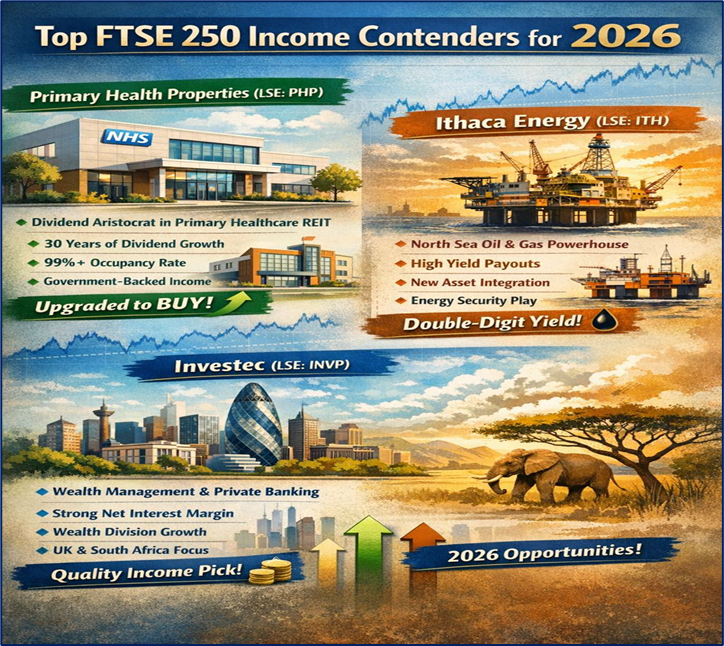
Top FTSE 250 Income Contenders for 2026
Source: Kalkine Group
Primary Health Properties (LSE: PHP)
- Key Reasons & Drivers: An undisputed "dividend aristocrat" of the London market, PHP has increased its payout for nearly 30 consecutive years. Its primary driver is the UK’s aging demographic, which necessitates modern, localized primary care facilities.
- Business Model: A Real Estate Investment Trust (REIT) specializing in modern GP surgeries. Over 85% of its rental income is backed by government bodies like the NHS, providing a "sovereign-grade" security to the cash flow.
- Latest Financials: Operational updates in early 2026 show high occupancy rates (99%+) and rental growth driven by inflation-linked reviews.
- Analyst View: Recent upgrades from "Hold" to "Buy" by major City brokers cite the stabilizing interest rate environment in 2026 as a tailwind for REIT valuations.
- Key Reasons & Drivers: For those seeking aggressive yield, Ithaca remains a standout in the North Sea energy sector. It serves as a play on sustained energy security demands and strategic partnerships in the UK Continental Shelf.
- Business Model: Independent oil and gas operator focused on the development and production of North Sea assets. The model prioritizes cash generation for shareholder distributions over massive exploration risk.
- Latest Financials: Following a robust 2025, the 2026 outlook emphasizes the integration of newly acquired assets and a commitment to a significant base dividend.
- Analyst View: While some boutique firms remain cautious due to windfall tax uncertainties, consensus remains positive on its double-digit yield potential.
- Key Reasons & Drivers: Benefiting from a specialized niche in wealth management and private banking, Investec has capitalized on a "higher-for-longer" interest rate environment compared to the previous decade.
- Business Model: An international banking and wealth management group with deep roots in the UK and South Africa. It focuses on high-net-worth individuals and corporate clients.
- Latest Financials: 2026 updates indicate strong net interest margins and a growing contribution from its wealth management division, supporting a dividend cover of over 2x.
- Analyst View: Labeled as a "Quality Income" pick, analysts have recently nudged price targets upward, citing capital strength and a disciplined payout ratio.
The 2026 Technical & Macro Landscape
Source: Trading View
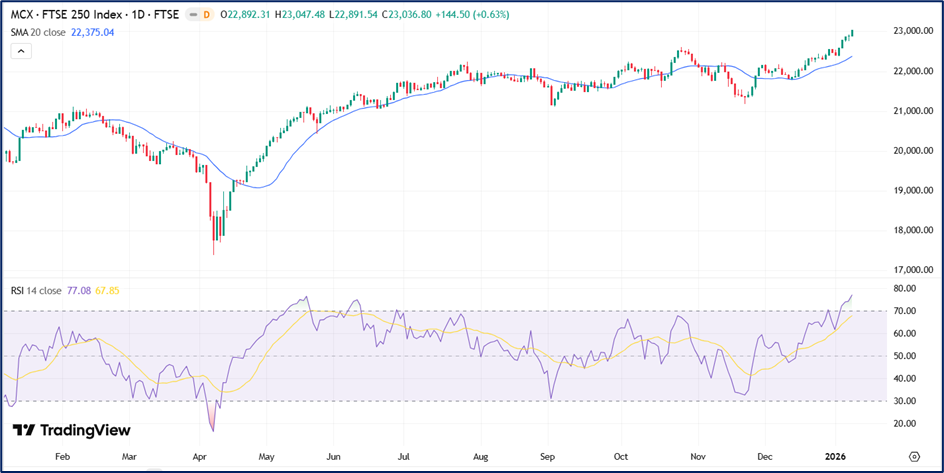
The FTSE 250 enters 2026 as a "barometer of recovery." After years of trading at a significant discount to historical averages, technical analysis shows the index testing key resistance levels at the 23,000 mark. A "Golden Cross" on the weekly charts—where the 50-day moving average crosses above the 200-day—has signaled a potential long-term trend reversal.
- Technical Support: Strong support has formed around the 21,500 level, providing a floor for long-term accumulators.
- Macro Drivers: Falling inflation (targeting 2% in 2026) and anticipated Bank of England rate cuts are the primary catalysts. These factors lower borrowing costs for mid-cap firms and make their dividend yields more attractive relative to "risk-free" government gilts.
- Market Sentiment: Valuation reversion is the buzzword for 2026; the FTSE 250 trades at a price-to-earnings (P/E) ratio significantly lower than the S&P 500 or even the FTSE 100, luring international value hunters.
Critical Risks to the Income Stream
Investing for passive income is never without peril, particularly in the mid-cap space where companies are more sensitive to the local economy.
- Dividend Sustainability: High yields (7%+) can sometimes be "red flags," signaling that the market expects a dividend cut. Monitoring the Dividend Cover Ratio (earnings per share divided by dividend per share) is vital.
- Regulatory & Tax Headwinds: Changes in UK corporation tax or specific sector levies (like the Energy Profits Levy) can instantly erode the cash available for distributions.
- Liquidity Risk: Mid-cap stocks can experience higher volatility and wider "spreads" than the FTSE 100, meaning prices can swing sharply on low trading volumes.
Conclusion: The Path to £2k a Month
Generating £2,000 in monthly passive income from the FTSE 250 in 2026 is a balance of capital size and yield selection. While a £450,000 to £500,000 portfolio is a realistic baseline for safety, the current 2026 market offers a unique window where "unloved" mid-caps provide high-quality yields that are well-covered by earnings. By diversifying across defensive REITs like PHP and pro-cyclical financials like Investec, an investor can build a resilient income machine.


 Jun 29, 2026




 Please wait processing your request...