
 AU
AU
 CA
CA
 US
US
 NZ
NZ
 IND
IND

 UK
UK

 Share
Share
 X (Formerly Twitter)
 Whatsapp
 Facebook
 LinkedIn
 Telegram
 Email This Article
 Copy Link
 Summarize with AI
 Chat GPT
 Perplexity
National Grid (LSE: NG) shares climbed ~1.4% to GBX 1,157.50 on January 2, 2026, outperforming the broader FTSE 100 on the first full trading day of the year.
This movement reflects investor confidence in the utility giant’s massive infrastructure pivot and its defensive "safe haven" status amidst shifting macroeconomic conditions.
Key Drivers: Why the Stock Jumped on Jan 2
Source: Kalkine Group
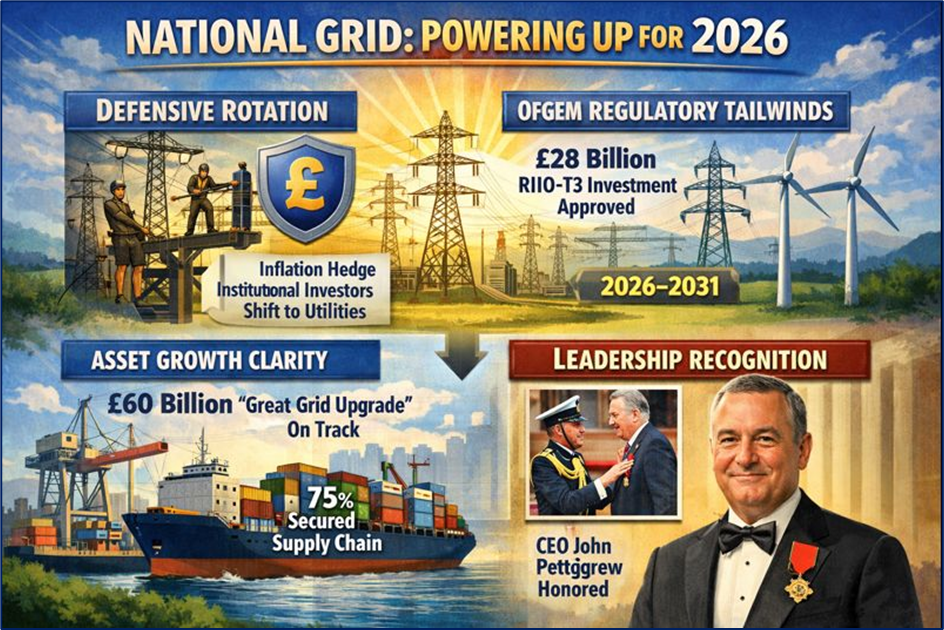
The 1.4% rise was driven by a combination of regulatory clarity, sector rotation, and operational milestones:
- Defensive Rotation: As the new year began, institutional investors shifted toward high-yield, "defensive" utilities. National Grid's predictable regulated income is a preferred hedge against 2026's remaining inflationary pressures.
- Ofgem Regulatory Tailwinds: Recent approval of the £28 billion investment package for UK energy transmission networks (announced in late Dec 2025) has removed significant uncertainty regarding the "RIIO-T3" period (2026–2031).
- Asset Growth Clarity: Management's confirmation that they have secured the supply chain for over 75% of their £60 billion five-year investment plan signaled that the "Great Grid Upgrade" is on schedule despite global logistics bottlenecks.
- Recognition of Leadership: The New Year's Honours recognition of CEO John Pettigrew added a subtle but positive sentiment boost regarding the company's strategic alignment with UK government net-zero goals.
Latest Business Model: From Utility to Infrastructure Engine
In 2026, National Grid has transitioned from a traditional utility to a pure-play energy transition infrastructure provider.
- Regulated Monopolies: The core model remains earning a set return on the Regulated Asset Base (RAB) in the UK and US.
- Portfolio Streamlining: National Grid has successfully divested its Gas Transmission and Electricity System Operator (ESO) wings. It is now focused almost exclusively on Electricity Transmission and Distribution.
- The "Great Grid Upgrade": The business model now revolves around massive capital expenditure (CapEx) to connect offshore wind and solar to the grid, replacing old fossil fuel connections.
- US Expansion: Its US-regulated businesses in New York and Massachusetts now contribute nearly half of the group's underlying operating profit, providing a geographic hedge against UK-specific regulatory shifts.
Latest Financial & Operational Updates (H1 2025/26)
- Operating Profit: Increased 13% to £2.3 billion (on an underlying basis) for the first half of the 2025/26 fiscal year.
- Investment Ramp-up: A record £5.1 billion was invested in the first half alone, with a full-year target of £11 billion+.
- EPS Growth: Underlying Earnings Per Share (EPS) rose 6% to 29.8p, tracking the top end of its 6–8% CAGR guidance.
- Dividends: An interim dividend of 16.35p was declared, maintaining the policy of growing the dividend in line with CPIH inflation.
- Operations: Reliability remains high at 99.9%, while digital automation technology (FLISR) now covers 27% of New England customers, significantly reducing outage times.
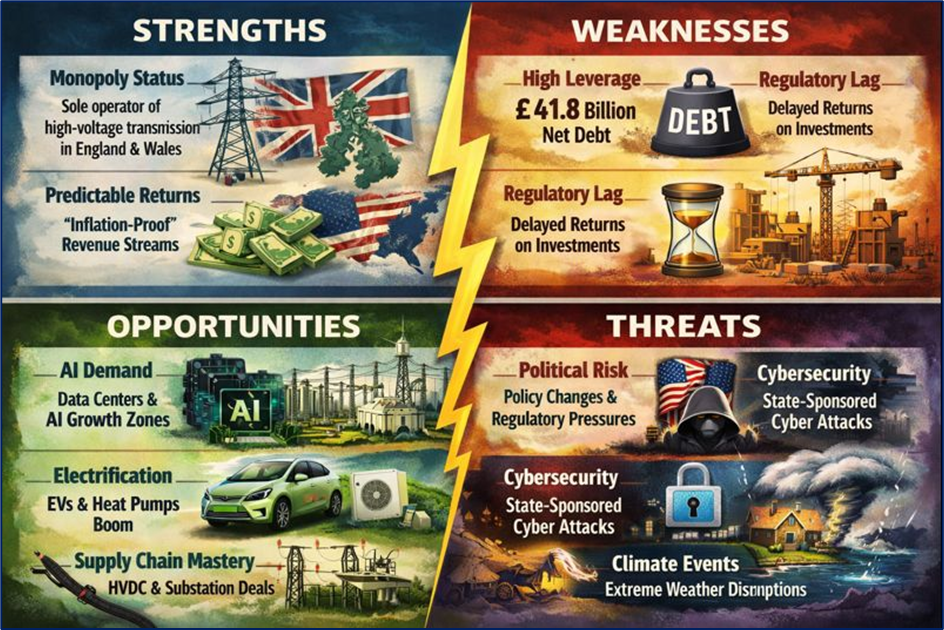
SWOT Analysis 2026
Source: Kalkine Group
Key Risks to Watch
- RIIO-T3 Final Determination: While the framework looks positive, the final allowed Return on Equity (RoE) from Ofgem in late 2025/early 2026 will dictate profitability for the next five years.
- Inflation/Interest Rates: Higher borrowing costs could erode the margins of the company’s massive debt-funded investment plan.
- Planning Permission: Local opposition to new pylons and transmission lines ("NIMBYism") remains the primary bottleneck for project delivery.
Conclusion
National Grid’s performance on January 2, 2026, reinforces its role as the backbone of the energy transition. By stripping away non-core gas assets and focusing on high-growth electricity infrastructure, the company has aligned itself with the trillion-dollar global shift toward decarbonization. While its debt levels remain a point of scrutiny, its ability to deliver 6–8% EPS growth in a regulated environment makes it a cornerstone of the FTSE 100's stability in 2026.


 Jun 03, 2026




 Please wait processing your request...