
 AU
AU
 CA
CA
 US
US
 NZ
NZ
 IND
IND

 UK
UK

 Share
Share
 X (Formerly Twitter)
 Whatsapp
 Facebook
 LinkedIn
 Telegram
 Email This Article
 Copy Link
 Summarize with AI
 Chat GPT
 Perplexity
Key Takeaways
- AI Inflection Point: 2025 marks the shift from generative AI hype to autonomous, ROI-driven agentic AI.
- Capital vs. Workforce: Massive Capex drives concentrated productivity gains, while 141,000+ tech jobs cut globally, highlighting the labor-capital shift.
- UK Strategic Advantage: Flexible AI regulations, £250M government compute support, AI Growth Zones, and hyperscaler investments position the UK as a global AI hub.
- Compute & Energy Challenges: GW-scale data centers strain the National Grid; solutions include Green Computing, SMRs, and renewable integration.
- Smart Money Winners: Key beneficiaries include ARM (chips), Rolls-Royce SMR (energy), Oxford Nanopore (deep science), and AI startups like incident.io and PhysicsX.
- ROI-Driven Enterprise Adoption: AI delivers tangible results in healthcare (NHS efficiency gains), cybersecurity (97% UK firms), and fintech (Revolut fraud reduction 50%).
- Disruption & Risks: Firms failing to secure compute, restructure operations, or reskill staff face marginalization, while mid-skilled roles are displaced by automation.
- Outlook (2025–2030): Success depends on scaling infrastructure, deploying agentic AI, reskilling workforce, and leveraging sustainable energy solutions to fully capture the AI Supercycle.
AI is no longer hype—it’s a capital-intensive force reshaping the UK economy. The year 2025 marks a critical inflection point: generative AI moves from novelty to autonomous, agent-driven enterprise utility, forcing major global capital deployment decisions. Britain, with its flexible regulatory framework and talent-rich ecosystem, is perfectly positioned to capture outsized value in this AI supercycle.
- The AI Inflection Point – From Hype to ROI
Explosive Market Growth
The UK AI market is poised to grow from US$7.95 billion in 2025 to US$26.89 billion by 2030, implying a 27.6% CAGR (global market reports). This expansion is underpinned by autonomous AI adoption in enterprise workflows, industrial processes, and fintech.
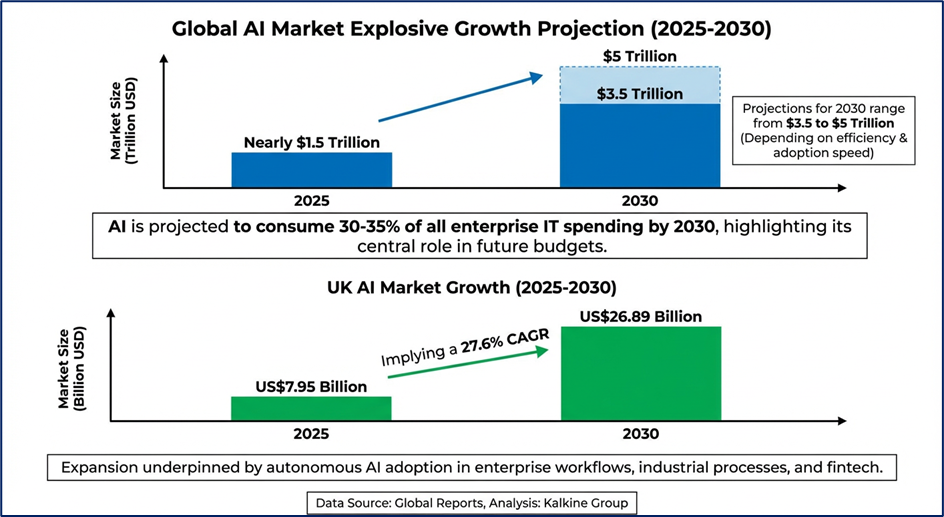
Yet, this boom contrasts sharply with the global labor market: tech giants have announced over 141,000 job cuts in 2025 even as they invest $375 billion in AI infrastructure. Capital is replacing labor. The resulting productivity gains are highly concentrated, benefiting shareholders while reshaping employment structures.
Why the UK Matters
Britain is pursuing a flexible, principles-based regulatory approach, encouraging innovation and foreign direct investment. In contrast, the EU’s prescriptive AI Act imposes strict rules from August 2025.
- Microsoft: US$30 billion investment in UK AI infrastructure (2025–2028)
- UK Government (DSIT): Up to £250 million in compute resources for research and startups
- Zoom & Equinix: £28 million+ investments in UK data centers
This policy mix positions the UK as a global hub for AI safety, fintech, and scientific innovation, attracting both capital and talent.
II. The Compute Battleground
AI adoption depends on compute capacity. Large-scale AI models require high-density data centers and massive power. The global AI market demands $5.2 trillion in data center investment by 2030, adding 125 GW of new capacity.
UK Infrastructure Bottlenecks
- Existing UK grid capacity is constrained; future AI data centers may require 500 MW+, equivalent to several small towns.
- Electricity costs are among the highest in Western Europe, with OpEx pressure for running large-scale AI operations.
- Microsoft shifted to leasing ready-to-use data centers at US$11.1 billion in 2026 to bypass grid delays.
Strategic Response
The UK has introduced AI Growth Zones, fast-tracking data center approvals and securing priority energy access.
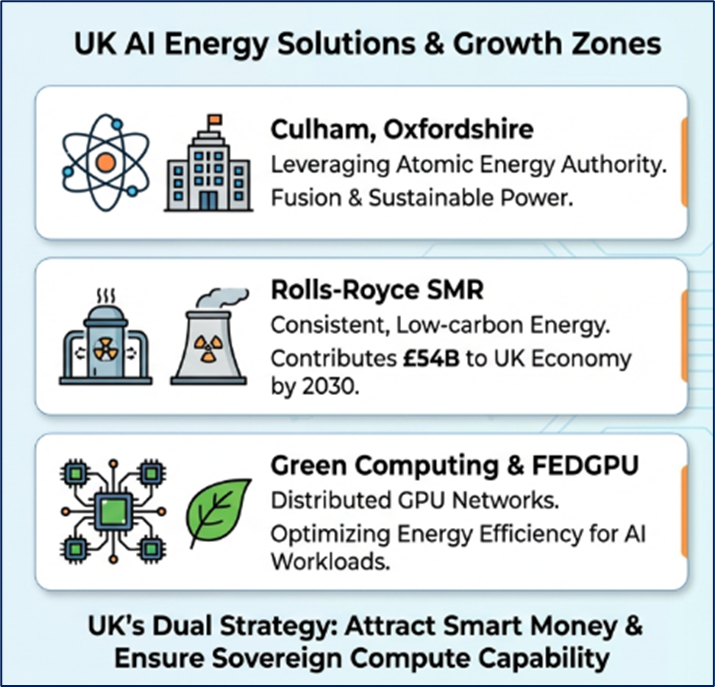
Analysis: Kalkine Group
III. Who Wins – The Smart Money Thesis
Investment in the AI supercycle flows into two primary areas: infrastructure enablers and enterprise automation platforms (Agentic AI).
- Infrastructure & Core Compute
- ARM Holdings (ARM, Nasdaq): Dominates chip architecture for edge devices and AI infrastructure. YTD stock growth: +90.48% (April 2025).
- Oxford Nanopore Technologies (ONT, LSE): AI-driven genomics accelerates drug discovery, backed by £137 million government funding for scientific research.
- Agentic Enterprise & High ROI
AI adoption now hinges on measurable outcomes rather than tech novelty.
Healthcare:
- Microsoft 365 Copilot pilots in 90 NHS organizations save 43 minutes per staff member per day, equating to millions of hours annually.
Cybersecurity:
- 97% of UK cyber orgs now consider AI essential for threat detection and predictive analytics.
Fintech:
- Revolut launched AI-powered financial assistants to guide customers and reduce fraud losses by up to 50%.
- AI triage cuts manual review time by 50%, transforming cost centers into competitive strengths.
- Venture Capital Hotspots
2025 saw record VC funding for UK AI startups:
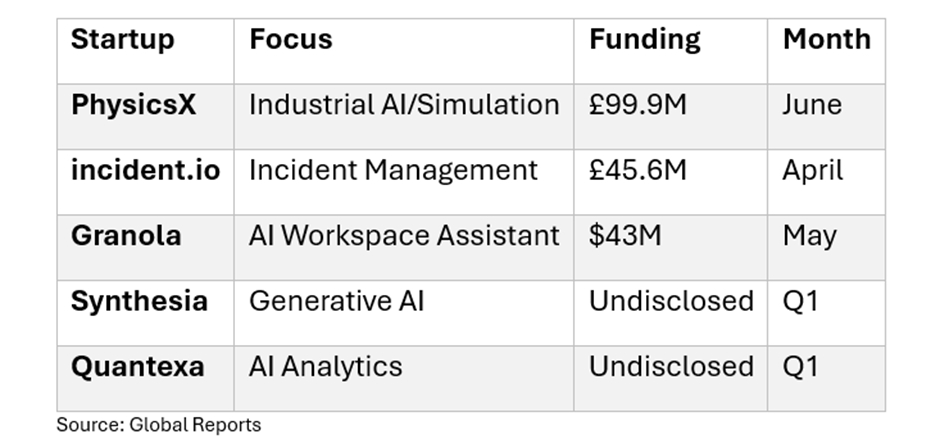
Smart money favors foundational IP and high-ROI agentic automation over organizational-wide, capital-intensive transformations.
IV. Who Loses – Disruption Zones
- Workforce Displacement
- Automation is hollowing out mid-skilled roles.
- AI-driven CapEx replaces labor, contributing to economic decoupling from employment.
- Talent Scarcity
- Specialized AI skills now command a 56% wage premium.
- Companies failing to retrain staff risk losing operational advantage.
- Legacy Software
- ERP and accounting providers like Sage face competition from cloud-native AI-first platforms (Xero, QuickBooks, NetSuite).
- Slow adaptation threatens market share and long-term profitability.
- Execution Failures
- Ocado Group demonstrates that technological leadership doesn’t guarantee commercial success.
- Robotics and reinforcement learning cut costs but scaling internationally proved challenging, eroding shareholder value.
V. Governance, Regulation, and Geopolitical Risk
- Flexible UK Regulation
- Principles-based approach encourages investment while minimizing deployment friction.
- Contrasts with EU’s prescriptive AI Act (active August 2025).
- AI Safety & International Coordination
- UK leads on global AI safety, including the Paris AI Action Summit 2025.
- AI Safety Institute operationalizes international agreements, focusing on catastrophic risk mitigation.
- Liability Risks
- Rapid adoption in healthcare introduces legal uncertainty.
- Survey: 20% of therapists report AI-generated guidance that could harm mental health patients.
- Creates a growing market for AI liability insurance and legal services.
- Financial Systemic Risk
- Concentrated Capex among hyperscalers risks market volatility if ROI targets fail.
- Bank of England warns of potential correction amid record AI valuations.
VI. Smart Money Flow Map (2025–2030)
1. Infrastructure vs. Software
 Analysis: Kalkine Group
2. Key Investment Themes
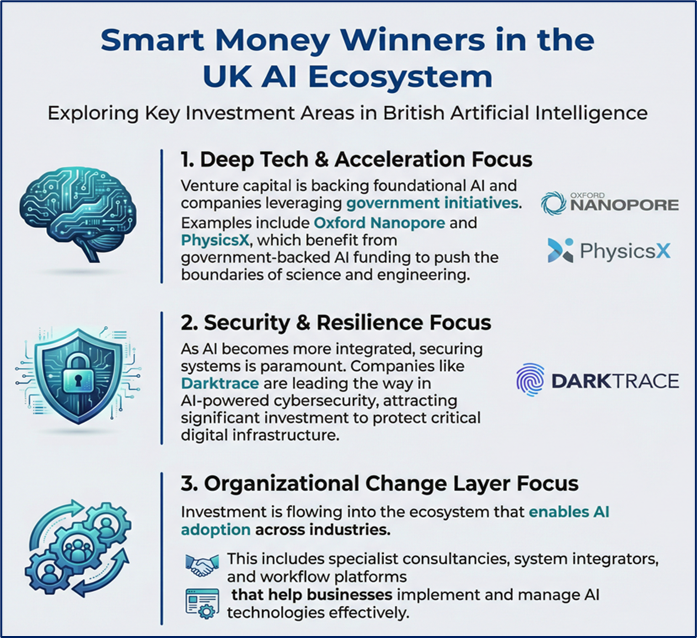
Analysis: Kalkine Group
VII. Winners and Losers – UK AI Supercycle 2025–2030
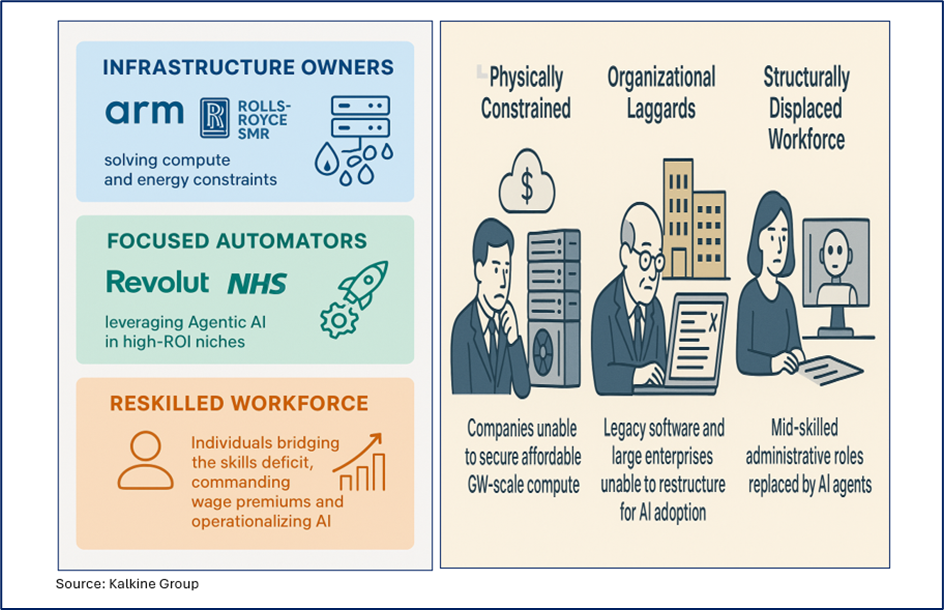
Conclusion
The UK AI Supercycle is a high-stakes convergence of capital, technology, regulation, and infrastructure. The next five years will determine who captures the £100 billion smart money flowing into Britain’s $27 billion AI economy.
- Success favors those who own the compute backbone, execute targeted high-ROI AI deployments, and reskill their workforce.
- Failure awaits those constrained by energy bottlenecks, legacy systems, or poor execution.
Britain’s flexible regulatory framework, combined with strategic infrastructure investments, positions the UK as a prime destination for global AI capital—provided it resolves the grid and energy constraints threatening its supercycle ambitions. The AI Supercycle is no longer optional; it’s the 21st-century industrial transformation defining who will lead in technology, capital, and global competitiveness.


 Jun 24, 2026




 Please wait processing your request...