
 AU
AU
 CA
CA
 US
US
 NZ
NZ
 IND
IND

 UK
UK

 Share
Share
 X (Formerly Twitter)
 Whatsapp
 Facebook
 LinkedIn
 Telegram
 Email This Article
 Copy Link
 Summarize with AI
 Chat GPT
 Perplexity
Views Expressed Disclaimer:
You are reading a free article with opinions that may differ from the recommendation given by Kalkine in its paid research reports. Become a Kalkine member today to get access to our research reports, in-depth technical and fundamental research.
Key Takeaways — February 2026
- FTSE 100 weakness on 24 February 2026 is mainly driven by global market volatility, interest-rate uncertainty, and sector rotation rather than company-specific deterioration.
• UK banking stocks including Lloyds, Barclays, NatWest, and Standard Chartered are reacting to margin outlook concerns as rate expectations shift.
• Cyclical industrial leaders such as Rolls-Royce and Melrose are seeing profit-taking after strong multi-year rallies.
• Dividend outlook across most companies remains stable based on latest company guidance and capital return frameworks.
• Long-term investment case for UK equities remains supported by attractive valuations, strong cash flows, and shareholder returns.

Source: Kalkine Group
Why Are FTSE 100 Stocks Falling Today in February 2026 Despite Strong Fundamentals?
FTSE 100 stocks including Rentokil Initial, Melrose Industries, Standard Chartered, Endeavour Mining, Lloyds Banking Group, Barclays, NatWest Group, and Rolls-Royce declined on 24 February 2026 amid a combination of global risk-off sentiment, bond yield volatility, GBP currency fluctuations, and investor profit-taking. Investors searching for FTSE 100 falling today, UK stock market news February 2026, best UK dividend stocks, and FTSE buying opportunities are seeing macroeconomic drivers dominating short-term price action rather than fundamental deterioration.
The UK stock market remains highly sensitive to global interest rate expectations, particularly US Federal Reserve policy signals and Bank of England rate trajectory forecasts. Rising uncertainty around when interest rates will decline has triggered temporary weakness across financial stocks, cyclicals, and commodity-linked companies. Importantly, the FTSE 100 continues to trade at a valuation discount compared with US and global equity markets, which many institutional investors view as a long-term opportunity.
February 2026 volatility also reflects portfolio rebalancing following strong performance in 2024 and 2025, especially in aerospace and banking sectors. This suggests consolidation rather than a structural downturn.
What Is Driving the UK Economy, FTSE 100, FTSE 250, and GBP Right Now?
UK Economy Dynamics
- Economic growth remains modest but stable with improving real wages.
• Inflation is trending lower but still above central bank targets.
• Interest rate cuts are expected later in 2026, creating uncertainty in the interim.
• Business investment sentiment is gradually improving.
GBP Currency Trends
- Pound volatility has increased due to global rate differentials.
• Currency movements impact multinational earnings translation for FTSE companies.
• A weaker GBP can support exporters but create inflation concerns.
FTSE 100 vs FTSE 250
- FTSE 100 benefits from global revenue exposure and strong dividend yields.
• FTSE 250 is more sensitive to domestic UK economic cycles.
• International investors continue monitoring UK valuation discounts.
Why Are UK Banking Stocks Like Lloyds, Barclays, NatWest, and Standard Chartered Declining?
Banking sector weakness is primarily linked to:
- Concerns that net interest margins may have peaked.
• Expectations of slower loan growth if economic conditions soften.
• Regulatory and capital requirement uncertainties.
• Profit-taking following strong share price gains since 2023.
However, underlying fundamentals remain supportive:
- Strong capital buffers and liquidity (company financial statements).
• Ongoing share buybacks and dividend payments.
• Credit losses still historically manageable.
Why Are Cyclical Leaders Like Rolls-Royce and Melrose Experiencing Pullbacks?
Rolls-Royce and Melrose have delivered exceptional shareholder returns due to aerospace recovery and operational restructuring. Recent declines reflect:
- Valuation consolidation after strong rallies.
• Investor rotation toward defensive sectors.
• Short-term macroeconomic caution.
Operational momentum remains positive with:
- Increasing aircraft engine flying hours.
• Defence spending growth globally.
• Long-term service revenue contracts providing visibility.
What Are the Latest Company Fundamentals and Dividend Outlooks?
Rentokil Initial
Recurring pest control and hygiene services generate stable cash flows. Terminix integration synergies continue progressing (company updates). Dividend growth remains gradual.
Melrose Industries
Focused aerospace platform with margin expansion potential following restructuring. Free cash flow improvement supports shareholder returns (company guidance).
Standard Chartered
Exposure to Asia, Africa, and Middle East markets offers diversification. Capital return plans including dividends and buybacks remain intact (results).
Endeavour Mining
Gold production cash flow supports dividends. Performance remains sensitive to gold price movements (company disclosures).
Lloyds Banking Group
Domestic retail banking dominance with strong capital generation supports dividends and buybacks (results).
Barclays
Diversified banking model including investment banking. Capital return strategy remains central to shareholder value (reports).
NatWest Group
Operational efficiency improvements and government stake reduction create catalysts. Dividend yield remains attractive (company updates).
Rolls-Royce Holdings
Transformation strategy delivering improving margins and free cash flow. Defence and power systems segments add diversification (capital markets updates).
How Do These Stocks Compare With Global Peers?
Banking Sector
- UK banks trade at lower valuation multiples than US counterparts.
• Dividend yields are generally higher than European peers.
• Capital strength metrics remain competitive globally.
Aerospace and Industrials
- Rolls-Royce profitability trajectory improving toward global leaders.
• Melrose aerospace margins still offer catch-up potential.
Mining Sector
- Endeavour Mining valuation tied more directly to gold price cycles compared with diversified miners.
What Is the Sector Outlook Across Time Horizons?
Short Term (3–6 Months)
- Continued volatility due to interest rate uncertainty.
• Banking stocks may remain range-bound.
• Cyclicals sensitive to global growth data releases.
Medium Term (1–2 Years)
- Potential rate cuts could support financial sector valuations.
• Aerospace demand recovery likely to continue.
• Dividend reinvestment opportunities attractive.
Long Term (3–5 Years)
- Structural aerospace growth supported by travel demand.
• Digital banking efficiency improvements.
• Commodity demand cycles benefiting miners.
What Forward-Looking Strategies Could Investors Consider?
Short Term
- Accumulate gradually during volatility.
• Focus on dividend yields and income stability.
• Monitor macro catalysts such as central bank decisions.
Medium Term
- Diversify across sectors including financials, industrials, and commodities.
• Reinvest dividends for compounding returns.
• Track earnings revisions and margin improvements.
Long Term
- Prioritize companies with strong cash generation and capital discipline.
• Benefit from potential UK valuation re-rating.
• Maintain exposure to structural growth industries.
Are These Stocks Bullish, Bearish, or Neutral Right Now?
Short Term
- Banking sector: Neutral due to interest margin uncertainty.
• Industrials: Neutral after strong rallies.
• Mining: Neutral dependent on commodity trends.
Long Term
- Overall outlook appears moderately bullish due to dividends, valuation discounts, and earnings growth potential.
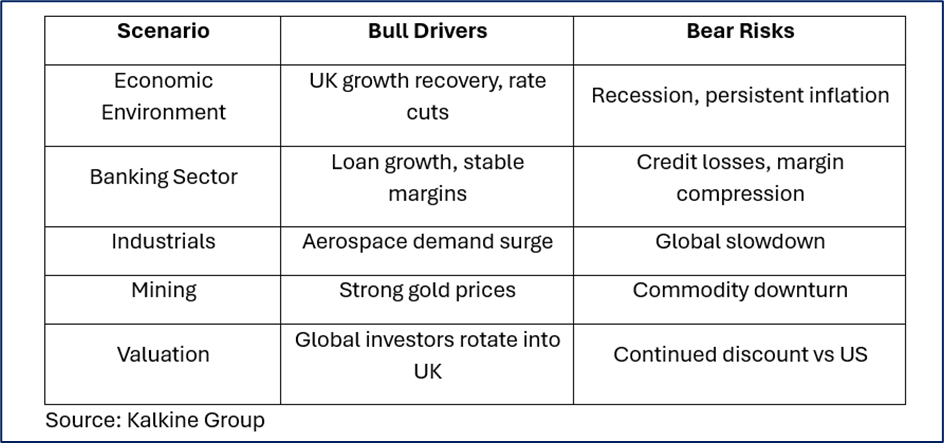
Scenario Analysis — Bull vs Bear Case
What Do Analysts Currently Expect?
Consensus broker sentiment from major institutions such as JPMorgan, UBS, Goldman Sachs, and Morgan Stanley indicates:
- Positive long-term outlook for Rolls-Royce driven by margin expansion.
• Attractive income case for Lloyds, Barclays, and NatWest.
• Moderate growth potential for Standard Chartered tied to emerging markets.
• Cyclical upside for Melrose linked to aerospace cycle recovery.
(Broker research consensus summaries)
What Risks Should Investors Monitor Closely?
- UK recession or consumer slowdown.
• Interest rate policy surprises.
• Regulatory changes in financial sector.
• Commodity price volatility.
• Geopolitical risks affecting trade.
• Currency fluctuations impacting earnings translation.
FAQ — Investor Questions
Why are FTSE 100 stocks down today?
Mostly due to global market volatility, interest rate uncertainty, and profit-taking.
Are UK banking stocks attractive now?
They offer strong dividends and valuations but face short-term margin risks.
Which FTSE stocks have strong dividends?
Lloyds, NatWest, Barclays, and Standard Chartered remain notable income options.
Is Rolls-Royce still a long-term growth story?
Yes, transformation progress and aerospace demand support long-term potential.
Final Investment Conclusion — Should Investors Buy the Dip in February 2026?
The February 2026 decline across RTO, MRO, STAN, EDV, LLOY, BARC, NWG, and RR appears primarily driven by macro sentiment rather than structural business deterioration. Strong dividends, improving profitability trends, and historically attractive UK valuations continue supporting the long-term investment thesis.
Short-term volatility is likely to persist, but long-term investors focused on income, value, and compounding returns may find selective opportunities during market weakness.


 Jun 29, 2026




 Please wait processing your request...