
 AU
AU
 CA
CA
 US
US
 NZ
NZ
 IND
IND

 UK
UK

 Share
Share
 X (Formerly Twitter)
 Whatsapp
 Facebook
 LinkedIn
 Telegram
 Email This Article
 Copy Link
 Summarize with AI
 Chat GPT
 Perplexity
Views Expressed Disclaimer:
You are reading a free article with opinions that may differ from the recommendation given by Kalkine in its paid research reports. Become a Kalkine member today to get access to our research reports, in-depth technical and fundamental research.
The UK stock market offers far more biotech and healthcare opportunity than many investors realise. The FTSE 350 Pharmaceuticals & Biotechnology sector includes two of the world’s largest drugmakers, fast-growing mid-cap innovators, and early-stage companies developing therapies that could transform entire disease areas.
As 2026 begins, sentiment toward biotech is improving globally. Interest rates are easing, clinical trial activity is accelerating, and mergers and acquisitions — a key catalyst for smaller biotech firms — are rebounding after a slow period. Meanwhile, London’s pharmaceutical leaders are delivering strong financial performance and attracting positive analyst attention.
Here is a clearer, investor-focused look at the FTSE-listed biotech and pharmaceutical companies worth watching now.
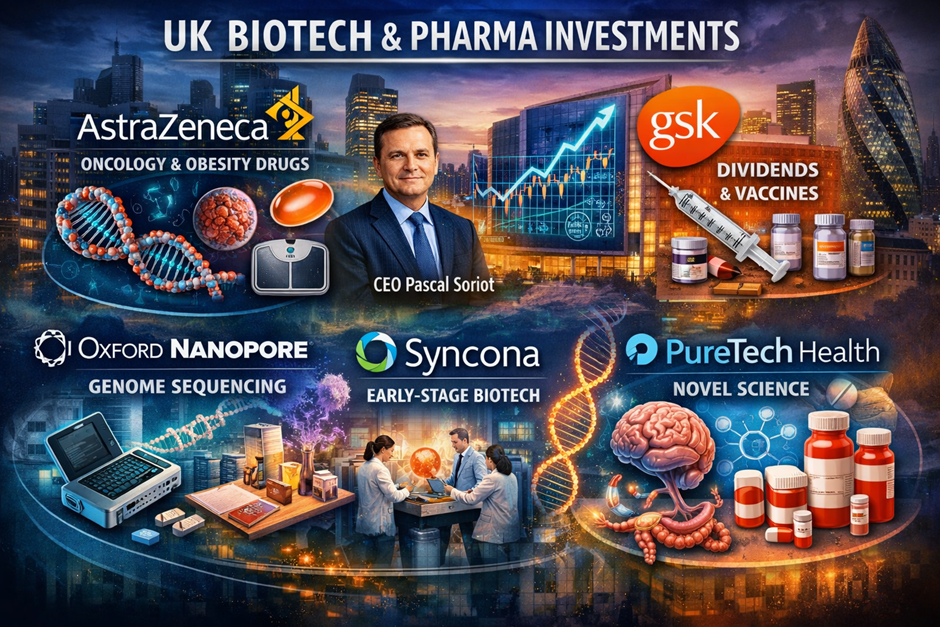
Source: Kalkine Group
AstraZeneca: The FTSE’s Biotech Powerhouse
AstraZeneca remains the dominant force in UK healthcare investing. With a market value exceeding £220 billion, it is not only the largest company on the London Stock Exchange but also one of the most influential pharmaceutical companies globally.
Over the past decade, AstraZeneca has undergone a remarkable transformation. Under CEO Pascal Soriot, the company shifted aggressively into oncology and rare diseases, rebuilt its research pipeline, and strengthened its position through the acquisition of Alexion. That strategy has paid off — revenue reached $58.7 billion in 2025, and long-term shareholders have seen exceptional returns.
Looking ahead to 2026, the growth outlook remains strong. Management expects mid-to-high single-digit revenue expansion and double-digit core profit growth. Late-stage clinical trials scheduled this year could support medicines with tens of billions in potential peak sales across oncology, cardiovascular disease, respiratory conditions, and metabolic disorders.
One particularly important opportunity is AstraZeneca’s obesity programme. Success in this area could position the company alongside leaders in the rapidly expanding weight-loss drug market. At the same time, investments in artificial intelligence-driven drug discovery aim to accelerate research timelines and improve success rates.
While risks such as regulatory scrutiny and future patent expirations exist, AstraZeneca’s scale, innovation engine, and pipeline depth make it a cornerstone holding for many healthcare investors.
GSK: Reliable Dividends with Defensive Strength
GSK represents a different type of opportunity — stability and income rather than aggressive growth. Since spinning off its consumer health business in 2022, the company has become a more focused pharmaceutical and vaccines specialist.
Recent performance has been encouraging. The share price has outperformed the broader FTSE 100, supported by strong demand for its vaccines portfolio and HIV treatments. Dividend payments remain a major attraction for investors seeking dependable income, with a yield that compares favourably against many global pharmaceutical peers.
The company also maintains a broad pipeline, with dozens of products in development and several potential regulatory approvals expected in the near term. Its shingles vaccine continues to generate significant revenue globally, while respiratory and infectious disease treatments provide consistent cash flow.
However, longer-term growth questions remain. Patent expirations in the HIV franchise later in the decade could pressure revenue unless new products successfully replace those earnings. For income-focused investors, GSK remains appealing, but for higher growth potential, other pharmaceutical names may offer greater upside.
Oxford Nanopore Technologies: A Genomics Innovator with Long-Term Potential
Oxford Nanopore stands out as one of the most technologically distinctive companies listed in London. Its DNA and RNA sequencing technology allows real-time analysis using portable devices — a capability that traditional sequencing platforms struggle to match.
The company’s business model combines hardware sales with recurring consumable revenue, creating the potential for improving margins as adoption grows. Revenue growth has been strong across clinical, research, and industrial segments, reflecting expanding commercial traction.
Profitability remains the key milestone ahead. Management expects to approach operating breakeven in the coming years, supported by a strong cash position that provides financial stability during the scaling phase.
Although the share price has declined significantly since its IPO, long-term investors interested in genomics innovation may see the current valuation as an opportunity if the company successfully executes its growth strategy.
Syncona: Venture-Style Biotech Exposure on the Stock Market
Syncona provides investors with access to early-stage biotechnology opportunities through a publicly traded investment vehicle. The company focuses on building and funding businesses in gene therapy, cell therapy, and oncology, often originating from academic research in the UK.
This approach offers significant upside potential because successful drug development can generate large returns. However, it also carries higher risk due to the uncertainty inherent in clinical research and the concentration of investments.
For investors comfortable with volatility and long investment horizons, Syncona offers exposure to cutting-edge medical innovation that would otherwise be difficult to access in public markets.
PureTech Health: Targeting Complex Diseases with Novel Science
PureTech Health operates at the intersection of neuroscience, immunology, and gastrointestinal biology — areas where unmet medical needs remain substantial. The company has multiple approved therapies and a broad pipeline of experimental treatments.
Its research into the gut-brain connection is particularly notable, reflecting growing scientific interest in how digestive system signalling influences neurological and immune disorders. While the company remains in a development phase with associated risks, successful clinical outcomes could significantly increase its value over time.
Hikma Pharmaceuticals: Consistent Growth from Essential Medicines
Hikma offers a more predictable pharmaceutical investment profile compared with research-heavy biotech firms. The company specialises in generic and branded generic medicines, with particular strength in injectable drugs used in hospitals.
These complex injectables provide higher barriers to entry than standard generics, supporting margins and reducing competitive pressure. Hikma also benefits from exposure to growing healthcare demand in emerging markets as well as the United States.
For investors seeking steady earnings growth without the uncertainty of clinical trial outcomes, Hikma represents a practical healthcare sector option.
Sector Outlook: Why Biotech Could Outperform in 2026
Several macroeconomic and demographic trends support the biotech sector:
- Lower interest rates increase the value of future earnings from innovative drug development.
- Ageing populations globally are driving demand for new treatments.
- Artificial intelligence is improving drug discovery efficiency and reducing development timelines.
- Increased merger and acquisition activity is creating opportunities for smaller biotech companies.
However, diversification remains essential. Clinical failures, regulatory setbacks, and shifting investor sentiment can all affect biotech stocks significantly.
The Bottom Line
The FTSE biotechnology and pharmaceutical sector offers a broad range of investment opportunities. AstraZeneca provides global leadership and growth potential. GSK delivers income stability. Oxford Nanopore and PureTech Health offer innovation-driven upside. Syncona enables venture-style exposure, while Hikma provides dependable earnings from essential medicines.
For investors willing to take a long-term perspective, the UK biotech sector presents a compelling mix of defensive resilience and breakthrough potential in 2026.
*Disclaimer: This article is for informational purposes only and does not constitute financial advice. The value of investments can fall as well as rise, and you may receive back less than you invest. Past performance is not a reliable indicator of future results. Always conduct your own research or consult a qualified financial adviser before making investment decisions.*


 Jun 29, 2026




 Please wait processing your request...