
 AU
AU
 CA
CA
 US
US
 NZ
NZ
 IND
IND

 UK
UK

 Share
Share
 X (Formerly Twitter)
 Whatsapp
 Facebook
 LinkedIn
 Telegram
 Email This Article
 Copy Link
 Summarize with AI
 Chat GPT
 Perplexity
Views Expressed Disclaimer:
You are reading a free article with opinions that may differ from the recommendation given by Kalkine in its paid research reports. Become a Kalkine member today to get access to our research reports, in-depth technical and fundamental research.
Technology has never been the defining feature of the FTSE. The UK’s leading index is traditionally dominated by energy giants, banks, and pharmaceutical companies rather than high-growth software names. However, within the FTSE 100 and FTSE 250 sits a group of powerful technology-driven businesses generating billions in recurring revenue, benefiting from strong competitive advantages, and — crucially — now trading at some of the most attractive valuations seen in years.
What triggered this shift? A sharp sell-off driven largely by investor concerns that artificial intelligence could disrupt companies focused on data, analytics, and software. Over the past year, major names such as RELX, Experian, Sage Group, and Rightmove have declined between roughly 27% and 44%. For some investors, that decline signals risk. For others, it may represent one of the most compelling buying opportunities in the UK market in a decade.
Here’s a closer look at several FTSE technology stocks that could benefit if market fears prove exaggerated.
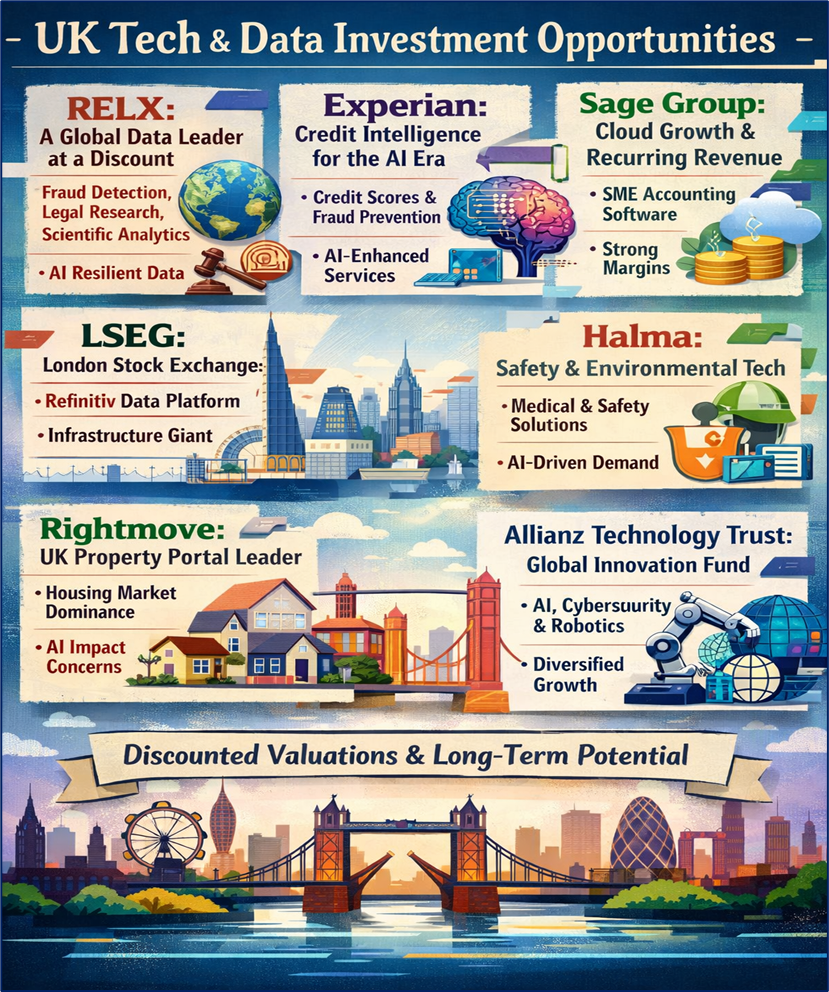
Source: Kalkine Group
RELX: A Global Data Leader at a Discounted Valuation
RELX has transformed itself from a traditional publishing business into a global leader in analytics, decision tools, and professional information services. Its operations span risk analytics, scientific research databases, legal information platforms, and exhibitions — all supported by proprietary datasets that are extremely difficult for competitors to replicate.
Despite this strong positioning, RELX shares have fallen significantly over the past year amid concerns that generative AI tools could reduce reliance on its services. However, much of RELX’s data — particularly in fraud detection, identity verification, and legal research — comes from private, structured sources that AI systems cannot easily replace.
The company continues to deliver steady growth, with underlying revenue rising in 2025 and dividends increasing year after year. For long-term investors, RELX may combine high-quality fundamentals with an unusually attractive entry price.
Experian: Credit Intelligence Positioned for the AI Era
Experian remains one of the world’s leading providers of credit data, fraud prevention, and decision analytics. Its services are deeply embedded in global banking and financial systems, creating high switching costs for customers.
Although its share price has declined alongside other data companies, business performance remains strong. Recent results showed solid revenue growth, rising earnings, and exceptionally high return on equity — evidence of a highly efficient business model.
Importantly, AI is more likely to enhance Experian’s products than disrupt them. Demand for automated credit assessment and fraud detection is increasing, positioning the company as a potential long-term beneficiary of technological change rather than a casualty.
Sage Group: Recurring Revenue and Cloud Momentum
Sage is the UK’s largest listed software company, serving millions of small and medium-sized businesses with accounting, payroll, and financial management tools. Its transition toward subscription-based cloud services has improved revenue visibility and profitability.
Despite these improvements, investor sentiment has weakened, pushing the valuation down to levels that appear modest compared with global software peers. Strong margins, high returns on capital, and ongoing AI integration into its products suggest Sage could continue growing over the long term.
Management’s decision to launch share buybacks also signals confidence that the market may be undervaluing the business.
London Stock Exchange Group: A Financial Data Powerhouse
The London Stock Exchange Group (LSEG) has evolved into a global financial data and analytics company following its acquisition of EODHD/Others. Subscription-based data services now account for the majority of revenue, providing stable and recurring income.
Concerns that financial institutions could build their own analytics using AI have weighed on the share price. However, the scale, reliability, and regulatory importance of LSEG’s datasets make replication challenging for most organisations. For investors, the current valuation could represent a rare opportunity to buy a strategic infrastructure business at depressed levels.
Halma: A High-Quality Compounder Benefiting From AI Growth
Halma operates differently from typical software companies. The group acquires niche technology businesses focused on safety, environmental monitoring, and medical equipment — sectors often supported by regulation and long-term demand.
Unlike other FTSE tech names, Halma’s shares have continued to perform strongly. Increased investment in data centres and infrastructure related to artificial intelligence is expected to drive additional demand for its products, positioning the company as an indirect beneficiary of the AI boom.
Rightmove: Market Leader Facing AI Uncertainty
Rightmove dominates the UK online property portal market with strong network effects. Estate agents list properties where buyers are searching, and buyers search where listings are concentrated — reinforcing its competitive position.
Recent share price weakness reflects concerns that AI-powered property platforms could disrupt this model. However, Rightmove’s brand recognition, extensive listings, and integration into the UK property ecosystem provide meaningful barriers to entry. If those advantages persist, the stock could offer significant recovery potential.
Allianz Technology Trust: Diversified Exposure to Global Innovation
For investors seeking broader exposure beyond individual UK stocks, Allianz Technology Trust offers access to global technology themes including artificial intelligence, cybersecurity, robotics, and quantum computing.
The trust has delivered strong long-term returns historically and currently trades at a discount to its underlying asset value, providing diversified exposure to international technology leaders from a FTSE-listed vehicle.
The Bigger Investment Opportunity
Technology represents only a small portion of the UK equity market compared with the United States, meaning FTSE tech companies often receive less investor attention. When sentiment turns negative, valuations can fall more sharply than fundamentals justify.
Yet many UK technology businesses continue to deliver recurring revenue, strong margins, and global growth opportunities. Forecast sector earnings growth remains robust, and artificial intelligence could accelerate — rather than undermine — demand for several of these companies.
For investors with a long-term perspective, the recent sell-off may offer a rare chance to buy high-quality FTSE technology businesses at attractive prices.
*Disclaimer: This article is for informational purposes only and does not constitute financial advice. The value of investments can fall as well as rise, and you may receive back less than you invest. Past performance is not a reliable indicator of future results. Always conduct your own research or consult a qualified financial adviser before making investment decisions.*


 Jun 29, 2026




 Please wait processing your request...