
 CA
 NZ
 US
 AU
 IND

 UK

 Share
 X (Formerly Twitter)
 Whatsapp
 Facebook
 LinkedIn
 Telegram
 Email This Article
 Copy Link
 Summarize with AI
 Chat GPT
 Perplexity

Key Takeaways (Quick Insights for Investors & Buyers)
- UK house prices have shown remarkable nominal resilience, but in real (inflation-adjusted) terms, values are already declining
- Structural shifts like fixed-rate mortgages and lender forbearance have delayed a traditional crash
- Affordability is at breaking point, especially for first-time buyers in southern England
- The housing market is now highly dependent on employment stability and mortgage rates
- A soft correction (sideways prices + real decline) remains the base case
- The biggest downside risk is rising unemployment, not just interest rates
- The rental crisis is artificially supporting demand but is not sustainable long-term
- Policy options are constrained—government cannot easily stimulate demand again
- Regional divergence is widening: North resilient, South fragile
- The probability of a sharper correction is rising if macro shocks intensify
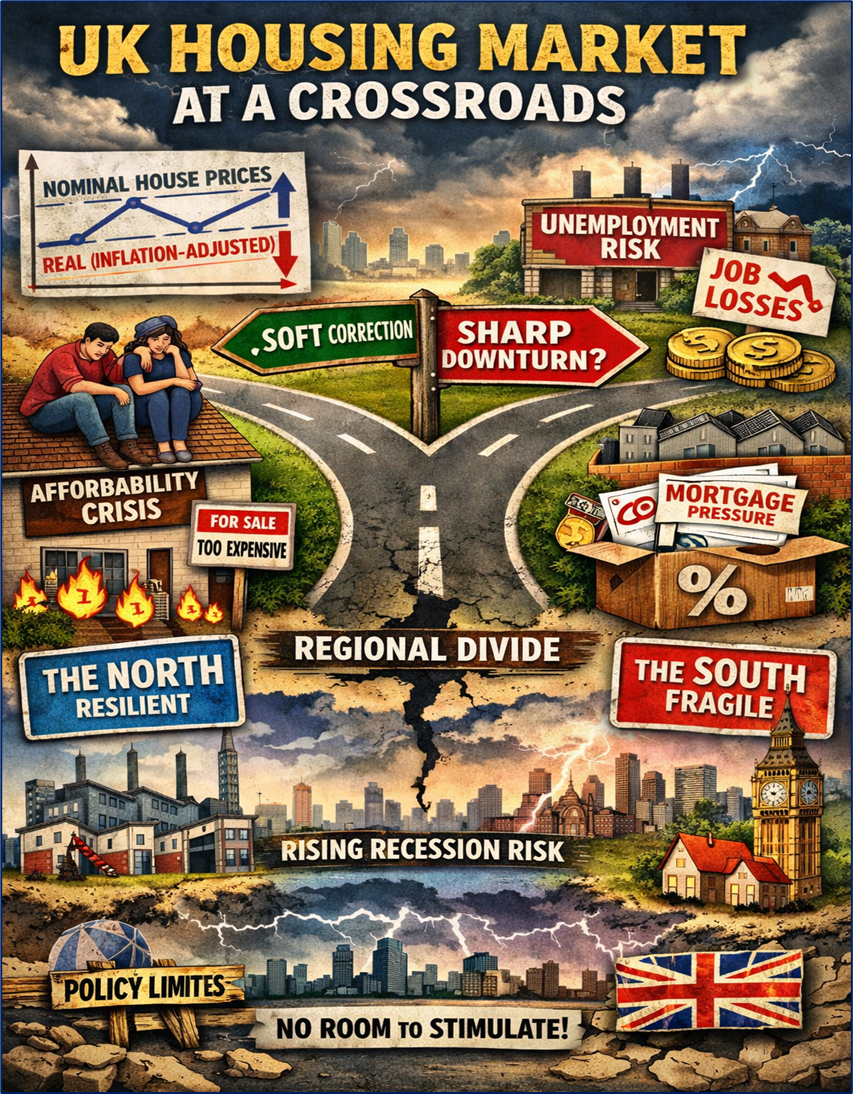
Source: Kalkine Group
Introduction: The Illusion of Stability
The UK housing market has long been considered one of the most resilient asset classes globally. Over the past decade, it has endured a series of unprecedented shocks—pandemic disruption, inflation surges, geopolitical crises, and monetary tightening—yet headline prices have largely held up.
At first glance, this looks like strength.
But beneath the surface lies a more fragile reality. What appears to be resilience is, in fact, the result of structural changes that have distorted how the housing market reacts to economic stress.
Rather than crashing, the market has been slowly compressing affordability, stretching buyers, and suppressing activity.
The key question now is not whether the market has survived shocks—it clearly has. The real question is:
Can it survive another one?
A Decade of Continuous Economic Shocks
The 2020s have been one of the most turbulent periods for housing markets in modern UK history.
- Pandemic Boom (2020–2021)
Ultra-low interest rates and government stimulus triggered a surge in demand. The “race for space” pushed prices higher, especially outside major cities.
- Inflation & Rate Shock (2022–2023)
The sharp rise in inflation forced aggressive rate hikes. Mortgage costs doubled in many cases, crushing affordability.
- Financial Instability (Mini-Budget Crisis)
Bond market volatility directly fed into mortgage pricing, exposing how fragile housing finance really is.
- Geopolitical Pressure (2025–2026)
Energy shocks and global uncertainty have pushed mortgage rates higher again—just when the market expected relief.
Despite all this, prices didn’t collapse.
That’s not because the system is strong—it’s because the adjustment mechanism has changed
The Reality Behind “Resilient” House Prices
Nominal vs Real Prices
While UK house prices are roughly 25% higher than pre-pandemic levels, inflation has eroded much of that gain.
In real terms:
- Prices are flat or declining
- Wealth effect is weaker than perceived
- Housing is no longer a guaranteed inflation hedge
This creates a “stealth correction”—less visible but equally impactful.
Why the Market Hasn’t Crashed (Yet)
- Fixed-Rate Mortgage Shield
Most UK borrowers are now on fixed-rate mortgages.
Impact:
- Payment shocks are delayed, not immediate
- Stress is spread over years instead of months
- Forced selling is reduced
But this is temporary.
As fixed deals expire:
- Borrowers refinance at much higher rates
- Disposable income declines
- Demand weakens gradually
- Lender Forbearance Policies
Banks now avoid repossessions where possible.
Effects:
- Fewer distressed sales
- Reduced downward pressure on prices
- Hidden financial stress in the system
This creates artificial stability, not true strength.
- Rise of Mortgage-Free Owners
A growing share of homeowners:
- Have no mortgage
- Are unaffected by interest rates
- Do not need to sell
This reduces market volatility—but also:
- Reduces liquidity
- Makes price discovery slower
- Lower Transaction Volumes
The UK housing market operates at structurally lower volumes than pre-2008 levels.
Result:
- Fewer price-setting transactions
- Slower corrections
- “Sticky” pricing behavior
Prices don’t fall quickly—they stagnate instead.
Affordability Crisis: The Core Problem
At the heart of the housing debate is a simple issue:
People can no longer afford homes at current price levels.
Key Pressures
- Mortgage rates have surged from ~2% to ~4–6%
- Loan eligibility has declined sharply
- Deposits remain prohibitively high
- Wage growth has lagged housing costs
First-time buyers are now:
- Borrowing at maximum limits
- Spending over 20% of income on repayments
- Highly vulnerable to shocks
This is not a stable foundation for long-term growth
The Rental Crisis: A Hidden Driver
Paradoxically, the broken rental market is supporting house prices.
What’s happening:
- Rents are rising rapidly
- Landlords are exiting the market
- Supply is shrinking
This pushes renters into buying—even when:
- It’s financially risky
- They are overstretched
This creates forced demand, not healthy demand.
Once this pool is exhausted, demand could weaken sharply.
Regional Divide: Two Housing Markets
The UK housing market is no longer uniform.
North & Midlands
- More affordable
- Stronger demand
- Stable price growth
South & London
- Highly stretched affordability
- Weak demand
- Real price declines
London, in particular, faces:
- High supply
- Falling international demand
- Financial sector risks
This divergence will define the next phase of the cycle.
Mortgage Rates: The Single Biggest Driver
Everything in housing now revolves around interest rates.
Why it matters:
- Even small rate changes significantly impact affordability
- Higher rates reduce borrowing capacity
- Lower rates unlock demand
The problem:
- Inflation remains sticky
- Global risks are rising
- Rate cuts are uncertain
This creates a prolonged affordability squeeze.
The Ultimate Risk: Rising Unemployment
If there is one factor that can truly break the housing market, it is:
Job losses
Why?
- Mortgage payments depend on income
- Forbearance cannot replace earnings
- Forced sales increase supply
Historically:
- Housing crashes coincide with rising unemployment
- Interest rates alone rarely trigger collapses
So far, employment has held strong.
If that changes, the market dynamic changes completely
What Could Trigger a Housing Correction?
Scenario 1: Persistent Inflation
- Rates stay high
- Demand weakens
- Prices stagnate or decline in real terms
Scenario 2: Recession & Job Losses
- Forced selling increases
- Nominal prices fall
- Negative equity rises
Scenario 3: Financial Shock
- Credit availability tightens
- Lending slows
- Market liquidity collapses
Scenario 4: Confidence Collapse
- Buyers delay purchases
- Transactions freeze
- Prices drift downward
Outlook: What Happens Next?
Base Case (Most Likely): Soft Correction
- Prices flat in nominal terms
- Real values decline gradually
- Low transaction volumes
- Regional divergence continues
Downside Case: Sharp Correction
- Triggered by unemployment or rate spike
- 10–15% price falls possible in vulnerable regions
- Construction slowdown
Upside Case: Managed Recovery
- Inflation falls
- Rates decline
- Demand recovers gradually
However, this scenario depends heavily on global stability.
Long Conclusion: A Market That Looks Strong but Isn’t
The UK housing market has not defied economic gravity—it has simply delayed it.
What we are witnessing is not resilience in the traditional sense. It is a restructuring of how stress is absorbed.
Instead of:
- Sudden crashes
- Rapid price declines
We now have:
- Slow erosion of affordability
- Hidden financial stress
- Reduced market activity
This makes the system appear stable—but actually more fragile.
The key vulnerabilities today are:
- Overstretched first-time buyers
- Weak affordability fundamentals
- High dependence on low unemployment
- Limited policy flexibility
- Structural supply constraints
Each shock over the past decade has:
- Tested the system
- Consumed resilience
- Reduced future flexibility
The margin for error is now extremely thin.
This doesn’t mean a crash is inevitable.
But it does mean:
The next shock matters more than any previous one.
For investors:
- Focus on regional strength and rental dynamics
- Avoid over-leveraged exposure
For buyers:
- Stress-test affordability under higher rates
- Avoid maximum borrowing limits
For policymakers:
- Structural reform is unavoidable
- Demand-side stimulus is no longer sustainable
The UK housing market is entering a new phase—one defined not by boom or bust, but by constraint, imbalance, and slow adjustment.


 Nov 26, 2026





 Please wait processing your request...