
 AU
AU
 CA
CA
 US
US
 NZ
NZ
 IND
IND

 UK
UK

 Share
Share
 X (Formerly Twitter)
 Whatsapp
 Facebook
 LinkedIn
 Telegram
 Email This Article
 Copy Link
 Summarize with AI
 Chat GPT
 Perplexity
The Mid-Cap Meltdown: Why London’s Growth Engine Lost Steam Today
The FTSE 250 index traded lower on January 8, 2026, dropping by 0.40% at approximately 22,796. This decline marks a second consecutive day of losses for the London market, as a perfect storm of disappointing retail earnings, a surprise drop in UK house prices, and escalating geopolitical tensions in South America weighed heavily on investor sentiment.
While the blue-chip FTSE 100 also struggled, the mid-cap FTSE 250—often seen as a barometer for the health of the UK economy—faced specific pressure from domestic consumer-facing stocks. A series of "Christmas trading updates" revealed that the crucial festive period was not the goldmine many had hoped for.
Key Market Drivers: What Dragged the Index Down?
Several critical factors converged to pull the index into the red:
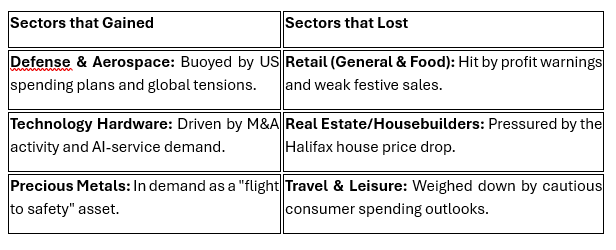
- Retail Reality Check: The "Golden Quarter" appears to have lost its luster. Major high-street names reported missed sales targets, citing a combination of "discounting fatigue" and a weary UK consumer.
- Housing Market Cool-off: Data from Halifax released this morning showed that UK house prices unexpectedly fell in December. This unexpected weakness in property values hit housebuilders and real estate investment trusts (REITs) hard.
- The "Venezuela Factor": Geopolitical instability involving US sanctions and oil tanker seizures near Venezuela spiked global uncertainty. While this boosted defense stocks, it created a "risk-off" environment that saw investors flee mid-cap growth plays.
- Sticky Inflation Fears: While the Bank of England has signaled potential rate cuts later in 2026, today’s cautious corporate outlooks suggest that wage growth and operational costs remain stubbornly high, squeezing profit margins.

Source: Kalkine Group
Winners & Losers: The Stock Scoreboard
The Gainers (Risers)
Despite the gloom, some tech and defense names managed to buck the trend.
- Computacenter (+3.89%): The technology services provider surged after announcing the strategic acquisition of US-based AgreeYa Solutions, signaling aggressive international expansion.
- Softcat (+4.36%): Benefited from a positive read-across in the IT infrastructure sector.
- Hochschild Mining (+2.98%): Precious metals provided a safe haven as gold and silver miners attracted defensive flows.
- Trustpilot (+2.64%): Continued to show resilience as a high-growth tech play.
The Losers (Fallers)
- Greggs (-6.70%): The high-street bakery giant was the day's biggest victim. Despite reporting a sales increase, its 2026 guidance missed analyst expectations, with the company warning of "challenging market conditions."
- Raspberry Pi Holdings (-5.22%): Experienced a sharp pullback following recent gains as investors locked in profits amid tech volatility.
- Ithaca Energy (-3.08%): Pressured by the broader volatility in energy prices and specific production concerns.
- WH Smith (-2.90%): Dragged down by the wider retail sector malaise following poor updates from peers like AB Foods and Tesco.
Sector Spotlight
Analyst Updates: Upgrades & Downgrades
The brokerage community was busy recalibrating expectations following the morning's flurry of news:
- Greggs: Several analysts shifted to a "Neutral" stance, citing margin pressure from rising labor costs despite strong brand loyalty.
- Computacenter: Received several "Buy" reiterations, with analysts praising the AgreeYa acquisition as a "valuation-accretive move into the US market."
- AB Foods: While a FTSE 100 constituent, its 11% plunge triggered a wave of downgrades across the mid-cap retail space, with analysts warning of a "structural shift" in fashion retail profitability.
Technical Analysis Summary
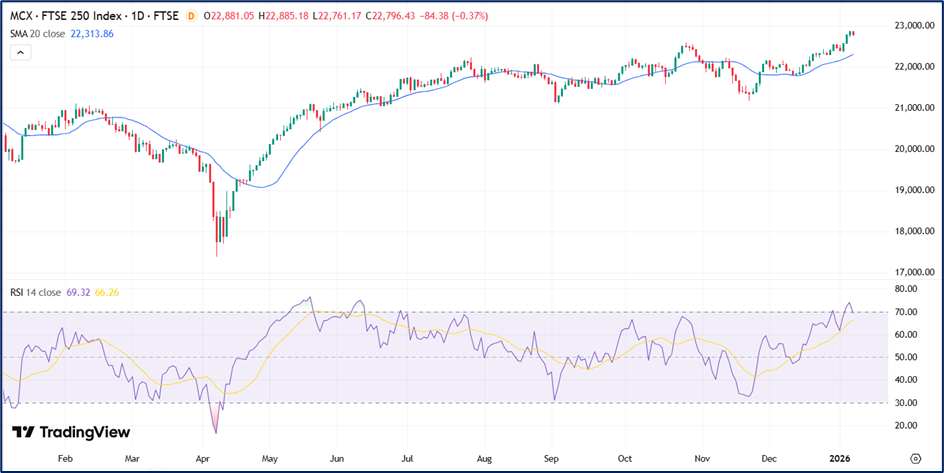
From a technical perspective, the FTSE 250 is currently testing its 50-day Moving Average.
- Support Levels: The index is looking for a floor at 22,600. If it breaks below this, the next major support sits at 22,450.
- Resistance: On the upside, 23,000 remains a psychological and technical barrier that the index has failed to breach multiple times this month.
- RSI (Relative Strength Index): Currently hovering around 69, suggesting the index is leaning toward "oversold" territory but hasn't yet reached the point of a guaranteed bounce.
Source: Trading View
Investor Note: The market is currently "stock-specific." Rather than trading the whole index, professional investors are cherry-picking companies with "self-help" stories or international revenue streams to hedge against UK domestic weakness.
What’s Next?
All eyes are now on the upcoming US inflation data and further UK retail updates due next week. If the consumer continues to pull back, the FTSE 250 may struggle to reclaim the 23,000 mark in the short term.


 Jun 03, 2026




 Please wait processing your request...