
 AU
AU
 CA
CA
 US
US
 NZ
NZ
 IND
IND

 UK
UK

 Share
Share
 X (Formerly Twitter)
 Whatsapp
 Facebook
 LinkedIn
 Telegram
 Email This Article
 Copy Link
 Summarize with AI
 Chat GPT
 Perplexity

Key Takeaways
Source: Kalkine Group
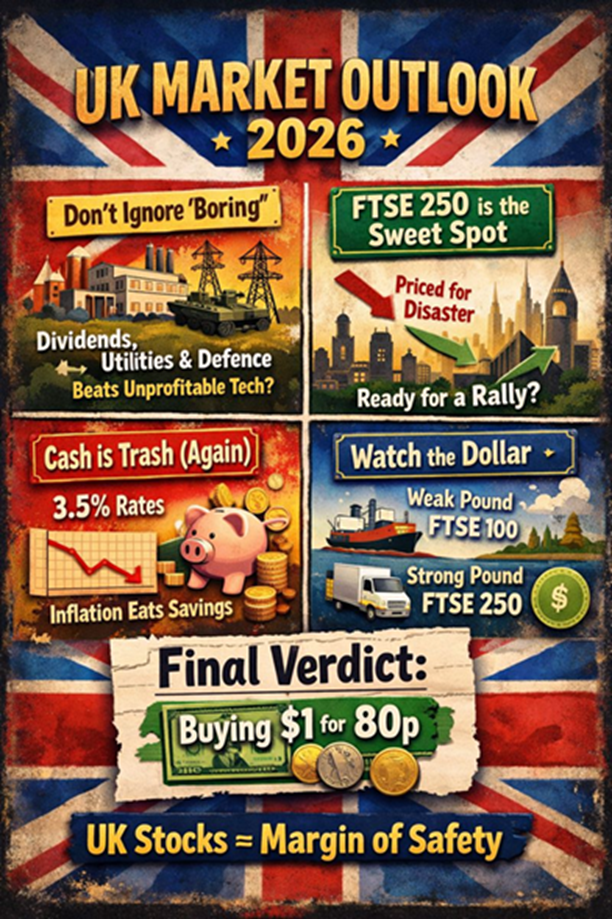
- Don't Ignore "Boring"
The sexy tech stocks are in the US, but the cash cows are in the UK. 2026 is the year where boring (dividends, utilities, defence) might outperform exciting (unprofitable tech).
If you believe the UK economy will avoid recession, the mid-caps offer the best risk-reward ratio. They are priced for disaster; if "merely okay" happens, they rally.
With rates falling to ~3.5%, leaving money in a savings account will start losing you purchasing power against inflation. The rotation back into assets (stocks/bonds) is expected to accelerate.
- Watch the Dollar:
A weaker Pound is good for the FTSE 100 (exporters). A stronger Pound is good for the FTSE 250 (importers/domestic). Your currency view dictates your index choice.
Final Verdict: 2026 isn't about finding the "next Nvidia." It's about buying dollar bills for 80 pence. The UK market offers a "margin of safety" that the US currently does not. If 2025 was the year of "Wait and See," 2026 is shaping up to be the year of "Catch Up." The consensus from the City to Wall Street is shifting. While the US tech giants wrestle with eye-watering valuations and "AI bubble" fears, the UK market is flashing a rare signal:
Deep Value. With interest rates projected to stabilize between 3.25% - 3.75% by year-end 2026, the heavy fog over the FTSE 250 is lifting.
The Outlook in a Nutshell:
Source: Kalkine Group
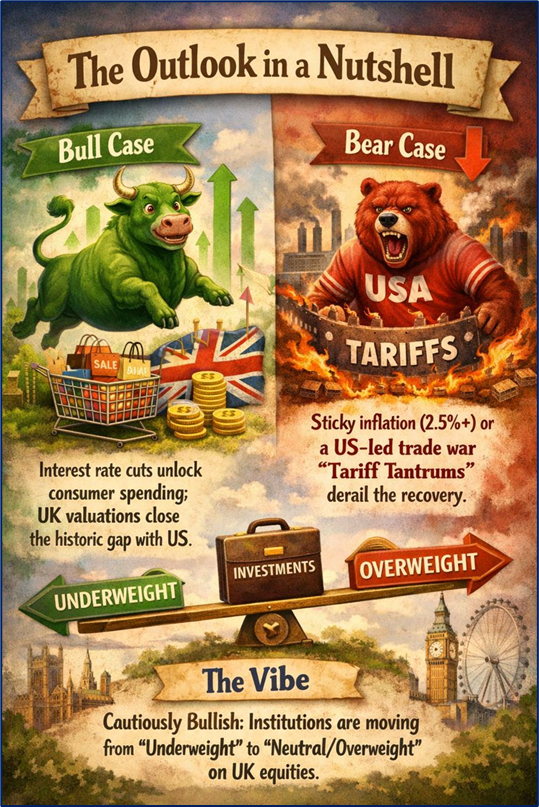
- Bull Case: Interest rate cuts unlock consumer spending; UK valuations close the historic gap with the US.
- Bear Case: Sticky inflation (2.5%+) or a US-led trade war ("Tariff Tantrums") derail the recovery.
- The Vibe: Cautiously Bullish. Institutions are moving from "Underweight" to "Neutral/Overweight" on UK equities.
Top Investment Themes for 2026
Source: Kalkine Group
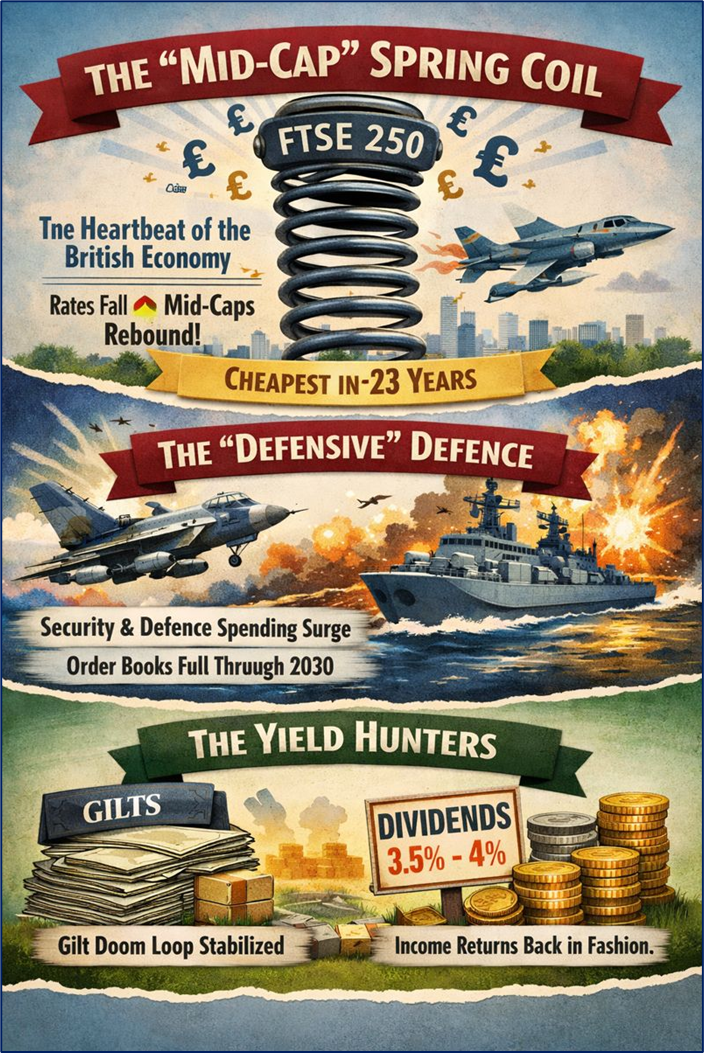
- The "Mid-Cap" Spring Coil
The FTSE 100 is global, but the FTSE 250 is the heartbeat of the British economy. For three years, mid-caps have been beaten down by high rates.
- The Play: As the Bank of England (BoE) cuts rates, debt-servicing costs drop for these companies, and domestic consumption rises.
- Institutional View: Interactive Investor and Rathbones argue the FTSE 250 looks "the cheapest in 23 years" relative to large caps.
- The "Defensive" Defence
Geopolitics isn't calming down. With fragmentation in global supply chains and rising NATO commitments, defence spending is no longer cyclical—it’s structural.
- The Trend: UK defence contractors are seeing order books fill up through 2030. RBS/Coutts highlights "Security and Defence" as a persistent top-tier theme.
- The Yield Hunters (Gilt Doom Loop Ends)
With the "Gilt doom loop" (bond market volatility) largely stabilized, steady dividend payers are back in fashion. The FTSE 100’s dividend yield (approx. 3.5-4%) looks highly attractive against falling cash savings rates.
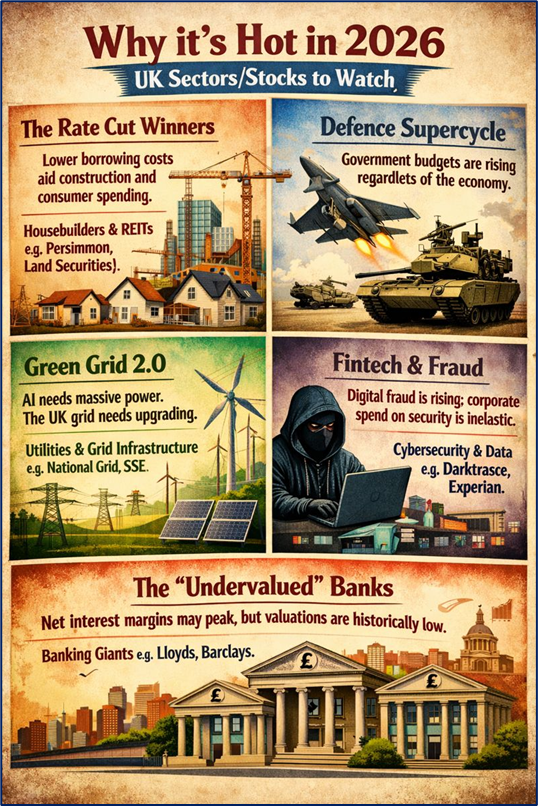
Sectors & Stocks to Watch (Thematic Analysis)
Source: Kalkine Group
The Institutional Scorecard: Who Says What?
- Goldman Sachs: Neutral/Tactical. Sees the UK as a "Stock Picker's Market." They are cautious on the GBP but see value in the FTSE 100 due to its global earnings exposure (75% non-UK).
- BlackRock: Thematic Bulls. Their "Micro is Macro" theme for 2026 implies a focus on Infrastructure (Data Centers/Energy) and Private Credit. They see UK opportunities in the transition to a low-carbon economy.
- Morgan Stanley: Cautious on AI, Bullish on "Old Economy". They warn of "creative destruction" in AI but like Utilities and Industrials that benefit from the "re-industrialization" of the West.
- J.P. Morgan: Income Focused. "Prepare for inflation's structural shift." They recommend high-quality dividend payers and Real Assets (infrastructure/commodities) to hedge against volatile inflation.
- Barclays: Pro-Equities. "Stocks over Bonds." They believe the UK economy could finally move out of "first gear" post-budget clarity.
The Risks: What Could Go Wrong?
- Inflation "Sticky" at 2.5%: If wages keep rising, the BoE may halt rate cuts. This would hurt the "Mid-Cap Spring Coil" thesis immediately.
- The "Tariff Tantrum": Any aggressive US tariffs (Trump trade policies) could hit global-facing FTSE 100 companies hard.
- The "AI Hangover": If US tech stocks crash due to an AI bubble burst, global sentiment will drag the UK down, even if the UK isn't tech-heavy.
The Final Verdict: From "Value Trap" to "Value Map"
The 2026 narrative is crystal clear: The "Great British Discount" is finally closing shop. While the global herd chased the dizzying heights of the AI skyline, London quietly cemented itself as the ultimate bargain bin for smart capital.
As interest rates descend, the safety net of cash is fading, replaced by the magnetic pull of juicy yields and historically low P/E ratios. This year isn't about the FOMO (Fear Of Missing Out) on the next overpriced tech unicorn; it’s about the JOMO (Joy Of Missing Out) on volatility in favor of rock-solid fundamentals.
The unloved UK market is shedding its "old economy" skin and emerging as 2026’s premier contrarian play. The rotation has begun—don't let the "boring" label fool you; the comeback is always louder than the crash.


 Jun 29, 2026




 Please wait processing your request...