
 AU
AU
 CA
CA
 US
US
 NZ
NZ
 IND
IND

 UK
UK

 Share
Share
 X (Formerly Twitter)
 Whatsapp
 Facebook
 LinkedIn
 Telegram
 Email This Article
 Copy Link
 Summarize with AI
 Chat GPT
 Perplexity
The 7 January 2026 Surge: Key Drivers and Catalysts
Vodafone Group (LSE: VOD) emerged as the standout performer on the FTSE 100 today, climbing approximately 3.1% to reach 103.60p.
The primary engine behind this rally was a significant analyst upgrade from Berenberg, which shifted its rating from ‘Hold’ to ‘Buy’ while aggressively raising the price target from 82p to 119p. This implies a nearly 20% upside from current levels.
The market's enthusiasm is rooted in a fundamental shift in perception regarding Vodafone’s cash engine. Berenberg's note highlighted a "sustainable free cash flow" trajectory that had previously been doubted by the broader market.
Furthermore, the imminent receipt of approximately €1 billion from Zegona Communications’ share cancellation is providing an immediate boost to the balance sheet, reinforcing the company's "value-creation" capacity through potential share buybacks or bolt-on acquisitions.
Technical Analysis Summary: Breaking Through Resistance
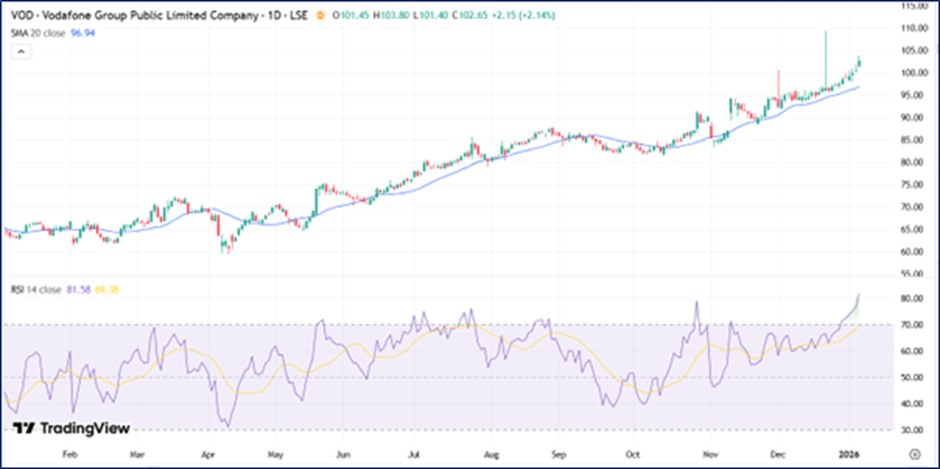
Source: Trading View
From a technical perspective, today’s move is significant as it validates a mid-term recovery trend that began in late 2025.
- Moving Average Alignment: The stock is currently trading above its 50-day and 100-day moving averages, a classic "Golden Cross" signal for many trend-following algorithms.
- Volume Profile: Trading volume today spiked significantly above the 20-day average, indicating that the move is backed by institutional accumulation rather than retail speculation alone.
- Resistance and Support: The 105p mark remains a critical psychological resistance level. If the stock closes the week above this threshold, technical analysts anticipate a clear run toward the 112p-115p zone. Immediate support has now shifted upward to the 98p level.
- RSI Levels: The Relative Strength Index (RSI) is currently hovering around 81, suggesting the stock hits the overbought territory (typically 80+).
The 2026 Business Model: Simplicity and Growth
Vodafone's latest business model is the result of a multi-year "right-sizing" strategy spearheaded by CEO Margherita Della Valle. The "New Vodafone" is leaner, focused on three core pillars: Customers, Simplicity, and Growth.
- Portfolio Rationalization: By divesting underperforming assets in Spain and Italy, the company has refocused its capital on high-return markets like Germany and the UK.
- Vodafone Business: A major shift in the business model involves moving away from being just a "dumb pipe" (connectivity provider) to a digital services partner. Vodafone Business is now seeing double-digit growth in cloud and security services.
- Consumer Ecosystem: In markets like India (via Vodafone Idea) and the UK, the company is integrating AI-driven features—such as the "Vi Protect" spam protection and AI-based self-optimizing networks—to reduce churn and improve "Network NPS" (Net Promoter Score).
Financial and Operational Updates
Recent H1 and Q3 FY26 updates provide the empirical data for the current stock rally.
- Germany’s Recovery: After a period of stagnation due to regulatory changes in the TV market (MDU law), German service revenue has returned to growth. This is vital as Germany is Vodafone’s largest profit center.
- Three UK Merger Impact: The integration with Three UK is ahead of schedule. Over 5,000 sites have already been upgraded, allowing for seamless network sharing and significant synergy realizations that are boosting EBITDAaL margins.
- Revenue Metrics: Group service revenue increased by roughly 8.1% on a reported basis, driven by strong performances in the UK, Africa, and Turkey.
- Dividend Policy: The company has introduced a progressive dividend policy, forecasting an increase of 2.5% for the current financial year, signaling management’s confidence in long-term earnings.
Risks to the Bull Case
Despite the optimistic 7 January rally, several headwinds remain on the horizon that investors are monitoring.
- Competitive Intensity: While Germany is improving, the mobile market there remains "hyper-competitive," limiting the ability to raise prices without risking subscriber losses.
- Debt Burden: Although the balance sheet is "increasingly robust," the absolute debt level remains meaningful. Future interest rate fluctuations could impact the cost of refinancing this debt.
- Execution Risk: The Three UK merger is complex. Any delays in realizing the promised synergy targets could lead to a swift reassessment of the stock's valuation.
- Geopolitical and Macro Factors: With significant exposure to Africa and Turkey, Vodafone remains sensitive to foreign exchange volatility and geopolitical instability in emerging markets.
Conclusion
Vodafone’s 3% climb on 7 January 2026 represents more than just a daily fluctuation; it is a market vote of confidence in a restructured entity. The combination of Berenberg’s bullish upgrade, a return to growth in the critical German market, and a disciplined approach to capital allocation has repositioned the stock from a "value trap" to a credible "growth and income" play. While risks regarding debt and competition persist, the 2026 roadmap suggests that the "New Vodafone" is finally finding its footing in the post-divestment landscape.


 Jun 03, 2026




 Please wait processing your request...