
 AU
AU
 CA
CA
 US
US
 NZ
NZ
 IND
IND

 UK
UK

 Share
Share
 X (Formerly Twitter)
 Whatsapp
 Facebook
 LinkedIn
 Telegram
 Email This Article
 Copy Link
 Summarize with AI
 Chat GPT
 Perplexity
What Is the VUKE ETF?
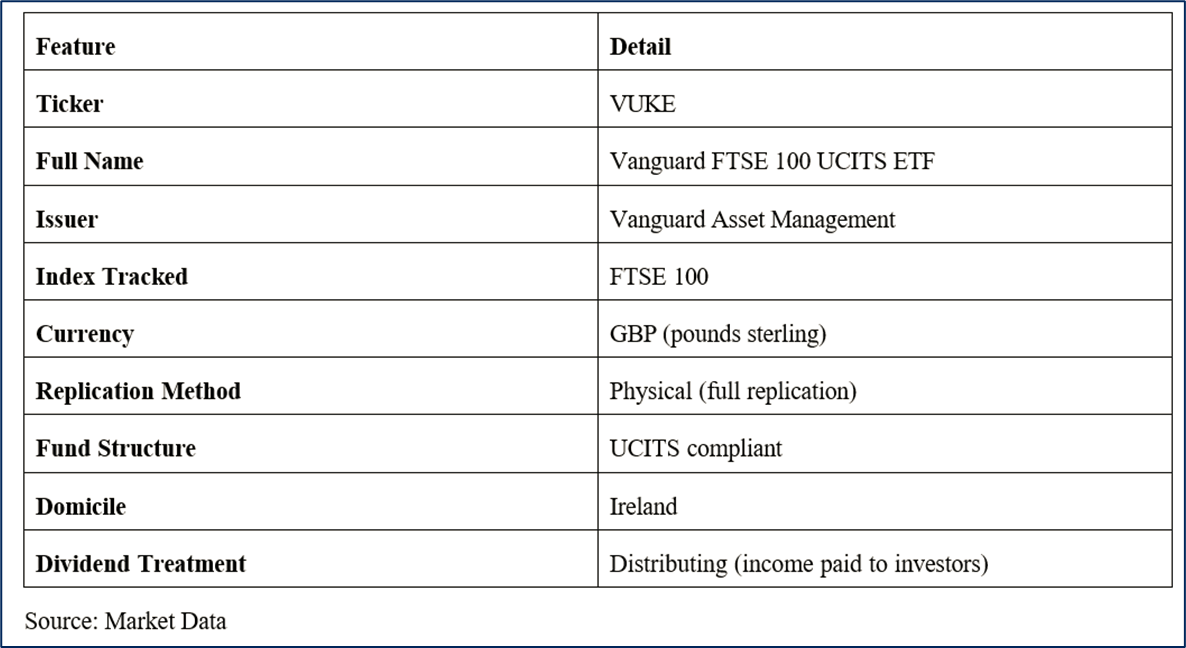
The Vanguard FTSE 100 UCITS ETF (VUKE) is one of the flagship exchange-traded funds from Vanguard, the investment management giant founded by John C. Bogle — widely regarded as the father of index investing. Listed on the London Stock Exchange and trading in GBP (pounds sterling) rather than pence, VUKE offers investors clean, low-cost, physically replicated exposure to the FTSE 100 Index, the benchmark of the UK's 100 largest listed companies.
Currently priced at £47.40 with a daily gain of +0.15% on February 27, 2026, VUKE reflects the steady uptick in UK large-cap equity valuations on the day and remains one of the most trusted FTSE 100 ETF options available to retail and institutional investors alike.
The fact that VUKE is priced in GBP (£47.33) rather than pence (GBX) is a notable feature that distinguishes it from ISF (GBX 1,061.00) and L100 (GBX 1,949.80). This is simply a unit pricing convention — all three track the same underlying FTSE 100 index.
VUKE ETF Key Facts and Specifications
Vanguard: The Index Investing Pioneer
To understand why VUKE commands such investor trust, it helps to understand Vanguard's unique structure and philosophy. Unlike most asset managers that are owned by external shareholders, Vanguard operates under a mutual ownership structure — the funds own Vanguard, and Vanguard's investors are effectively its owners. This eliminates the profit motive that can create conflicts of interest, and it has historically translated into some of the lowest management fees in the industry.
Vanguard was founded in 1975 by John C. Bogle, who pioneered the concept of the retail index fund on the premise that most active managers underperform their benchmarks over the long term, net of fees. Decades of academic research and real-world data have validated this thesis. Vanguard now manages over $8 trillion in global assets, making it one of the two largest asset managers in the world alongside BlackRock.
For UK investors, Vanguard's reputation for low costs, simplicity, and investor-first culture is particularly resonant.
Physical Replication: Why VUKE Holds the Actual Stocks
VUKE uses full physical replication — meaning Vanguard actually purchases shares in each of the 100 companies comprising the FTSE 100 in proportions that match the index weights. This is the most transparent and intuitive replication method:
- You own a slice of iShares in Shell, HSBC, AstraZeneca, Unilever, BP, and all other FTSE 100
- There is no counterparty risk from swap agreements (unlike synthetic ETFs such as L100).
- Dividend income flows from underlying companies through the ETF to unitholders
- Holdings are fully disclosed and auditable.
For investors who value simplicity and transparency above all else, physical replication is the gold standard. Vanguard's scale also means it can manage the operational complexity of holding 100 stocks efficiently, keeping transaction costs and tracking error minimal.
Understanding the FTSE 100: What VUKE Gives You Access To
The FTSE 100 is an internationally recognised equity benchmark launched in January 1984. The index is market-capitalisation weighted, meaning larger companies have proportionally greater influence on its performance.
As of early 2026, the index's largest constituents typically include companies like AstraZeneca, Shell, HSBC, Unilever, BP, Rio Tinto, British American Tobacco, Diageo, GSK, and Lloyds Banking Group — though exact weightings shift with market movements and quarterly rebalancing.
Sector breakdown (approximate market data):
Financials: Banks, insurers, and asset managers — roughly 20% of the index
Energy: Shell and BP dominate, contributing ~13%
Consumer Staples: Household names in food, beverages, and tobacco — ~15%
Healthcare: AstraZeneca and GSK are heavyweight contributors — ~12%
Materials: Mining giants including Rio Tinto and Anglo American — ~10%
Industrials, Utilities, Real Estate, Technology: Remainder
This composition makes the FTSE 100 a value-and-income-oriented index with significant exposure to global commodity cycles, rather than a technology-heavy growth index.
VUKE Dividend Income: One of Its Strongest Features
One of the most compelling reasons UK investors choose VUKE is its dividend income potential. The FTSE 100 has historically offered one of the highest dividend yields among major global equity indices — typically 3–4% per year depending on market conditions and constituent payouts.
VUKE distributes dividends quarterly, making it particularly attractive for:
Retirees and near-retirees seeking regular passive income
SIPP investors building a retirement income stream
ISA investors receiving tax-free dividend income
Income-focused portfolio builders supplementing salary or other income
The quarterly cadence of distributions ensures investors receive income more frequently than annual or semi-annual payers.
VUKE in an ISA or SIPP: Tax Efficiency
VUKE is fully eligible for inclusion in a Stocks and Shares ISA and a Self-Invested Personal Pension (SIPP) - the two primary tax-advantaged investment vehicles for UK retail investors.
In an ISA: All dividends and capital gains are tax-free. With a £20,000 annual ISA allowance, VUKE is a natural "core" holding for ISA investors seeking broad UK equity exposure.
In a SIPP: Contributions receive income tax relief (at your marginal rate), and all growth and income is tax-deferred until withdrawal.
Using VUKE inside these wrappers maximises the after-tax return on the FTSE 100's historically generous yield.
VUKE vs. ISF vs. L100: How Does Vanguard Compare?
All three ETFs track the FTSE 100 and will deliver broadly similar long-term returns. The key differences for investors to evaluate are:
Cost (OCF): Vanguard, Amundi (L100), and iShares (ISF) are all extremely competitive. Investors should check current OCFs on each provider's website as these change periodically. Historically, Vanguard and Amundi have been the most aggressive on fees.
Replication method: VUKE and ISF are physical; L100 is synthetic. For counterparty risk-averse investors, VUKE and ISF are preferable.
Dividend treatment: VUKE and ISF are distributing. L100 may be available in accumulating form, depending on the specific share class accessed.
Liquidity: ISF typically leads on daily trading volumes given BlackRock's market presence; VUKE and L100 are also liquid but may have slightly wider spreads in less active markets.
Price per unit: VUKE at £47.40 is the lowest unit price in GBP terms, which may influence choice for investors making small regular contributions where fractional share availability varies by platform.
Risks of Investing in VUKE
Market risk: VUKE will fall when the FTSE 100 falls. Equity markets are volatile over the short term.
Sector concentration: Heavy weights in energy, materials, and financials create cyclical exposure.
Currency risk: Non-UK investors face GBP exchange rate risk.
Dividend variability: Distributions can be cut in economic downturns — as seen during the COVID- 19 pandemic in 2020 when many FTSE 100 companies suspended dividends.
Large-cap only: VUKE provides no exposure to UK mid or small caps, which sometimes outperform.
How to Buy VUKE
VUKE is available on all major UK investment platforms: Vanguard's own platform (often the cheapest route for Vanguard funds), Hargreaves Lansdown, AJ Bell, Interactive Investor, Trading 212, Freetrade, and others. It is eligible for ISA and SIPP accounts.
Frequently Asked Questions: VUKE ETF
What is the VUKE ETF? VUKE is the Vanguard FTSE 100 UCITS ETF, a physically replicated ETF
listed on the London Stock Exchange that tracks the FTSE 100 Index.
Does VUKE pay dividends? Yes. VUKE is distributing and pays dividends quarterly based on income received from FTSE 100 constituents.
Is VUKE physically or synthetically replicated? VUKE uses full physical replication — Vanguard directly holds shares in all 100 FTSE 100 companies.
What is VUKE's current price? As of February 27, 2026, VUKE is trading at £47.40 (GBP), up +0.15% on the day.
Can I hold VUKE in an ISA? Yes. VUKE is eligible for a UK Stocks and Shares ISA and SIPP.
Why is VUKE priced in GBP while ISF and L100 are in GBX? This is a unit pricing convention. VUKE is priced in pounds sterling (GBP) while ISF and L100 are priced in pence (GBX). The underlying exposure to the FTSE 100 is identical.
This article is for informational and educational purposes only and does not constitute financial advice. Investing involves risk including possible loss of capital. Always consult a qualified financial adviser.


 Jun 03, 2026




 Please wait processing your request...