
 AU
AU
 CA
CA
 US
US
 NZ
NZ
 IND
IND

 UK
UK

 Share
Share
 X (Formerly Twitter)
 Whatsapp
 Facebook
 LinkedIn
 Telegram
 Email This Article
 Copy Link
 Summarize with AI
 Chat GPT
 Perplexity
Why did the FTSE 100 retreat from record highs on 5 Feb 2026? What does the sell-off signal for UK equities, sector rotation, and investor strategy in the weeks and months ahead?
What Happened to the FTSE 100 on 5 February 2026?
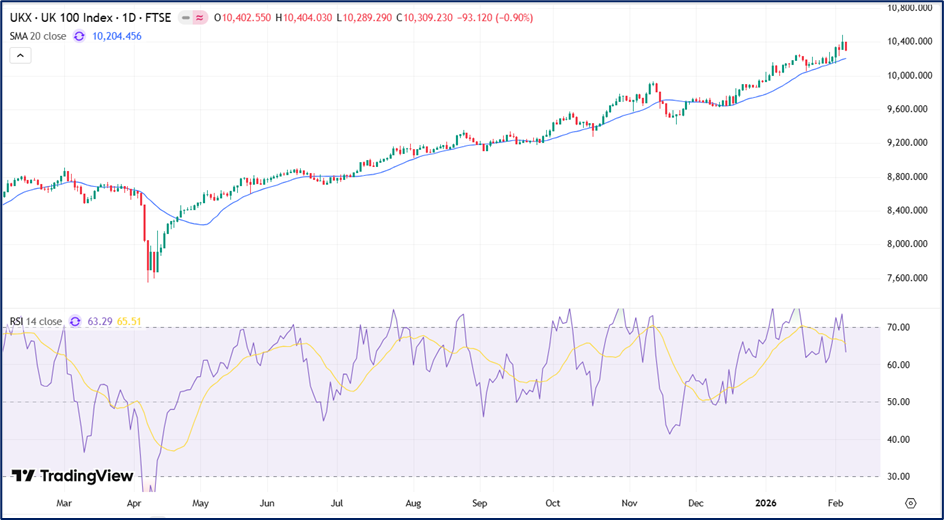
On Thursday, 5 February 2026, the UK’s benchmark FTSE 100 closed 0.90% lower at 10,309.22, snapping a short winning streak after flirting with all-time highs earlier in the week.
The index experienced heightened intraday volatility, trading between 10,289 and 10,404, as investors locked in profits, repositioned portfolios, and reacted to fresh signals from policymakers and global macro trends.
This decline was not panic-driven. Instead, it reflected a classic late-cycle pullback: profit-taking near highs, sector rotation away from crowded defensives, and renewed sensitivity to central bank guidance.
Key Reasons Behind the FTSE 100 Sell-Off on 5 Feb 2026
Source: Kalkine Group
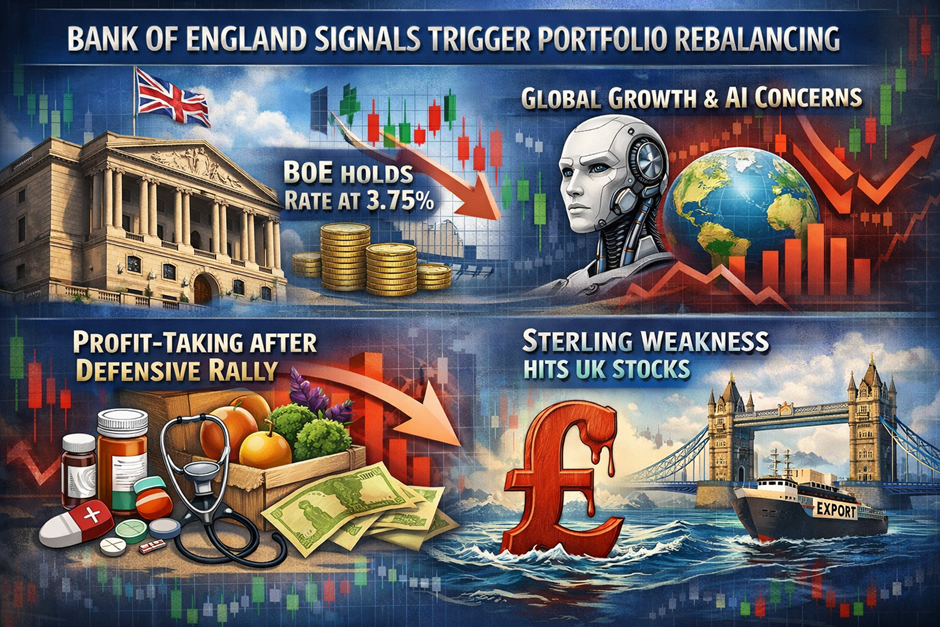
Bank of England Signals Trigger Portfolio Rebalancing
The Bank of England left interest rates unchanged at 3.75%, but its increasingly dovish tone—hinting at potential future rate cuts—prompted investors to reassess risk exposure. While rate cuts are supportive long term, near-term uncertainty encouraged caution.
Global Growth & AI-Related Concerns Resurface
Soft international economic data and renewed debate around AI-led disruption weighed on sentiment, particularly in cyclical and growth-linked segments of the UK market.
Profit-Taking After a Defensive Rally
Healthcare, staples, and low-volatility stocks had outperformed earlier in the week. On 5 February, investors banked gains, leading to a temporary unwind of defensive positioning.
Sterling Weakness Pressures Domestic Stocks
A softer pound following BoE commentary added pressure to UK-focused businesses, even as exporters found partial relief.
Sector Performance: Winners vs Losers on 5 February 2026
Sectors Ending Higher
- Healthcare & Defensives:
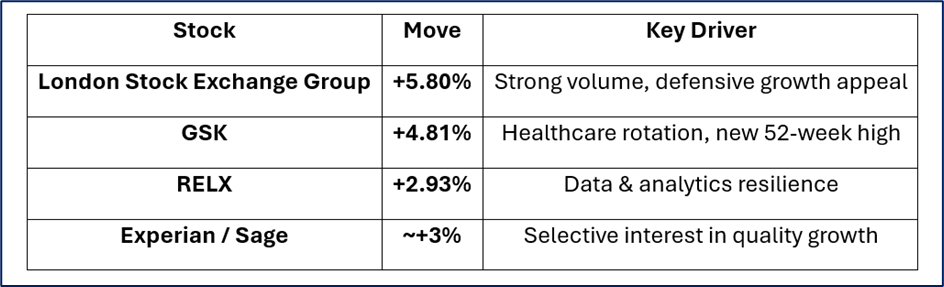
GSK surged, benefiting from safe-haven demand and fresh momentum. - Financial Infrastructure & Data:
London Stock Exchange Group stood out as investors favoured high-quality, fee-based earnings.
Sectors Under Pressure
- Banking:
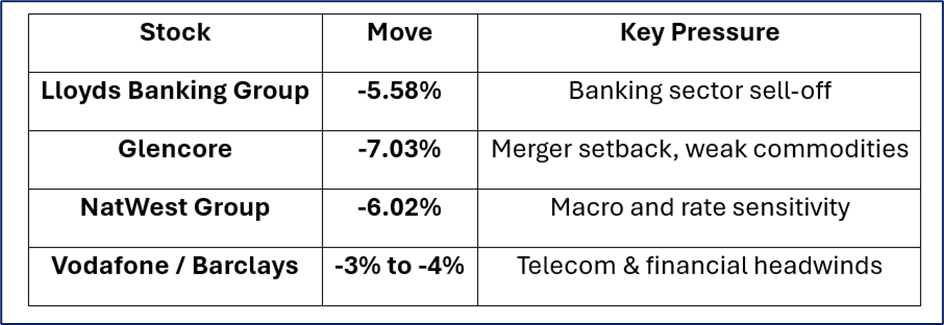
Concerns over net interest margins and economic growth weighed heavily on lenders. - Energy & Mining:
Falling commodity prices and deal-related uncertainty hit heavyweight constituents.
Top FTSE 100 Gainers on 5 Feb 2026
Source: Market Data
Biggest FTSE 100 Losers on the Day
Source: Market Data
Broader Market Dynamics Shaping UK Equities
Macro & Economy
- UK inflation continues to cool faster than expected
- Monetary policy remains restrictive but increasingly flexible
- Growth outlook is cautious rather than recessionary
Currencies
- Pound weakens versus the US dollar
- FX volatility impacts domestic earnings visibility
Cross-Asset Trends
- Equities: Rotation toward earnings visibility and balance-sheet strength
- Commodities: Energy and metals underperform
- Bonds: Yields remain highly reactive to central bank messaging
FTSE 100 Outlook: What Should Investors Watch Next?
Short Term (Days–Weeks)
- Expect continued volatility as markets digest policy signals and earnings updates
- Strong resistance near record highs, with range-bound trading likely
Medium Term (Months)
- Direction depends on inflation data, wage growth, and earnings momentum
- Defensive, dividend-paying stocks may outperform
Long Term (12 Months+)
- Bullish if global growth stabilises and earnings expand
- Downside risk if rates stay higher for longer or global demand weakens
FTSE 100 Bull vs Bear Scenarios
Bull Case
- Earnings resilience in banks and healthcare
- Supportive central bank signalling
- Continued demand for defensive income stocks
Bear Case
- Prolonged high interest rates
- Weak commodity pricing
- Global growth slowdown hitting cyclicals
Analyst Sentiment & Market Expectations (Latest – Feb 2026)
- Analysts broadly expect ongoing sector rotation rather than a full market reversal
- Broker outlooks remain cautious on banks and energy, constructive on healthcare and data-led businesses
Technical Analysis Snapshot (As of 5 Feb 2026)
Source: Trading View
- FTSE 100 showing consolidation after near-record highs
- Support holding, but momentum indicators suggest near-term caution
- Pullbacks increasingly viewed as selective buying opportunities
FTSE 100 FAQ – Investors’ Top Questions
Why did the FTSE 100 fall on 5 February 2026?
Profit-taking near highs, dovish BoE signals, and mixed sector performance drove the decline.
Which stocks outperformed despite the sell-off?
GSK and London Stock Exchange Group led gains.
Is the UK market signalling recession risk?
Not clearly. Current moves reflect rotation and caution, not systemic stress.
Which sectors look most attractive now?
Healthcare, selective financials, and defensive income stocks.
Final Takeaway: What the 5 Feb 2026 FTSE 100 Drop Really Means
The FTSE 100’s pullback to 10,309 on 5 February 2026 looks less like a trend reversal and more like a healthy pause after strong gains. Defensive stocks held up well, while banks and commodities bore the brunt of risk reduction.
For investors, the message is clear: volatility is back, selectivity matters, and sector rotation—not outright risk-off—is driving UK equities. Staying diversified and focused on earnings quality remains key as markets navigate the next phase of the cycle.


 Jun 29, 2026




 Please wait processing your request...