
 AU
AU
 CA
CA
 US
US
 NZ
NZ
 IND
IND

 UK
UK

 Share
Share
 X (Formerly Twitter)
 Whatsapp
 Facebook
 LinkedIn
 Telegram
 Email This Article
 Copy Link
 Summarize with AI
 Chat GPT
 Perplexity
Key Takeaways – FTSE 100 Market Snapshot (3 February 2026)
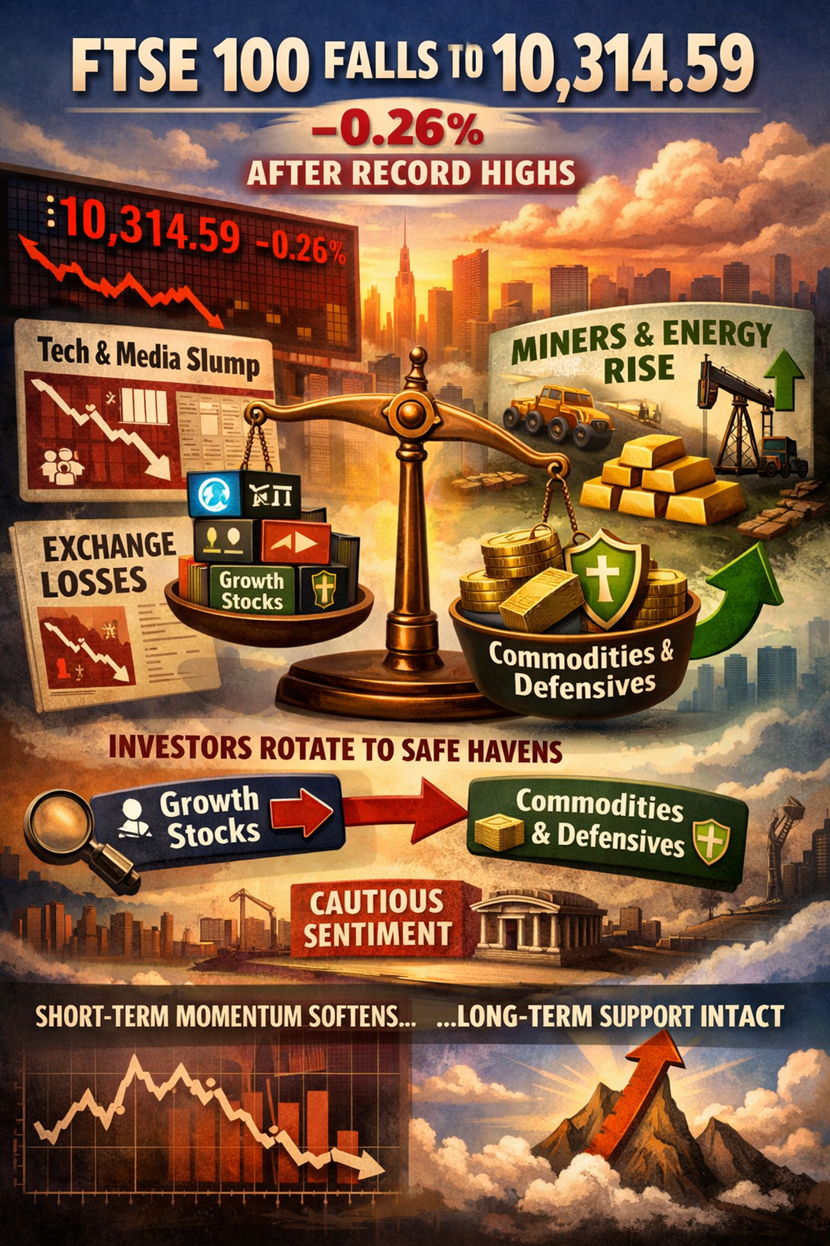
- The FTSE 100 Index closed at 10,314.59, down –0.26%, snapping a short winning streak after testing fresh record highs
- Heavy losses in technology, media, and exchange-related stocks outweighed strong gains in miners and energy
- Investors rotated toward commodities and defensives, while trimming exposure to growth-sensitive names
- Market sentiment remained cautious ahead of macro data and central-bank clarity
- Short-term momentum softened, but medium- and long-term structural support remains intact
Source: Kalkine Group
Why Did the FTSE 100 End in the Red on 3 February 2026?
The FTSE 100 slipped modestly on Tuesday, giving up early gains as investors locked in profits following the index’s recent rally to record territory. While commodity-linked stocks surged, sharp sell-offs in heavyweight technology, data, and media companies dragged the benchmark lower.
Concerns around earnings sustainability, AI-driven business disruption, and slowing global growth expectations led to aggressive selling in select growth names. At the same time, risk appetite cooled amid uncertainty over the Bank of England’s policy outlook and broader global monetary conditions.
The result was a classic sector rotation session rather than broad-based panic selling.
Which FTSE 100 Sectors Finished in Green and Red Today?
Which Sectors Outperformed the FTSE 100?
Basic Resources & Mining
- Strongest performing segment of the day
- Benefited from higher gold, copper, and base-metal prices
- Investors increased exposure to inflation-hedged and real-asset plays
Energy
- Supported by steady oil prices and supply-side discipline
- Defensive characteristics attracted capital during risk-off trading
Select Defensives
- Aerospace, tobacco, and consumer staples provided relative stability
Which Sectors Dragged the FTSE 100 Lower?
Technology & Software
- Sharp declines driven by earnings anxiety and AI-related disruption fears
Investment Services & Exchanges
- Lower trading volumes and profit-margin concerns hit sentiment
Media & Advertising
- Weak outlook for global advertising spend weighed heavily
Which FTSE 100 Stocks Were the Top Gainers on 3 February 2026?
Top Gainers and Key Reasons
- Anglo American – surged as metal prices rebounded and demand expectations improved
- Fresnillo – rallied alongside rising precious-metal prices
- Antofagasta – benefited from copper strength and commodity inflows
- Rio Tinto – advanced on renewed optimism for the mining cycle
- Endeavour Mining – gained on gold price momentum
Why These Stocks Rose:
The rally reflected renewed confidence in hard-asset exposure, inflation protection, and China-linked commodity demand recovery.
Which FTSE 100 Stocks Were the Biggest Losers Today?
Top Losers and Key Reasons
- RELX – plunged amid concerns that AI-driven automation could pressure its long-term pricing power
- London Stock Exchange Group – fell on worries about slower trading activity and margin compression
- WPP – slumped after renewed fears over advertising budgets and global economic slowdown
- Sage Group – declined as software valuations came under pressure
- Intermediate Capital Group – weakened on risk-off sentiment in alternative assets
Why These Stocks Fell:
Investors aggressively reduced exposure to growth-dependent, valuation-sensitive sectors, favoring balance-sheet strength and tangible assets instead.
What Does the FTSE 100’s Technical Picture Look Like Right Now?
Source: Trading View
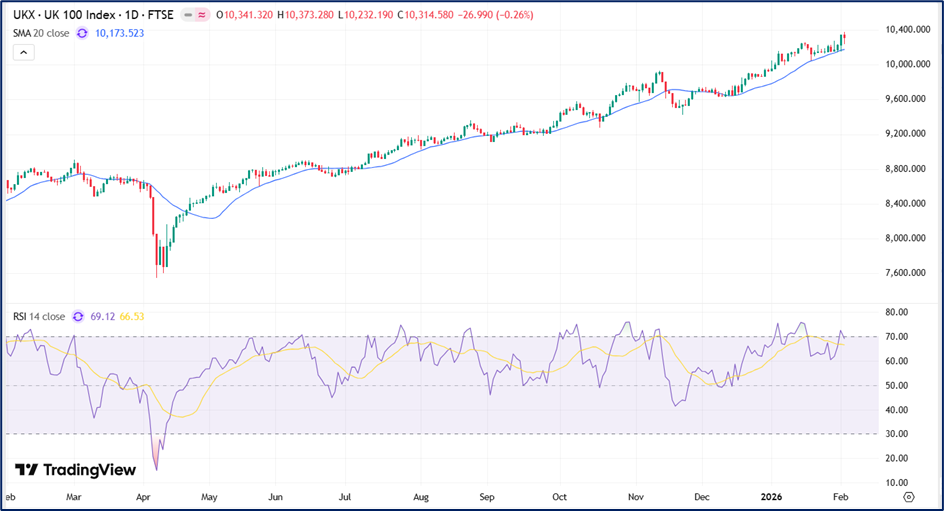
- The index failed to hold above the 10,370–10,380 resistance zone
- Immediate support sits around 10,200–10,250, a key consolidation area
- Momentum indicators suggest cooling but not breakdown
- Trend structure remains constructive above medium-term moving averages
Technical takeaway: This looks like healthy consolidation, not trend reversal.
What Are the Current Market Dynamics Across Assets and Currencies?
UK Economy
- Inflation remains elevated but is gradually easing
- Labour market stability supports consumer resilience
- Rate-cut expectations remain cautious rather than aggressive
Currencies
- GBP traded in a tight range as rate expectations stabilize
- Export-heavy FTSE constituents remain currency-resilient
Commodities
- Gold and base metals attracted defensive and speculative inflows
- Energy prices provided earnings visibility for oil majors
Bonds
- Yields stable but sensitive to inflation surprises and central-bank rhetoric
What Are Analysts and Brokers Saying About the FTSE 100?
- Valuation remains attractive relative to global peers
- Dividend yield continues to support long-term inflows
- Commodity exposure and international earnings provide insulation
- Upside potential highlighted toward 10,700–10,800 if earnings stabilize
Analysts broadly describe the FTSE 100 as structurally defensive with cyclical upside optionality.
What Is the FTSE 100 Outlook in the Short, Medium, and Long Term?
Short-Term Outlook (Weeks)
- Elevated volatility likely
- Sector rotation to continue
- Traders watching 10,200 support closely
Medium-Term Outlook (3–6 Months)
- Range-bound but constructive
- Commodities, energy, and financials may lead
- Earnings revisions will be key
Long-Term Outlook (12 Months+)
- Strong dividend appeal
- International revenue exposure remains a tailwind
- Potential beneficiary of global value rotation
FTSE 100 Scenario Analysis: Bull vs Bear Case
Bull Case
- Inflation moderates faster than expected
- Central banks signal policy flexibility
- Earnings resilience drives index beyond 10,700
Bear Case
- Inflation re-accelerates
- Growth slowdown intensifies
- Risk-off flows push index toward 9,800–9,900
What Strategies Should Investors Consider Right Now?
Short-Term Strategy
- Tactical trading around earnings and macro data
- Focus on volatility management
Medium-Term Strategy
- Sector diversification with emphasis on value and income
- Balanced exposure between defensives and cyclicals
Long-Term Strategy
- Prioritize dividend sustainability
- Focus on companies with global revenue and strong cash flows
FTSE 100 FAQ
Why did the FTSE 100 fall today?
Profit-taking in tech and media stocks outweighed strong gains in miners and energy.
Which sectors performed best?
Basic resources, mining, and energy led the market.
Is the FTSE 100 trend still bullish?
Yes — structurally bullish, but consolidating in the short term.
Final Verdict: What Does Today’s FTSE 100 Move Really Mean?
The –0.26% decline on 3 February 2026 was not a sign of market stress, but rather a controlled reset following record highs. Beneath the headline weakness, sector leadership rotated decisively toward commodities and defensives — a sign that investors are positioning strategically rather than exiting the market.
As macro uncertainty persists, the FTSE 100 continues to offer a unique blend of income, value, and global exposure, keeping it firmly on investors’ radar across all time horizons.


 Jun 03, 2026




 Please wait processing your request...