
 CA
 NZ
 US
 AU
 IND

 UK

 Share
 X (Formerly Twitter)
 Whatsapp
 Facebook
 LinkedIn
 Telegram
 Email This Article
 Copy Link
 Summarize with AI
 Chat GPT
 Perplexity

Key Takeaways
- The fallout from controversial remarks tied to Grenfell highlights the deep political sensitivity around building safety in the UK
- Post-Grenfell regulations, including the Building Safety Act 2022, have significantly reshaped construction and development timelines
- The UK housing crisis remains severe, with supply far below demand, worsening affordability and inequality
- Deregulatory arguments—championed by figures linked to Nigel Farage—are gaining traction but face strong moral and political resistance
- The central policy dilemma: build faster vs build safer
- Political reality shows that emotion, memory, and public trust outweigh purely economic arguments
- The path forward requires smart regulation reform—not removal
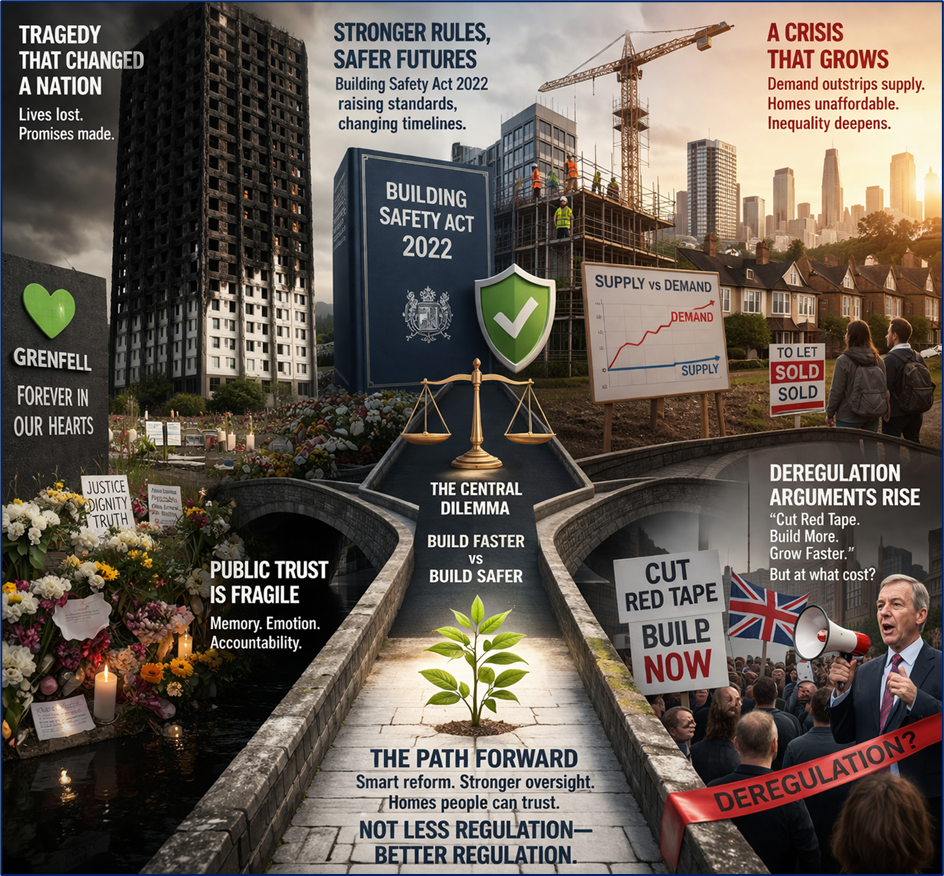
Source: Kalkine Group
Introduction: A Political Flashpoint That Exposes a National Crisis
In April 2026, a political controversy erupted in Westminster that quickly transcended partisan debate and exposed something far deeper: the unresolved tension at the heart of British housing policy.
When comments perceived as dismissive of the Grenfell tragedy triggered outrage across the political spectrum—including condemnation from Keir Starmer and Sadiq Khan—the incident became more than a communications failure. It became a lens through which we can examine one of the most difficult policy trade-offs facing modern Britain.
At its core, this debate is not about one politician or one remark. It is about a fundamental question:
Can the UK build enough homes without compromising safety—and at what cost?
The Shadow of Grenfell: Why This Debate Is Different
The Grenfell Tower fire in 2017 was not just a tragedy—it was a systemic failure.
Seventy-two lives were lost in a disaster that official inquiries later determined was entirely avoidable. The causes were not random or inevitable. They were rooted in:
- Regulatory gaps
- Corporate misconduct
- Ignored warnings
- Weak enforcement
This matters because it fundamentally changes the nature of the policy debate.
Unlike other regulatory discussions driven by efficiency or cost, Grenfell carries moral weight. It represents:
- Institutional failure
- Social inequality
- Neglect of vulnerable communities
Any attempt to question post-Grenfell regulations is therefore not treated as a technical adjustment—it is perceived as a challenge to justice and accountability.
The Regulatory Overhaul: Safety Comes First
The UK responded with sweeping reforms, most notably the Building Safety Act 2022.
Key elements include:
- Strict oversight of high-rise residential buildings
- A three-stage approval system (planning, construction, occupation)
- The “golden thread” of safety data across a building’s lifecycle
- Bans on combustible materials
- Mandatory sprinkler systems and evacuation infrastructure
These changes were designed to ensure “never again.”
But they also introduced significant friction into the housing system.
The Hidden Cost of Safety: Delays, Backlogs, and Rising Prices
While safety improvements are widely supported, their implementation has created real-world challenges:
- Thousands of housing units delayed due to regulatory approvals
- Backlogs stretching months—sometimes over a year
- Rising construction costs due to compliance requirements
- Additional taxes and levies on developers
The result?
Fewer homes being built at a time when the UK desperately needs more.
This is where the debate becomes economically critical.
Britain’s Housing Crisis: A System Under Strain
The UK is not just facing a housing shortage—it is facing a structural crisis.
Key realities:
- Government target: 300,000 homes/year
- Actual output: often below 200,000
- First-time buyers increasingly priced out
- Rents rising sharply
- Homelessness and overcrowding increasing
Demand continues to surge due to:
- Population growth
- Migration
- Urban concentration
Meanwhile, supply is constrained by:
- Planning restrictions
- Labour shortages
- High interest rates
- Regulatory complexity
This creates a dangerous feedback loop:
Less supply → higher prices → more inequality → greater political pressure
The Deregulation Argument: Efficiency vs Reality
Political movements like Reform UK argue that overregulation is choking supply.
Their position is built on several claims:
- Regulations have gone beyond necessity
- Development has become economically unviable
- Bureaucracy is delaying urgently needed housing
- Costs are ultimately passed on to buyers
There is truth in these arguments.
Even major developers have signaled concern, citing:
- Reduced returns on investment
- Hesitation to acquire land
- Slowing pipeline activity
But the argument has a critical flaw:
It underestimates the political and moral constraints created by Grenfell.
Why Deregulation Hits a Political Wall
In theory, deregulation can boost supply.
In practice, in the UK context, it faces three major barriers:
- Moral Memory
Grenfell is still recent. Survivors, families, and the public demand accountability—not rollback.
- Public Trust
Reducing safety measures risks eroding already fragile trust in institutions.
- Political Risk
No government wants to be associated with weakening safety after a national tragedy.
This is why even strong deregulatory voices often retreat when confronted with the emotional reality of Grenfell.
The Real Problem: A False Binary
The current debate is often framed incorrectly as:
- Safety vs Supply
- Regulation vs Growth
But this is a false binary.
The real issue is not whether regulation exists—but how it functions.
Key inefficiencies include:
- Slow, manual approval processes
- Lack of regulatory capacity
- Overlapping compliance requirements
- Poor coordination between agencies
These are design problems—not moral ones.
The Political Economy of Housing: Hard Trade-Offs
Housing policy sits at the intersection of:
- Economics
- Politics
- Ethics
And this creates unavoidable trade-offs:
- Faster approvals vs thorough checks
- Lower costs vs higher safety standards
- Developer incentives vs public protection
These trade-offs cannot be eliminated—they can only be managed intelligently.
Lessons from the Controversy
The recent political fallout highlights several important lessons:
- Tone Matters as Much as Policy
Even valid economic arguments can fail if framed insensitively.
- Public Memory Shapes Policy Boundaries
Grenfell defines what is politically acceptable.
- Populism Has Limits
Anti-regulation rhetoric must adapt to emotionally charged issues.
- Housing Policy Requires Nuance
Simplistic solutions—either extreme regulation or deregulation—are inadequate.
The Path Forward: Smarter, Not Softer Regulation
The UK does not need less safety—it needs better systems.
Potential solutions include:
- Streamlining Approvals
Digitising processes and reducing administrative bottlenecks
- Increasing Regulatory Capacity
More resources for faster, high-quality decision-making
- Risk-Based Regulation
Focusing scrutiny where it matters most rather than applying blanket rules
- Aligning Incentives
Ensuring developers can build safely and profitably
- Stakeholder Inclusion
Involving residents and survivors in policy design
Conclusion: The Balance Between Memory and Momentum
The clash between deregulation and safety in Britain is not going away.
It reflects a deeper truth:
Modern societies must build for the future without forgetting the past.
Grenfell is not just a historical event—it is a moral anchor in public policy. It ensures that efficiency cannot override human life.
At the same time, the housing crisis is real and urgent. Failing to build enough homes creates its own form of social harm—one that affects millions.
The challenge, therefore, is not choosing one over the other.
It is building a system that:
- Delivers homes at scale
- Maintains uncompromising safety
- Operates efficiently and transparently
This requires:
- Political maturity
- Institutional reform
- Public trust
The lesson from recent events is clear:
Careless rhetoric can derail serious policy debate—but the underlying issues remain unresolved.
Britain stands at a crossroads where policy must evolve beyond ideology, and where the true test of leadership is not choosing sides—but designing solutions that respect both.


 Nov 24, 2026





 Please wait processing your request...