
 AU
AU
 CA
CA
 US
US
 NZ
NZ
 IND
IND

 UK
UK

 Share
Share
 X (Formerly Twitter)
 Whatsapp
 Facebook
 LinkedIn
 Telegram
 Email This Article
 Copy Link
 Summarize with AI
 Chat GPT
 Perplexity
BP stock is attracting investor attention thanks to strong cash flow, dividends, and energy transition investments. Here’s whether it’s a buy now.
What Are the Key Takeaways for BP Investors in February 2026?
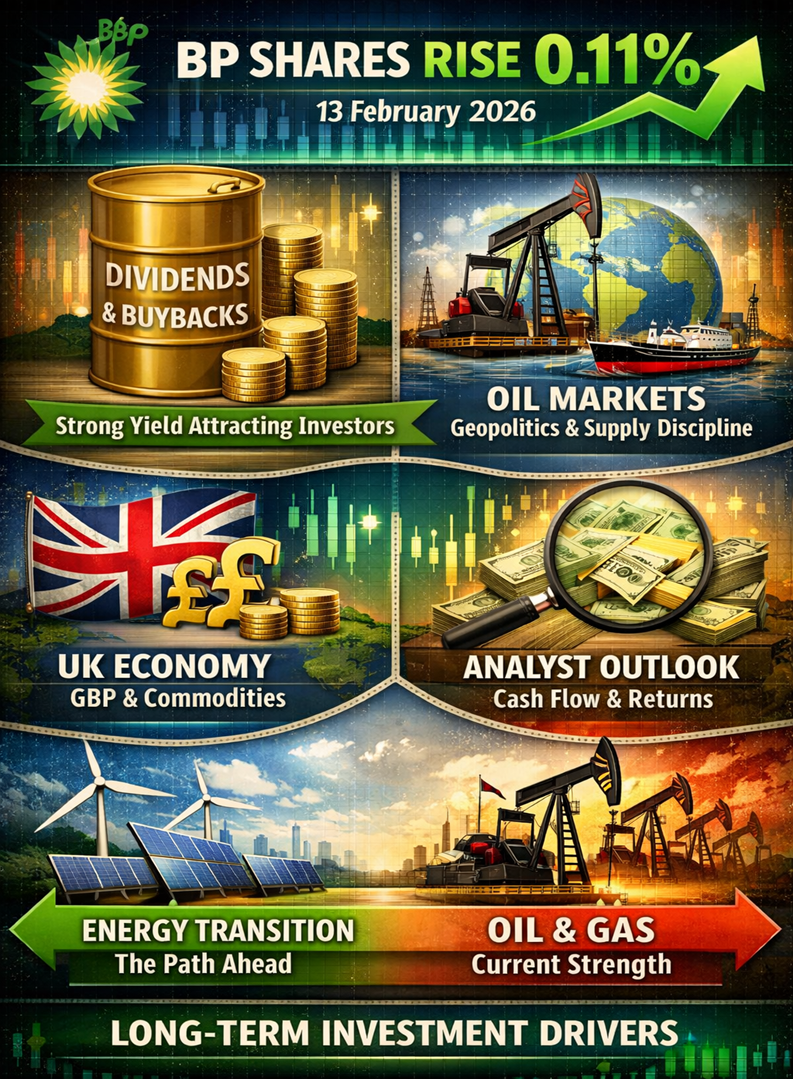
- BP share price increased around 0.11% on 13 February 2026 amid resilient oil prices and positive global energy sector sentiment
- Strong dividend yield and ongoing share buybacks continue attracting income investors searching for FTSE 100 dividend stocks
- Global oil supply discipline, geopolitical uncertainty, and stable demand trends support earnings outlook
- UK macroeconomic stabilisation and GBP currency movements are influencing investor flows into commodity-linked equities
- Analysts maintain balanced but constructive long-term views driven by free cash flow strength and capital returns
- Energy transition execution remains the most important long-term valuation driver
Source: Kalkine Group
Why Is BP Stock Trending Globally Among FTSE 100 Investors in February 2026?
BP stock, FTSE 100 energy stocks, oil and gas dividend shares, passive income investments, high dividend yield UK stocks, commodity stocks, and inflation hedge investments are among the most searched global investment themes in February 2026. Investors are actively analysing whether BP shares represent a compelling opportunity as oil prices remain stable, interest rate expectations shift, and equity markets experience volatility.
The modest upward movement in BP’s share price reflects improving sentiment across the global energy sector. Oil markets remain supported by supply discipline from major producers, geopolitical uncertainty, and recovering demand in Asia and emerging economies. Integrated oil majors like BP continue to benefit from strong free cash flow generation, capital discipline, and shareholder-friendly strategies including dividends and share buybacks.
From an investor psychology and search-trend perspective, BP remains one of the most widely discussed UK blue-chip stocks because it combines income yield, commodity exposure, defensive characteristics during inflationary periods, and long-term strategic transition potential.
How Are Global Market Dynamics Supporting Oil and Energy Stocks in 2026?
The global macroeconomic environment entering 2026 contains several supportive factors for energy equities:
- Inflation moderating across developed economies
- Expectations of monetary easing later in 2026
- Persistent geopolitical risks affecting supply chains
- Structural demand growth from emerging markets
- Capital discipline among global oil producers
Oil prices remain relatively firm because global supply growth has been constrained following years of underinvestment. This environment benefits companies like BP through stronger upstream margins and resilient downstream profitability.
Energy equities are increasingly viewed by institutional investors as:
- Dividend income alternatives to bonds
- Inflation protection assets
- Cash-flow-generating defensive exposures
How Are the UK Economy, FTSE 100, FTSE 250, and GBP Influencing BP Shares?
The UK economic environment in early 2026 shows gradual stabilisation:
- Moderate economic growth trajectory
- Cooling inflation pressures
- Potential interest rate reductions later in the year
- Currency volatility against the US dollar
BP benefits from several structural advantages:
- Oil revenues are primarily dollar-denominated, so weaker GBP can support earnings translation
- FTSE 100 index weighting toward commodities supports energy sector valuations
- International revenue exposure makes BP less sensitive to domestic UK conditions compared with FTSE 250 companies
The FTSE 100 has shown relative resilience compared with some European markets due to its commodity exposure, indirectly supporting BP share performance.
What Are the Latest Company Drivers Supporting BP’s Share Performance?
Key business drivers include:
- Strong operating cash flow from upstream production
- Continued shareholder returns through dividends and buybacks
- Cost discipline and operational efficiency programmes
- Portfolio optimisation and asset sales
- Investment in low-carbon and transition energy projects
BP operates a diversified integrated business model including exploration and production, refining, marketing, trading operations, and renewable energy investments. The company continues balancing near-term hydrocarbon profitability with long-term energy transition ambitions according to recent corporate updates.
How Does BP Compare With Global Energy Peers?
Compared with major international energy companies:
Strengths:
- Competitive dividend yield
- Integrated global operations
- Strong trading business
- Scale and diversified revenue streams
Challenges:
- Investor uncertainty regarding energy transition pace
- Commodity price exposure
- Competition from US energy majors with higher production growth
Overall, BP remains competitively positioned within the global integrated energy sector.
What Is the Dividend Outlook for BP Investors?
Dividend sustainability remains one of the most attractive aspects of BP stock:
- Yield remains above many FTSE 100 sectors
- Free cash flow coverage appears solid at current oil prices
- Share buybacks enhance total shareholder returns
- Capital discipline has improved significantly compared with previous cycles
Income-focused investors continue to view BP as a core dividend holding within energy portfolios.
What Is the Sector Outlook for Oil and Gas Stocks Across Time Horizons?
Short-term outlook:
- Oil price stability supports earnings
- Potential volatility from geopolitical developments
Medium-term outlook:
- Continued global demand growth
- Expansion of transition investments
Long-term outlook:
- Structural uncertainty due to decarbonisation policies
- Continued reliance on hydrocarbons during the energy transition
What Strategies Could Investors Consider Across Different Time Horizons?
Short-term strategies:
- Monitor oil price momentum and macroeconomic news
- Track earnings releases and shareholder return announcements
- Consider volatility-driven opportunities
Medium-term strategies:
- Dividend reinvestment for compounding returns
- Sector diversification across energy companies
- Monitoring capital allocation discipline
Long-term strategies:
- Evaluate energy transition execution
- Focus on free cash flow sustainability
- Maintain diversified exposure to commodity cycles
Is BP Stock Bullish, Bearish, or Neutral Right Now?
Short-term view: Neutral with mild bullish bias
- Oil prices supportive but lacking major catalysts
- Macro uncertainty remains elevated
- Range-bound trading possible
Long-term view: Moderately bullish with structural risks
- Strong cash generation potential
- Attractive dividend profile
- Energy transition execution uncertainty
This analysis is informational and not financial advice.
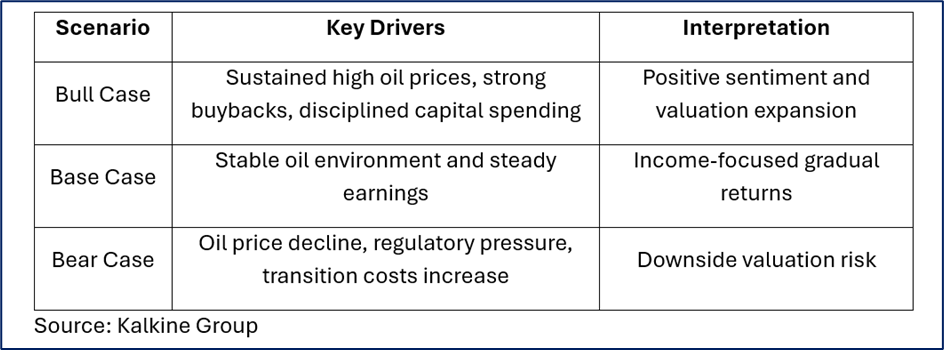
What Does the Bull and Bear Scenario Matrix Show for BP Stock?
What Are Analysts and Brokers Saying About BP Shares?
Major institutional perspectives indicate balanced optimism:
- Barclays highlights long-term cash flow potential
- Goldman Sachs views energy sector as relatively attractive
- JP Morgan emphasises shareholder return strength
- Morgan Stanley focuses on transition execution risk
Consensus suggests income appeal with moderate growth expectations rather than high-growth momentum.
What Are the Key Risks Investors Should Consider?
Major investment risks include:
- Oil price volatility
- Regulatory and climate policy changes
- Transition investment execution risk
- Currency fluctuations
- Global economic slowdown
What Are the Most Common Investor Questions About BP Stock in 2026?
Investors frequently ask why BP stock is rising, whether it remains a good dividend investment, and what factors could influence future performance. The main drivers currently include oil prices, global demand, capital discipline, and shareholder returns. Many investors also question whether interest rate cuts could boost dividend stocks like BP, and whether the company’s transition strategy will create long-term value.
BP is generally viewed as attractive for income investors due to its dividend yield and strong cash flow generation, although performance remains closely tied to commodity markets.
What Is the Final Investment Conclusion for Investors Considering BP Shares?
BP remains one of the most globally recognised FTSE 100 energy companies offering a compelling combination of dividend income, commodity exposure, and strategic transformation potential. The company’s ability to generate strong free cash flow during supportive oil price environments positions it as an attractive option for investors seeking inflation-resilient assets and passive income opportunities.
However, long-term valuation will depend heavily on energy transition execution, capital discipline, and macroeconomic commodity cycles. Investors comfortable with cyclical sectors and energy market volatility may find BP an interesting consideration within a diversified portfolio.


 Jun 17, 2026




 Please wait processing your request...