
 AU
AU
 CA
CA
 US
US
 NZ
NZ
 IND
IND

 UK
UK

 Share
Share
 X (Formerly Twitter)
 Whatsapp
 Facebook
 LinkedIn
 Telegram
 Email This Article
 Copy Link
 Summarize with AI
 Chat GPT
 Perplexity
The "Yield Shield" Strikes Back: Unpacking the Year-End Rally
On December 31, 2025, while much of the FTSE 100 drifted sideways in low-volume holiday trading, British American Tobacco PLC (LSE: BATS) notched a gain of approximately 1%, closing the year near GBX 4,214. In a market obsessed with tech and growth, this "boring" giant’s quiet ascent wasn't an accident—it was a calculated rotation.
As portfolio managers closed their books for 2025, BATS became the target of a classic "flight to safety." With global gilt yields fluctuating and 2026 economic forecasts turning cautious, smart money moved into the "Yield Shield"—stocks offering massive, inflation-beating dividends backed by recession-proof cash flows.
The 3 Hidden Drivers Behind the Move

Source: Kalkine Group
1. The £1.3 Billion Buyback Catalyst (The Dec 9th Aftershock)
The primary engine for this move was ignited weeks earlier but fully priced in by year-end. On December 9, 2025, BAT released its Pre-Close Trading Update, dropping a bombshell for shareholders: a reaffirmed commitment to a £1.3 billion share buyback program for FY26.
- Why it matters: In a flat market, a guaranteed buyer (the company itself) provides a "price floor." Investors bought in on Dec 31 to front-run the buyback execution expected to ramp up in January 2026.
2. "Velo" Velocity & The Smokeless Surprise
The narrative that "tobacco is dying" is outdated. The market is waking up to BAT’s massive success in Modern Oral (nicotine pouches). The December update confirmed that Velo is delivering double-digit revenue growth.
- The Pivot: Unlike cigarettes, which face secular volume decline, Velo has higher margins and lower regulatory friction. The market began pricing BAT not as a shrinking cigarette seller, but as a growing nicotine pouch platform.
3. The US Vape Enforcement "Windfall"
For years, BAT’s Vuse vape brand struggled against illegal, disposable Chinese vapes in the US. Late 2025 saw a pivot in US regulatory enforcement, with crackdowns on illicit disposables finally gaining traction. This clears the shelf space for compliant, big-player brands like Vuse, turning a major headwind into a 2026 tailwind.
Business Model 2025: "A Better Tomorrow" or Just Better Margins?
BAT has successfully mutated its business model. It is no longer just selling "cancer sticks"; it is selling nicotine delivery systems.
- The Cash Cow (Combustibles): Cigarettes (Lucky Strike, Dunhill) are managed for value, not volume. Prices are hiked aggressively (>5-8% annually) to offset volume declines of ~2-3%. This segment funds the transition.
- The Growth Engine (New Categories):
- Vapour (Vuse): Focus on profitability over blind market share.
- Heated Products (glo): Targeted rollout in Europe/Japan (glo Hilo launch).
- Modern Oral (Velo): The crown jewel. Extremely high margins, low manufacturing costs, and rapid adoption in Europe and the US.
The Goal: To become a predominantly "Smokeless" business by 2035. As of late 2025, they have already captured 29.1 million non-combustible consumers.
Financial Snapshot: The Numbers That Matter (Q4 2025 Context)
- Revenue Growth: Organic revenue growing at c. 2% (driven by price hikes).
- New Category Growth: Accelerating to double-digits in H2 2025.
- Leverage: Net Debt/EBITDA is dropping fast. On track for the 2.0x – 2.5x range by end of 2026. This deleveraging unlocks even more cash for dividends.
- Dividend Yield: A massive ~8.2%, covered comfortably by free cash flow.
SWOT Analysis
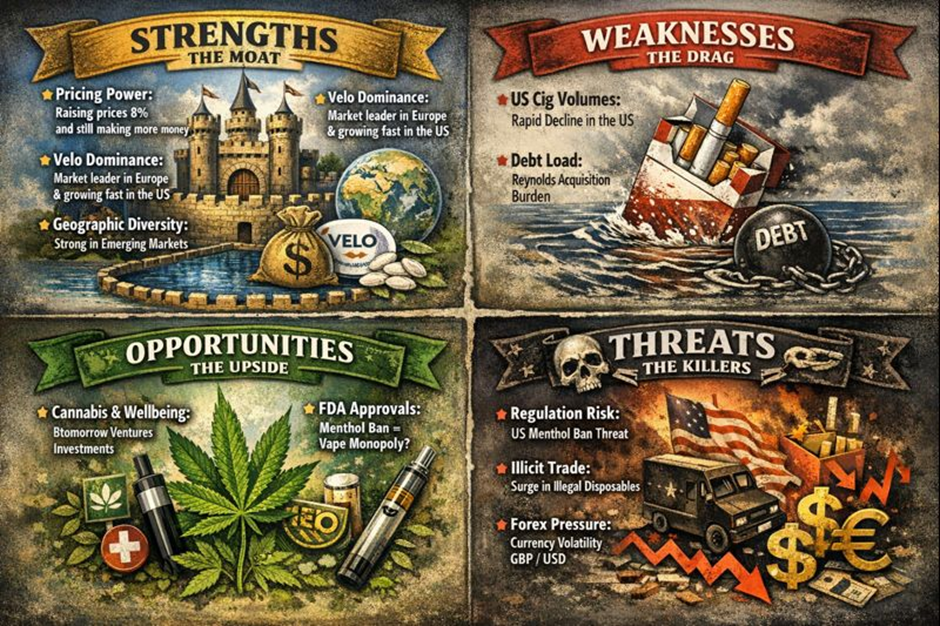
Source: Kalkine Group
Strengths (The Moat)
- Pricing Power: Few companies can raise prices 8% while losing customers and still make more money. BAT is one of them.
- Velo Dominance: Market leader in Europe and rapidly growing in the US (Velo Plus).
- Geographic Diversity: Huge footprint in emerging markets (AME region) which offsets slower western markets.
Weaknesses (The Drag)
- US Cigarette Volumes: The US market is shrinking faster than expected. Reliance on this specific cash pool is dangerous if the decline accelerates to >5%.
- Debt Load: While manageable, the debt from the Reynolds American acquisition still restricts "big bang" M&A moves.
Opportunities (The Upside)
- Cannabis & Beyond Nicotine: BAT has quietly invested in non-nicotine wellbeing (Btomorrow Ventures). Any legalization wave is a dormant call option.
- US FDA Authorizations: If the FDA aggressively bans competitor menthols but approves BAT’s PMTA (Premarket Tobacco Product Applications) for vapes, BAT wins a monopoly-lite status in compliant vapes.
Threats (The Killers)
- Regulatory Hammers: A potential US Menthol Ban (delayed but not dead) would wipe out a significant chunk of profit.
- Illicit Trade: If enforcement fails, illegal disposables will continue to eat Vuse’s lunch.
- Forex (FX): Earning in weak emerging market currencies but paying dividends in GBP/USD is a constant headwind.
Major Risks to Watch in 2026
- The "Menthol" Sword of Damocles: The US administration could reignite the ban on menthol cigarettes. This is the single biggest binary risk for the stock.
- Tax Shocks: Governments strapped for cash in 2026 (UK, France) view tobacco excise taxes as "free money." Sudden tax hikes could break the pricing elasticity model.
- Litigation: Canadian tobacco litigation settlements are mostly resolved, but US class actions remain a dormant volcano.
Conclusion: The "Boring" Winner
The ~1% rise on December 31, 2025, wasn't about excitement; it was about certainty. In a volatile world, BAT offered a 8%+ yield, a shrinking share count (buybacks), and a growing, high-margin nicotine pouch business.
Investors parked their cash here to sleep well into 2026. The stock remains a battleground between ethical decline (cigarettes) and pragmatic reinvention (smokeless), but for now, the cash flow argument is winning.


 Jun 29, 2026




 Please wait processing your request...