
 AU
AU
 CA
CA
 US
US
 NZ
NZ
 IND
IND

 UK
UK

 Share
Share
 X (Formerly Twitter)
 Whatsapp
 Facebook
 LinkedIn
 Telegram
 Email This Article
 Copy Link
 Summarize with AI
 Chat GPT
 Perplexity
The FTSE 100 surged 1.15% to a record 10,341 on 2 Feb 2026. Discover the key drivers, top gainers, sector moves, and outlook.
Key Takeaways – FTSE 100 Market Update (February 2026)
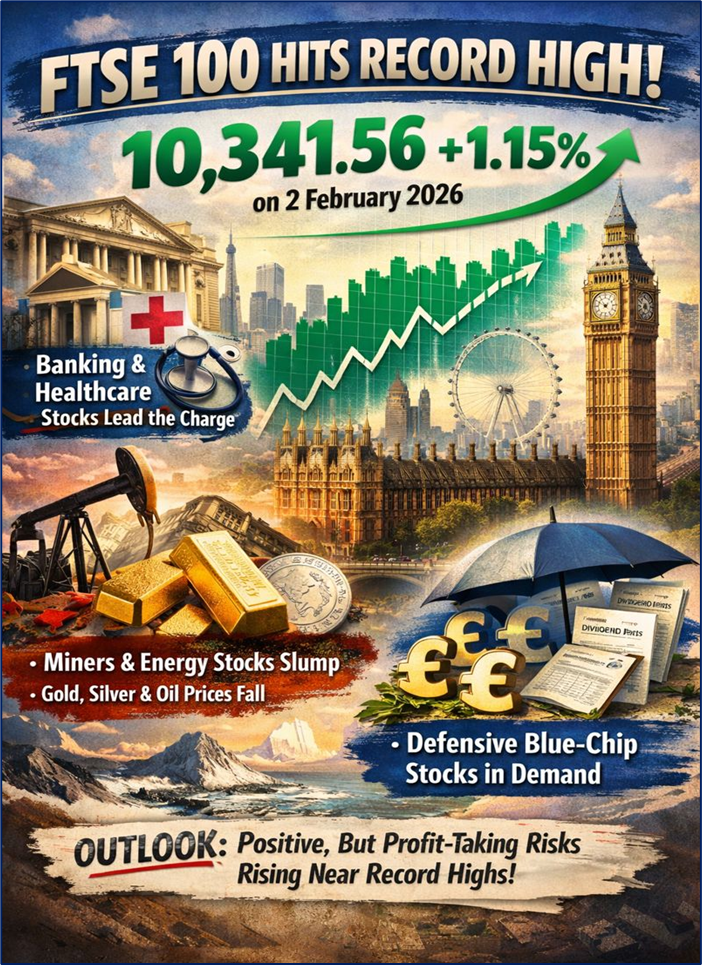
- The FTSE 100 Index surged +1.15% to 10,341.56 on 2 Feb 2026, marking a record all-time closing high
- Banking and healthcare stocks led the rally, driving broad-based gains across UK equities
- Precious metals miners and energy stocks underperformed, weighed down by falling gold, silver, and oil prices
- Investor positioning favoured defensive, income-oriented UK blue-chip stocks
- Outlook remains constructive, though near-term profit-taking risks are rising near record highs
Source: Kalkine Group
FTSE 100 Performance Summary – 2 February 2026
Source: Trading View
The UK benchmark FTSE 100 Index delivered a powerful upside breakout on 2 February 2026, closing up 118 points (+1.15%) at 10,341.56, its highest close on record, supported by strong volume and sector rotation.
Intraday snapshot:
- Open: ~10,223.7
- High: ~10,345.5
- Low: ~10,145.4
- Volume: ~938 million shares
- Daily Change: +118 points (+1.15%)
Momentum was driven by institutional inflows into UK banks, pharmaceuticals, and consumer defensives, offsetting weakness in commodity-linked names.
Which FTSE 100 Sectors Outperformed or Lagged on 2 Feb 2026?
Best-Performing FTSE 100 Sectors
- Financials: UK banks rallied strongly as risk sentiment improved and rate expectations stabilised
- Healthcare & Pharmaceuticals: Defensive demand lifted large-cap pharma stocks
- Retail & Consumer Staples: Investors rotated into cash-generative, resilient earnings plays
Underperforming Sectors
- Precious Metals & Miners: Gold and silver price declines triggered sharp equity sell-offs
- Energy: Lower oil prices pressured integrated oil majors
- Basic Materials: Follow-through weakness from metals markets
Top FTSE 100 Gainers on 2 February 2026 – What Drove the Rally?
Leading the upside charge were heavyweight index constituents:
- Barclays PLC – +2.75%, hitting fresh 52-week highs as banking stocks surged
- Tesco PLC – +1.46%, benefiting from defensive consumer positioning
- AstraZeneca – Outperformed on strong pharma sector momentum
Key drivers behind top gainers:
- Rotation into defensive and dividend-paying FTSE 100 stocks
- Strength in UK banking shares amid easing financial stress
- Demand for earnings visibility and balance-sheet quality
FTSE 100 Top Losers – Stocks That Dragged on the Index
Lagging stocks were concentrated in commodity-exposed sectors:
- Fresnillo – Slumped as silver prices weakened
- Endeavour Mining – Sold off sharply on falling gold prices
- Shell and BP – Declined amid oil price weakness
Why these stocks fell:
- Sharp gold and silver price declines
- Stronger US dollar pressuring commodities
- Reduced appetite for cyclical and resource-heavy equities
What Powered the FTSE 100’s Record Close? Key Market Drivers Explained
Several macro and market forces aligned to lift UK equities:
- Improved European equity risk sentiment
- Outperformance in banks and healthcare stocks
- Ongoing commodity sell-off, pushing investors toward defensives
- Anticipation of policy signals from the Bank of England and the Federal Reserve
Cross-Asset Market Snapshot – 2 Feb 2026
- Equities: UK and European markets higher, led by defensives
- Commodities: Gold, silver, and oil prices under pressure
- Currencies: US dollar strength redirected flows away from metals
- Bonds: Mixed yield movements ahead of central bank meetings
- Cryptocurrencies: Bitcoin weakness reinforced risk re-pricing
FTSE 100 Outlook: Short-, Medium- & Long-Term Scenarios
Short-Term Outlook (Days to Weeks)
- Potential resistance near record highs
- Profit-taking risk elevated
- Banks and defensives may continue to lead
Medium-Term Outlook (Months)
- Trend can extend if inflation, PMIs, and wage data cooperate
- Bank of England policy guidance remains critical
Long-Term Outlook (2026 and Beyond)
- Bullish structural case if earnings growth accelerates
- Bear risk if rates remain higher for longer or recession fears return
Scenario Analysis: Bull Case vs Bear Case for FTSE 100
Bull Case
- Strong earnings from banks and pharma
- Clear central-bank guidance toward easing
- Stabilising global growth
Bear Case
- Prolonged commodity weakness hits cyclicals
- Hawkish Fed keeps dollar elevated
- Geopolitical or macro shocks re-emerge
FTSE 100 Technical Overview (as of 2 Feb 2026)
- Index closed at all-time highs
- Short-term indicators approaching overbought levels
- Breakout continuation possible if momentum holds above 10,300
FTSE 100 Investment Strategies to Consider (Not Financial Advice)
Short-Term Traders
- Trade volatility around record resistance levels
- Focus on high-liquidity defensive stocks
Medium-Term Investors
- Balance cyclicals with defensives
- Rebalance portfolios around macro data
Long-Term Investors
- Emphasise diversification, dividends, and quality
- Use market pullbacks for phased accumulation
FTSE 100 FAQ
Why did the FTSE 100 rise +1.15% on 2 Feb 2026?
Strong gains in banks and healthcare stocks offset weakness in commodities.
Which FTSE 100 stocks led gains?
Barclays, Tesco, and AstraZeneca were among the top performers.
Which sectors underperformed?
Precious metals miners, energy, and basic materials lagged.
Is the FTSE 100 outlook still bullish?
Momentum remains positive, but short-term consolidation is possible near highs.
Final Takeaway: What the FTSE 100’s Record Close Really Signals
The FTSE 100’s +1.15% surge to 10,341.56 on 2 February 2026 reflects a decisive rotation into defensive and financial UK blue chips as investors navigate global uncertainty and commodity weakness. While new highs signal confidence, markets are entering a phase where selectivity, risk management, and sector allocation matter more than ever.


 Jun 03, 2026




 Please wait processing your request...