
 AU
AU
 CA
CA
 US
US
 NZ
NZ
 IND
IND

 UK
UK

 Share
Share
 X (Formerly Twitter)
 Whatsapp
 Facebook
 LinkedIn
 Telegram
 Email This Article
 Copy Link
 Summarize with AI
 Chat GPT
 Perplexity
The 8 January Catalyst: Why the Stock is Climbing
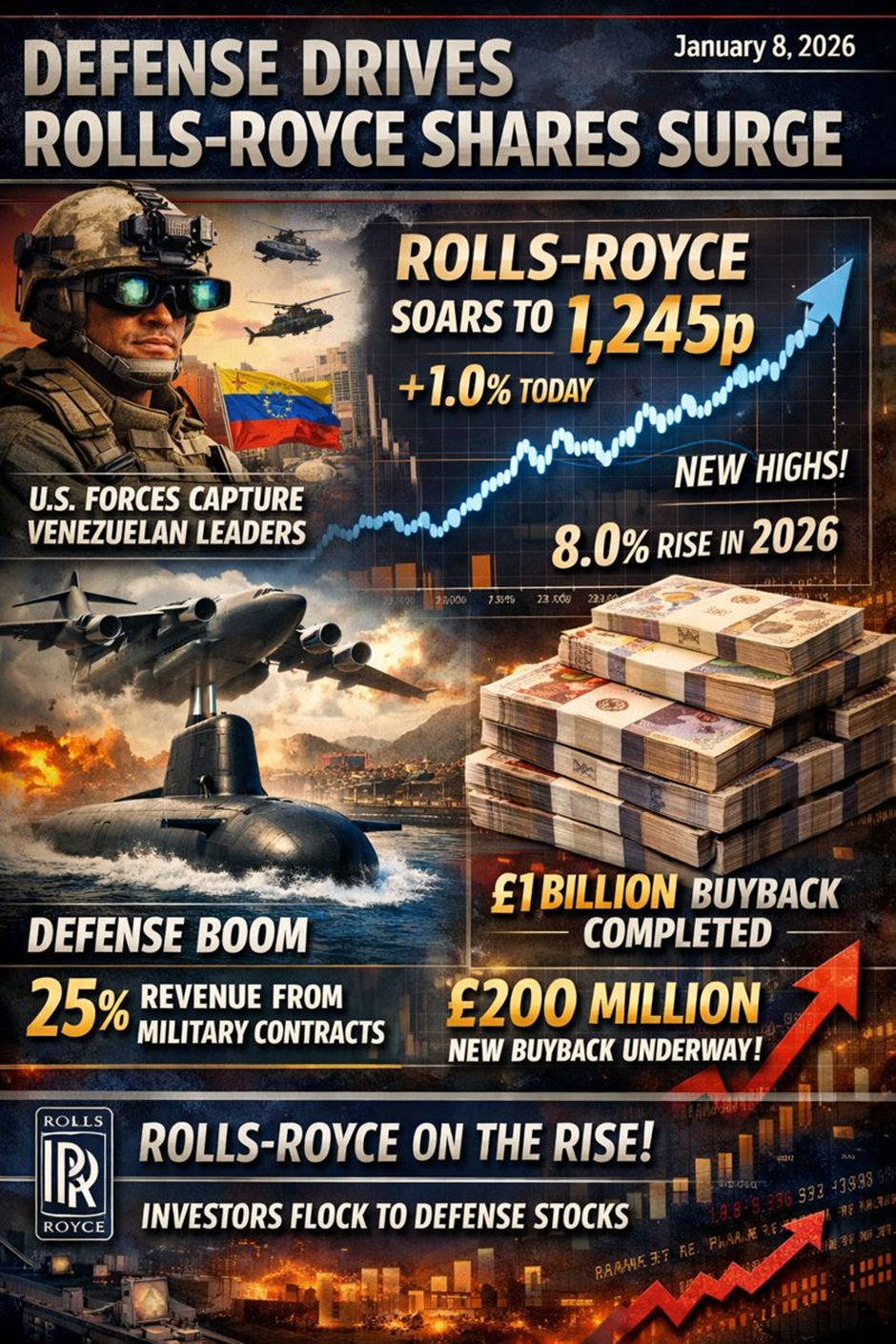
Rolls-Royce shares continued their relentless upward trajectory on 8 January 2026, gaining roughly 1% to trade near record levels around 1,245p. The immediate driver for today's price action is a significant "defense rotation" across European markets. Geopolitical shifts in South America—specifically the capture of political figures in Venezuela by US special forces—have triggered a sudden investor appetite for defense contractors.
With approximately 25% of its revenue derived from defense, including nuclear propulsion for submarines and engines for military transport, Rolls-Royce is being treated by the market as a primary defense play alongside BAE Systems.
Beyond the immediate headlines, the stock is benefiting from a "carry-over" effect from a stellar start to the year. In just the first week of 2026, the share price has climbed over 8%. This is underpinned by the completion of a £1 billion share buyback program and the commencement of a new £200 million interim buyback on 2 January, which provides a consistent floor for the stock price by reducing share supply.
Source: Kalkine Group
Current Technical Analysis: Bullish Momentum Meets Overbought Territory
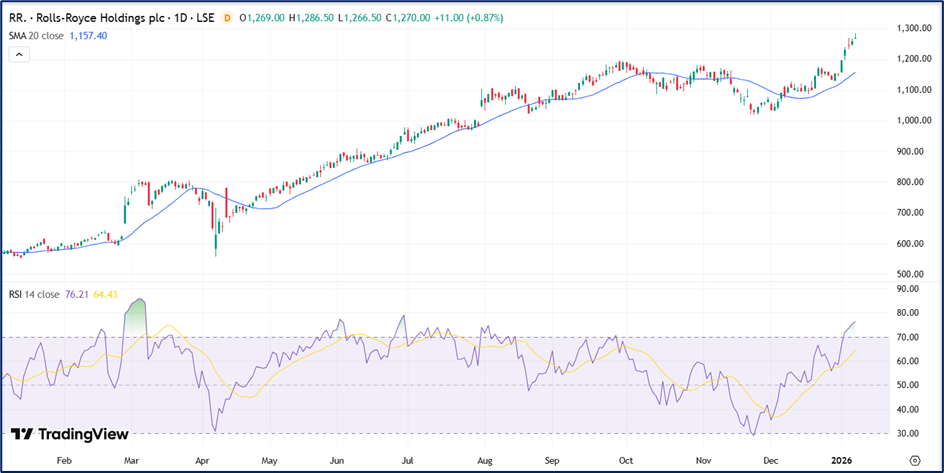
From a technical perspective, Rolls-Royce is in a clear "price discovery" phase, having broken above all historical resistance levels. The stock is trading well above its 50-day moving average (1,114p) and 200-day moving average (989p), signaling a powerful long-term bullish trend. However, the Relative Strength Index (RSI) is currently hovering around 76.20, suggesting the stock is entering overbought territory.
The Moving Average Convergence Divergence (MACD) remains positive at 19.18, significantly above the signal line, which confirms that the momentum is still firmly with the bulls. Traders are currently eyeing the psychological resistance level of 1,300p, while immediate support is pegged at the previous breakout point of 1,200p. The narrow 1% gain today reflects a period of "healthy consolidation" at these highs as the market digests the rapid gains of the new year.
Source: Trading View
Analyst Sentiment: Upgrades and Price Targets
The brokerage community remains overwhelmingly positive, though some are beginning to question the valuation.
- JPMorgan recently raised its price target to £13.20 (1,320p), maintaining an "Overweight" rating based on the company's superior cash flow generation.
- UBS holds one of the more aggressive stances with a target of 1,350p, citing the massive potential in the Civil Aerospace aftermarket.
- Morgan Stanley maintains a target of 1,275p, focusing on the "de-risking" of the company's 2028 profit targets.
- Consensus View: Of the 18 analysts covering the stock, 14 maintain "Buy" or "Strong Buy" ratings, with 4 "Holds" and zero "Sells." While the average target is approximately 1,216p, the market price has already exceeded this, often a precursor to a fresh round of target price upgrades during the February earnings season.
The 2026 Business Model: Beyond Jet Engines
Rolls-Royce has transitioned from a struggling engine manufacturer to a diversified "mission-critical power" powerhouse. The 2026 business model rests on three diversified pillars:
- Civil Aerospace: High-margin "Power-by-the-Hour" contracts. As widebody flying hours hit 109% of 2019 levels, Rolls-Royce earns more from servicing existing engines (like the Trent XWB) than from selling new ones.
- Defense & Nuclear: A shift toward "sovereign resilience." The company is now a lead partner in the AUKUS submarine pact and has entered the US regulatory process for its Small Modular Reactors (SMRs), eyeing a global market projected to be worth billions by the 2030s.
- Power Systems: The "AI Play." Rolls-Royce is now a major supplier of backup power and cooling systems for global data centers. In India and the US, non-governmental demand (AI and semiconductors) is expected to outpace government contracts by the end of 2026.
Financial and Operational Updates
Management has reinforced its Full Year 2025 guidance (to be reported in Feb 2026), projecting an underlying operating profit between £3.1 billion and £3.2 billion. Free cash flow is expected to reach a record £3.0 billion to £3.1 billion, a monumental leap from the pandemic era. Operationally, the company recently secured a major order for over 300 Leopard 2 tank engines, further solidifying its defense backlog. In the civil sector, new "time on wing" durability improvements for the Trent 1000 engine have been certified, which will lower maintenance costs and boost long-term margins.
Risks to the Bull Case
Despite the euphoria, several "tripwires" remain for investors. The Forward P/E ratio is currently around 36x, significantly higher than the 10-year average of 15x, meaning any earnings miss in February could trigger a sharp correction. Supply chain bottlenecks continue to plague the aerospace industry, potentially delaying engine deliveries. Furthermore, the "Trump Factor" in the US introduces uncertainty; any moves to block defense firms from paying dividends or changes in NATO spending could impact sentiment for transatlantic contractors like Rolls-Royce.
Conclusion
Rolls-Royce enters 2026 as a reformed industrial titan, trading more like a high-growth tech stock than a traditional engineer. The 1% gain on 8 January reflects a market that is fundamentally "long" on the company but cautious about overextending in the short term. The confluence of defense spending, the AI data center boom, and a disciplined capital return policy makes it the centerpiece of the FTSE 100’s current strength.


 Jun 03, 2026




 Please wait processing your request...