
 AU
AU
 CA
CA
 US
US
 NZ
NZ
 IND
IND

 UK
UK

 Share
Share
 X (Formerly Twitter)
 Whatsapp
 Facebook
 LinkedIn
 Telegram
 Email This Article
 Copy Link
 Summarize with AI
 Chat GPT
 Perplexity
Key Takeaways – February 2026 (Latest Update)
- Persimmon shares surged 5.3% on 11 February 2026, outperforming segments of the FTSE 100
- UK mortgage approvals are improving as inflation moderates
- Dividend visibility strengthened following January 2026 trading update
- UK macro conditions stabilising with easing interest-rate pressures
- Analysts remain cautiously constructive with improving risk/reward balance
Why Did Persimmon Shares Jump 5.3% on 11 February 2026?
Persimmon stock rallied sharply as investors rotated into UK domestic recovery plays amid falling mortgage rates, improving housing demand, stabilising UK inflation, and strengthening GDP forecasts for early 2026.
The January 2026 trading update highlighted:
- Improved forward sales year-on-year
- Stable average selling prices (ASP resilience)
- Cost discipline and margin recovery focus
- Strengthened balance sheet and solid cash generation
Markets are increasingly pricing in a cyclical housing rebound, particularly as mortgage affordability improves and first-time buyer demand stabilises. Given Persimmon’s high beta to UK macro conditions, even modest rate relief can significantly impact valuation sentiment.
Is the UK Economy Creating the Perfect Setup for a Housing Recovery?
The UK macro backdrop in February 2026 shows notable stabilisation:
- Inflation trending lower versus 2024 peaks
- The Bank of England tightening cycle nearing end-stage
- Mortgage approvals showing gradual recovery
- GBP stable versus USD and EUR
- Consumer confidence improving incrementally
Lower swap rates and competitive mortgage pricing have improved affordability metrics. With energy costs moderating and wage growth stabilising, housing demand fundamentals are strengthening.
The domestically exposed FTSE 250 has also regained momentum — reinforcing investor confidence in UK cyclicals.
How Does FTSE 100 Momentum Support Persimmon’s Rally?
While energy and financial stocks have anchored FTSE 100 gains, UK housebuilders had lagged — until now.
Persimmon benefits from:
- Valuation below long-term historical averages
- Strong land bank positioning
- Historically resilient dividend framework
- Exposure to structural UK housing undersupply
The UK continues to face chronic housing shortages — a long-term structural tailwind underpinning demand recovery potential.
What Is Persimmon’s Competitive Advantage in the UK Housing Market?
Persimmon operates a vertically integrated housebuilding model:
- Strategic land acquisition
- Development and construction
- Direct sales and customer delivery
Key listed peers include:
- Barratt Developments
- Taylor Wimpey
- Berkeley Group
Compared to peers, Persimmon stands out for:
- Strong capital discipline
- Focus on regional affordability markets
- Operational efficiency
- Historically generous dividend distributions
Is the Dividend Outlook Strengthening in 2026?
Following a prior dividend reset during the housing slowdown, Persimmon’s dividend outlook is improving as free cash flow normalises.
Dividend support drivers include:
- Cash flow recovery
- Lower build cost inflation
- Disciplined land investment
- Strengthened net cash position
Relative to UK gilt yields, Persimmon’s dividend yield remains competitive — potentially attracting income-focused investors back into the stock.
What Are Analysts Forecasting for Persimmon Shares?
February 2026 broker consensus suggests a cautiously improving stance:
- Barclays: Equal Weight – Moderate upside
- HSBC: Buy – Recovery leverage
- JPMorgan Chase: Neutral – Cyclical risk remains
- Morgan Stanley: Overweight – Margin recovery potential
Valuation metrics currently indicate:
- Forward P/E below long-term average
- Dividend yield attractive versus FTSE mean
- Price-to-book near historical mid-cycle norms
Overall consensus: Balanced but increasingly constructive.
What Is the Short-, Medium-, and Long-Term Stock Outlook?
Short Term (3–6 Months)
Momentum improving but volatility likely. Catalysts include macro data releases, mortgage trends, earnings updates, and sector ETF flows.
Medium Term (6–18 Months)
Recovery trajectory depends on rate cuts and sustained housing demand. Margin normalisation is critical.
Long Term (3–5 Years)
Structurally positive outlook supported by:
- UK housing undersupply
- Demographic demand growth
- Strategic land bank value
What Are the Key Drivers Behind the Recent Surge?
- Improving UK mortgage approvals
- Stabilising build costs
- Stronger-than-expected trading update
- Sector-wide re-rating
- Capital rotation into UK domestic recovery equities
What Risks Could Derail the Rally?
Investors should monitor:
- Unexpected UK recession
- Higher-for-longer interest rates
- Housing price declines
- Construction cost inflation resurgence
- Regulatory or policy changes
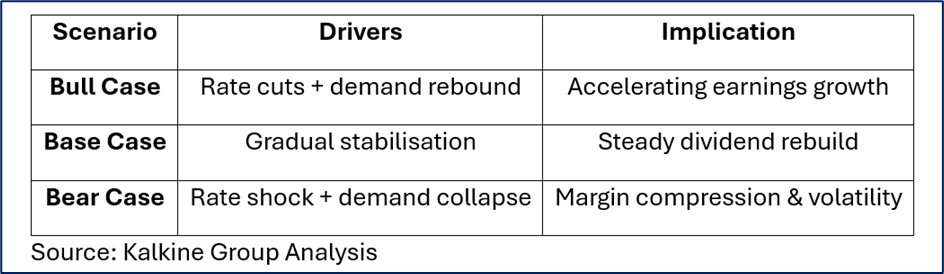
Bull vs Bear Case Outlook (2026)
How Does Persimmon Compare to UK Housebuilding Peers?
Peer benchmarking indicates:
- Comparable margin recovery potential
- Similar land bank exposure
- Valuation discount versus Berkeley
- Dividend recovery trajectory ahead of some competitors
Persimmon’s balance sheet resilience enhances downside protection relative to highly leveraged peers.
Investment Strategy Considerations
Short-Term Investors
- Monitor UK macro data closely
- Consider phased accumulation on pullbacks
- Track sector momentum flows
Medium-Term Investors
- Focus on earnings confirmation
- Evaluate dividend sustainability
- Monitor Bank of England rate policy
Long-Term Investors
- Accumulate during cyclical weakness
- Reinvest dividends
- Track disciplined land replacement
Final Investment Conclusion – February 2026
Persimmon appears to be transitioning into the early phase of a cyclical recovery. The 5.3% rally on 11 February 2026 reflects growing investor confidence in UK housing stabilisation and potential interest-rate relief.
While macro risks persist, valuation metrics, improving trading momentum, and structural housing undersupply create an increasingly attractive risk/reward profile.
For investors seeking exposure to UK domestic recovery, dividend restoration potential, and long-term housing demand trends, Persimmon represents a compelling — albeit cyclical — opportunity in 2026.
FAQ – Persimmon Stock February 2026
Is Persimmon a good dividend stock in 2026?
Dividend visibility is improving, but sustainability depends on housing market recovery and rate trends.
Is the UK housing market recovering?
Early stabilisation signs are visible in February 2026, particularly in mortgage approvals and pricing stability.
Is Persimmon undervalued?
Current valuation sits below historical averages, suggesting potential re-rating upside if macro conditions continue improving.


 Jun 29, 2026




 Please wait processing your request...