
 AU
AU
 CA
CA
 US
US
 NZ
NZ
 IND
IND

 UK
UK

 Share
Share
 X (Formerly Twitter)
 Whatsapp
 Facebook
 LinkedIn
 Telegram
 Email This Article
 Copy Link
 Summarize with AI
 Chat GPT
 Perplexity
Wizz Air Holdings PLC, a dynamic force in the European ultra-low-cost airline sector, witnessed a significant stock surge (LSE: WIZZ) on Friday, reflecting renewed confidence and the confirmed strength of its ambitious business strategy.
Key Takeaways
- Stock Movement: The Wizz Air stock was up notably on Friday (approximately 7%), indicating a strong positive shift in investor sentiment.
- Key Drivers: The rally was largely driven by positive operational updates, effective management of a major industry-wide challenge, and a strategic, aggressive capacity plan that signals confidence.
- Business Model: Wizz Air leverages the Ultra-Low-Cost Carrier (ULCC) model, focused on cost leadership, aggressive growth in Central and Eastern Europe (CEE), and maximising non-ticket (ancillary) revenue.
- Latest Updates: Recent reports highlighted strong passenger growth, high load factors, and concrete steps to mitigate the impact of the Pratt & Whitney engine groundings.
- Major Risks: The airline faces persistent risks from fuel cost volatility, ongoing engine inspection challenges impacting capacity, and exposure to geopolitical instability in its key markets.
The Engine of Growth: Key Reasons and Drivers for the Surge
The approximately 7% jump on Friday was fueled by a mix of market dynamics and company-specific performance:
- Robust Operational Metrics Confirmation:
- The market responded positively to recently published strong traffic figures, including consistently high load factors (near 90.7%) and passenger growth. This demonstrates sustained high demand for Wizz Air’s low fare offering.
- High load factors directly translate to exceptional efficiency and better unit economics, a core pillar of the ULCC model.
- Managing the GTF Engine Headwind:
- The industry-wide mandated inspection of Pratt & Whitney GTF engines has been a major operational and financial constraint, leading to significant aircraft groundings.
- Any indication that Wizz Air is better managing or mitigating the impact—such as securing compensation, efficiently managing grounded aircraft, or a reduction in the forecast number of planes out of service—removes uncertainty and boosts investor confidence.
- Aggressive, Opportunistic Expansion Strategy:
- Wizz Air's persistent strategy of expanding capacity, especially in high-growth, underserved CEE markets and, opportunistically, in locations like the Middle East, suggests the airline is capitalising on market share opportunities while rivals are more cautious.
- Positive Analyst Sentiment:
- A major analyst upgrade or a positive research note in the days prior to the surge may have served as a direct catalyst, prompting a flurry of buying activity.
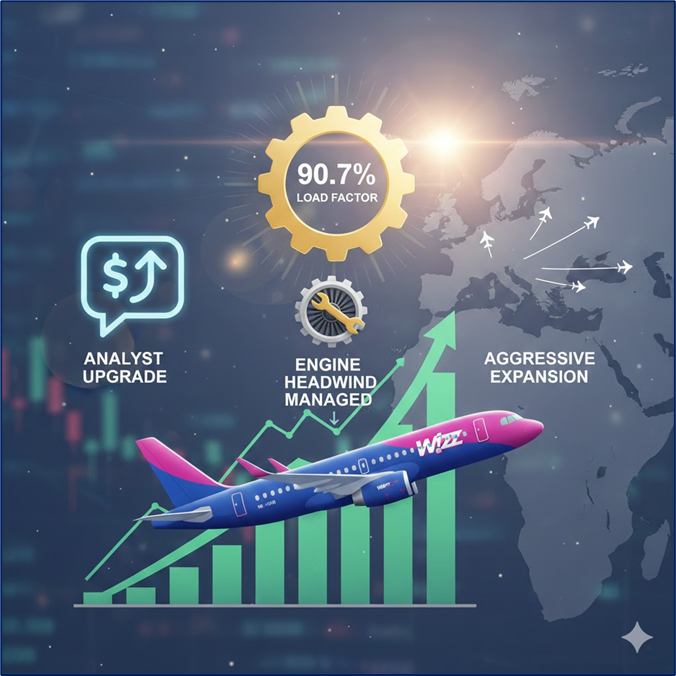
Source: Kalkine Group
The Wizz Air Playbook: Business Model & Latest Updates
Wizz Air’s success is built on an extreme focus on cost and efficiency, designed to be the absolute cost leader in its markets:
I. Core Ultra-Low-Cost Model (ULCC)
- Geographic Focus: Dominance in Central and Eastern Europe (CEE), a region offering lower operational costs (labour, airport fees) and high growth potential as more citizens choose air travel.
- Single, Modern Fleet: Operates a highly standardised fleet of Airbus A320/A321neo aircraft. This homogeneity ensures lower training, maintenance, and spare parts costs, while the modern "neo" engines deliver best-in-class fuel efficiency.
- Ancillary Revenue Power: The published fare is often just the base price. A substantial portion of total revenue (approaching 50%) is generated from mandatory add-ons like checked baggage, cabin bag allowances, seat selection, and priority boarding.
- High Asset Utilisation: Aircraft are kept in the air for maximum hours per day via quick airport turnarounds, ensuring optimal return on expensive assets.
II. Latest Strategic Business Updates
- "Customer First Compass" Transformation: The company has initiated a multi-year program to enhance the customer experience, often criticised in the past, through significant investment in digital platforms, technology (e.g., AI assistance), and fleet renewal.
- Network Agility: Wizz Air has demonstrated the ability to quickly shift capacity and adjust routes in response to geopolitical pressures (e.g., in the Middle East), protecting its overall unit revenue.
- Capacity Expansion: Despite industry headwinds, Wizz Air has maintained an aggressive delivery pipeline of new, efficient aircraft, underscoring its long-term ambition to grow market share and fleet size significantly by the end of the decade.
The Turbulence Ahead: Key Risks and Headwinds
For investors, the following risks temper the high-growth story:
- Pratt & Whitney GTF Engine Groundings: This remains the most immediate and severe operational risk. It forces the grounding of a significant portion of the fleet, artificially constrains capacity, and drives up non-fuel costs (Ex-fuel CASK) through increased maintenance and reliance on expensive leased aircraft.
- Fuel Price Volatility: Jet fuel is the single largest operating expense. Sustained high global oil prices can quickly undermine the low-cost carrier's tight profit margins, especially if the airline’s hedging policies are not fully protective.
- Geopolitical and Macro Risks:
- Exposure to regions like CEE and the Middle East makes the airline highly susceptible to global conflicts and sudden shifts in travel advisories, which can halt entire routes and impact forward bookings instantly.
- A broad European economic downturn could impact discretionary spending, leading to lower demand for travel and pressure on ticket prices.
- Growth Valuation Premium: The stock often trades at a high forward valuation (high P/E ratio), pricing in substantial future earnings growth. Any failure to meet these aggressive market expectations due to unforeseen challenges could trigger a sharp price correction.
Conclusion: A High-Octane Growth Stock
Wizz Air's 7% rally on Friday is a powerful affirmation that the market sees the company successfully navigating near-term operational challenges (specifically the engine issues) while maintaining its superior, structural growth trajectory.
The company is fundamentally a high-growth, high-leverage play, leveraging its Ultra-Low-Cost model to seize market leadership in fast-growing regions. This strategic positioning provides immense long-term upside. However, it also means the stock will continue to exhibit higher volatility than its more mature rivals, making it a proposition for investors with a greater appetite for risk. The recent price movement reflects the high stakes and high reward potential of its aggressive playbook.
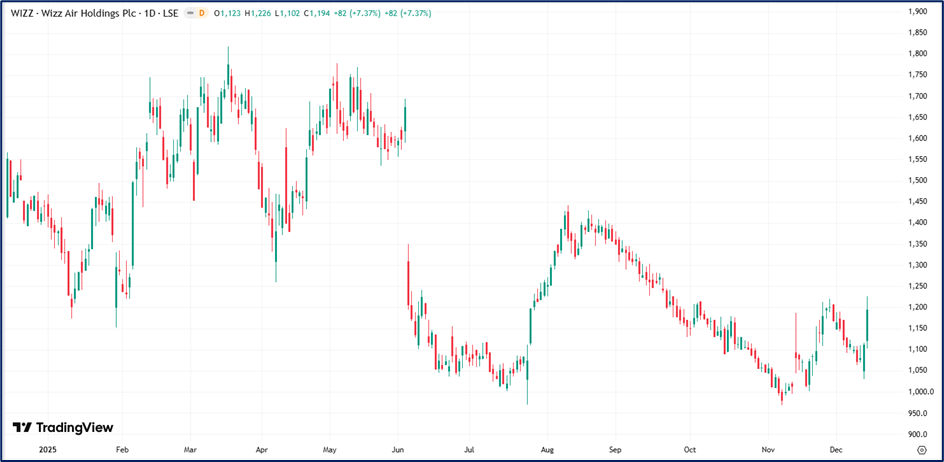
Source: Trading View, 12 December 2025


 Jun 03, 2026




 Please wait processing your request...