
 AU
AU
 CA
CA
 US
US
 NZ
NZ
 IND
IND

 UK
UK

 Share
Share
 X (Formerly Twitter)
 Whatsapp
 Facebook
 LinkedIn
 Telegram
 Email This Article
 Copy Link
 Summarize with AI
 Chat GPT
 Perplexity
What Is the XUKS ETF?
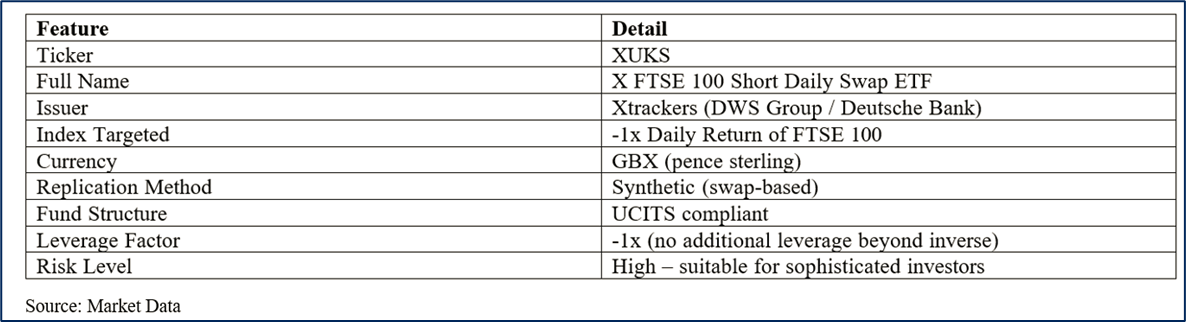
The X FTSE 100 Short Daily Swap ETF (XUKS) is an inverse ETF listed on the London Stock Exchange, issued under the Xtrackers brand by Deutsche Bank's asset management arm (now DWS Group). XUKS is designed to deliver -1x the daily performance of the FTSE 100 Index — meaning it rises in value when the FTSE 100 falls, and falls when the FTSE 100 rises.
Unlike SUK2 (which targets -2x leverage), XUKS targets a straightforward -1x inverse daily return, making it a less aggressive short-side instrument. On February 27, 2026, with the FTSE 100 broadly positive, XUKS is trading at GBX 233.95, down -0.28%, broadly consistent with its design as a -1x inverse product.
The relatively modest decline compared to the FTSE 100's positive movement on the day may reflect intraday timing differences, swap pricing adjustments, or minor tracking deviations.
XUKS ETF Key Facts and Specifications
Xtrackers and Deutsche Bank: Understanding the Issuer
Xtrackers is the ETF brand of DWS Group, the asset management division that was formally part of Deutsche Bank and is now a separately listed company (though Deutsche Bank remains a major shareholder). DWS is one of Europe's largest asset managers, overseeing approximately €900 billion in assets.
The Xtrackers brand has a strong heritage in the European ETF market, having been one of the early pioneers of synthetic (swap-based) ETF structures on European exchanges. Xtrackers offers a wide range of index-tracking ETFs spanning equities, fixed income, commodities, and currencies, with XUKS representing one of its specialist short-strategy products.
The association with Deutsche Bank means XUKS benefits from access to Deutsche Bank's swap infrastructure and market-making capabilities — important features for an ETF reliant on total return swaps for its inverse exposure.
XUKS vs. SUK2: The Key Difference - 1x vs. 2x Inverse
The most important distinction between XUKS and its competitor SUK2 (L&G FTSE 100 Super Short Strategy ETF) is the leverage factor:
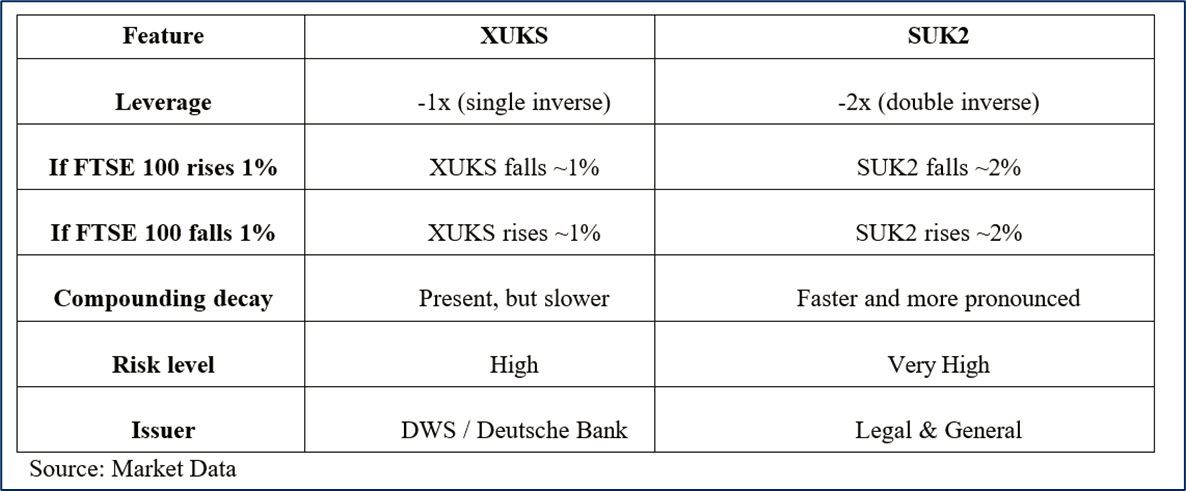
For investors who want short FTSE 100 exposure but prefer to avoid the additional amplification risk of double leverage, XUKS offers a more moderate position — though it remains unsuitable for long-term buy-and-hold strategies due to the universal compounding effects of daily rebalancing inverse products.
How XUKS Works: Total Return Swap Mechanics
|
XUKS achieves its inverse exposure through total return swap contracts with one or more counterparties. The mechanics are as follows:
A swap agreement with a counterparty (typically Deutsche Bank or other investment banks) contractually delivers -1x the daily total return of the FTSE 100 to the fund.
Each day, the swap resets, and the fund rebalances its exposure to maintain the -1x ratio.
This approach is operationally efficient and avoids the complexities of physically short-selling 100 individual stocks. However, it introduces counterparty risk — the risk that the swap counterparty fails to deliver the contractually promised returns.
Under UCITS regulations, counterparty risk is capped at 10% of the fund's net asset value, and Xtrackers actively manages collateral to maintain this compliance.
The Daily Rebalancing and Compounding Decay Problem
Like all daily-rebalancing inverse ETFs, XUKS is subject to compounding decay — a structural erosion of value that occurs over time in volatile or trending markets, even if the underlying index is flat over a multi- day period.
Why Compounding Decay Occurs
The -1x exposure is relative to each day's starting value. In volatile markets:
Day 1: FTSE 100 falls 3% → XUKS rises approximately 3%
Day 2: FTSE 100 rises 3% → XUKS falls approximately 3% (from its new, higher base)
The result: the FTSE 100 is back to roughly its starting point, but XUKS has experienced a net loss due to the asymmetry of percentage gains and losses applied to changing base values.
The practical implication: Holding XUKS for weeks, months, or years will almost certainly result in significant losses relative to a perfectly inverse position, particularly in volatile markets. The compounding decay is slower than in SUK2 (due to -1x vs. -2x leverage) but is still material over extended periods.
Who Uses XUKS and For What Purpose?
Short-Term Directional Traders
Traders who anticipate a near-term FTSE 100 decline — perhaps following a negative economic data release, central bank statement, or geopolitical event — can use XUKS to position for downside. With -1x leverage (as opposed to -2x in SUK2), XUKS provides a more measured short exposure that may suit traders who want to short the market without amplified volatility.
Portfolio Hedgers (Single Inverse)
Investors with substantial long exposure to the FTSE 100 (via physical holdings or ETFs like ISF, VUKE, or L100) may use XUKS as a short-term hedge to offset downside risk during periods of uncertainty. Because
XUKS is -1x (not leveraged), a position roughly equal to the long exposure can theoretically provide close to full downside protection over a single day.
For example: An investor holding £50,000 in ISF could purchase approximately £50,000 in XUKS to create a near-neutral FTSE 100 exposure for a short period, effectively going "cash-like" without selling the ISF position and triggering a tax event.
Risk Management for Equity Portfolios
Some institutions and sophisticated retail investors use XUKS systematically as part of a dynamic hedging strategy, adjusting the size of the XUKS position based on volatility signals, economic indicators, or quantitative models.
XUKS Performance in Context: February 27, 2026
The modest decline of -0.128% for XUKS on February 27, 2026, compared to the FTSE 100's gain of approximately +0.55% across peer ETFs, suggests a slight divergence from perfect -1x replication. This may reflect:
Intraday timing of price captures (the FTSE 100 may have gained more earlier or later in the day than the snapshot prices suggest)
Swap pricing adjustments and the cost of carry embedded in the daily swap reset
Minor tracking differences inherent in swap-based products
Over any given day, minor deviations from the theoretical -1x are normal and typically immaterial. Over multiple days, the compounding mechanics described above become the dominant driver of performance divergence.
XUKS vs. Simply Shorting FTSE 100 Futures
Experienced investors may wonder how XUKS compares to directly shorting FTSE 100 futures contracts. The key differences are:
Accessibility: XUKS requires no futures account, margin facility, or derivatives knowledge — it can be bought through any standard stockbroking account.
Regulation: XUKS is UCITS-regulated, providing investor protections that futures do not.
Cost: XUKS incurs management fees, swap costs, and bid-ask spreads. Futures may be more cost- efficient for large, sophisticated positions.
Simplicity: For retail investors, XUKS is far easier to use than futures.
Holding period: Futures can be rolled to maintain exposure indefinitely; XUKS's daily rebalancing makes extended holds increasingly expensive.
Regulatory Warnings and Suitability
The UK's Financial Conduct Authority (FCA) has issued broad guidance cautioning retail investors against complex leveraged and inverse products. While XUKS is technically accessible to UK retail investors, platforms typically require:
Completion of a knowledge and experience assessment
Review of the PRIIPS Key Information Document (KID)
Acknowledgement of the risks specific to daily-rebalancing inverse products
Investors should treat XUKS as a sophisticated tactical tool rather than a conventional investment product.
Key Risks of XUKS
Compounding decay: Value erosion over time in volatile or trending markets, even if the FTSE 100 ends up flat.
Counterparty risk: Reliance on swap counterparty performance.
Magnified directional loss: A sustained FTSE 100 rally will continuously erode the value of XUKS positions.
Inappropriate for ISA long-term investing: While technically ISA-eligible, holding XUKS long- term inside an ISA is almost certainly counterproductive.
Liquidity risk: During market stress, bid-ask spreads on inverse ETFs can widen.
How to Buy XUKS
XUKS is available on UK platforms that support the purchase of specialist and inverse ETFs. Check platform suitability requirements and risk disclosures. It can technically be held in an ISA or SIPP, though this is only appropriate for very specific tactical strategies.
Frequently Asked Questions: XUKS ETF
What does XUKS do? XUKS delivers approximately -1x the daily return of the FTSE 100 Index. It gains when the FTSE 100 falls and loses when the FTSE 100 rises.
Who manages XUKS? XUKS is managed by Xtrackers, the ETF brand of DWS Group (associated with Deutsche Bank).
What is the difference between XUKS and SUK2? XUKS targets -1x (single inverse) daily exposure to
the FTSE 100, while SUK2 targets -2x (double inverse). SUK2 offers greater amplification in both directions.
Is XUKS suitable for long-term investors? No. Due to compounding decay from daily rebalancing, XUKS is designed for short-term tactical use only.
What is the current price of XUKS? As of February 27, 2026, XUKS is trading at GBX 234.60, down
-0.15% on the day.
Can I hold XUKS in an ISA? Technically yes, but it is only appropriate for specific short-term tactical strategies, not long-term ISA saving.
This article is for informational and educational purposes only and does not constitute financial advice. Inverse ETFs carry significant risk and are not suitable for most retail investors. Always seek qualified financial advice before investing in complex products.


 Jun 03, 2026




 Please wait processing your request...