
 AU
AU
 CA
CA
 US
US
 NZ
NZ
 IND
IND

 UK
UK

 Share
Share
 X (Formerly Twitter)
 Whatsapp
 Facebook
 LinkedIn
 Telegram
 Email This Article
 Copy Link
 Summarize with AI
 Chat GPT
 Perplexity
Beazley plc (LSE: BEZ) – The Multi-Billion Pound Battle for London’s Specialty Crown
The London Stock Exchange witnessed a high-stakes standoff this week as Beazley PLC, a heavyweight in the specialty insurance market, ended Friday, January 23, 2026, up 3.23% at 1,152 pence. This latest surge is not merely a routine fluctuation but the aftershock of a tectonic shift in the insurance sector: a rejected £7.7 billion takeover approach from Swiss giant Zurich Insurance Group.
Beazley’s board has firmly drawn a line in the sand, dismissing Zurich’s aggressive 1,280 pence-per-share cash offer as significantly undervaluing the company, sparking a frenzy of speculation that the "Premier League" insurer is now firmly in play for a higher bid.
Latest Key Reasons for the Surge & Drivers

Source: Kalkine Group
- Hostile Takeover Speculation: The primary engine driving the share price is the market’s anticipation of a sweetened offer. Zurich’s proposal of 1,280p represents a roughly 56% premium to Beazley’s undisturbed share price, yet the rejection by Beazley’s board suggests they believe the company’s intrinsic value—specifically its dominance in cyber and specialty risks—is far higher. The 3.23% rise on Friday indicates investors are betting that Zurich will return with a higher figure before the February 16, 2026, "put up or shut up" regulatory deadline.
- Analyst Re-ratings: Following the bid rejection, the City has begun to re-evaluate Beazley’s standalone value. Analysts note that Beazley’s unique exposure to high-growth niche markets like cyber insurance and marine risks makes it a scarce asset in a consolidating industry. The rejection effectively sets a "floor" for the share price, as the market now views the company as a prime acquisition target for any global insurer looking to buy growth rather than build it.
- Defensive Growth Characteristics: In a volatile week where the broader FTSE 100 struggled, Beazley acted as a defensive magnet. Investors are flocking to the stock not just for the merger arbitrage opportunity but because of its resilient trading updates. The company’s refusal to engage at the current price signals extreme confidence in its upcoming full-year results and its strategic roadmap for 2026.
Current Business Model
- Specialty Risk Leader: Unlike general insurers that cover standard home or car policies, Beazley operates in the complex, high-margin world of "specialty" insurance. They are a leading participant in the Lloyd’s of London market, managing six syndicates. Their expertise lies in underwriting risks that others fear or do not understand, such as kidnap and ransom, high-value jewelry, fine art, and complex marine cargo.
- Cyber Insurance Pioneer: Beazley is a top-tier global player in cyber liability insurance. They don’t just pay out claims; their business model includes an integrated cyber security arm (Beazley Security) that helps clients prevent attacks and manage crises. This "ecosystem" approach creates sticky client relationships and provides Beazley with proprietary data to price risk better than competitors.
- Diversified Platforms: While anchored in London, Beazley has aggressively expanded its footprint in the US and Europe. Their "three-platform" strategy—Lloyd’s, US Admitted Market, and European networks—allows them to toggle capital allocation instantly to wherever rates are most profitable, insulating them from localized downturns.
Latest Financial & Operational Updates (Source: Beazley Q3 2025 Trading Statement & H1 Interim Results)
- Robust Premium Growth: In its most recent trading update (Q3 2025), Beazley reported that Insurance Written Premiums (IWP) had grown to approximately $4.67 billion. The company highlighted that despite softening rates in some US lines, they maintained growth by expanding in property and cyber sectors where demand remains structural and urgent.
- Combined Ratio Discipline: A critical metric for insurers is the "combined ratio" (claims + expenses divided by premiums). Beazley upgraded its guidance for the full year 2025, forecasting an undiscounted combined ratio in the "low 80s" percentile. This is exceptional efficiency, implying that for every $100 earned in premiums, the company keeps roughly $15-$20 as underwriting profit before investment income.
- Capital & Dividends: The company remains well-capitalized with a solvency ratio comfortably above regulatory requirements. Management has continued its progressive dividend policy, and the recent rejection of Zurich’s bid was explicitly linked to the board’s belief that their standalone strategy—including a new "Beazley Bermuda" platform launching in 2026—will deliver superior long-term returns to shareholders than the current cash offer.
SWOT Analysis
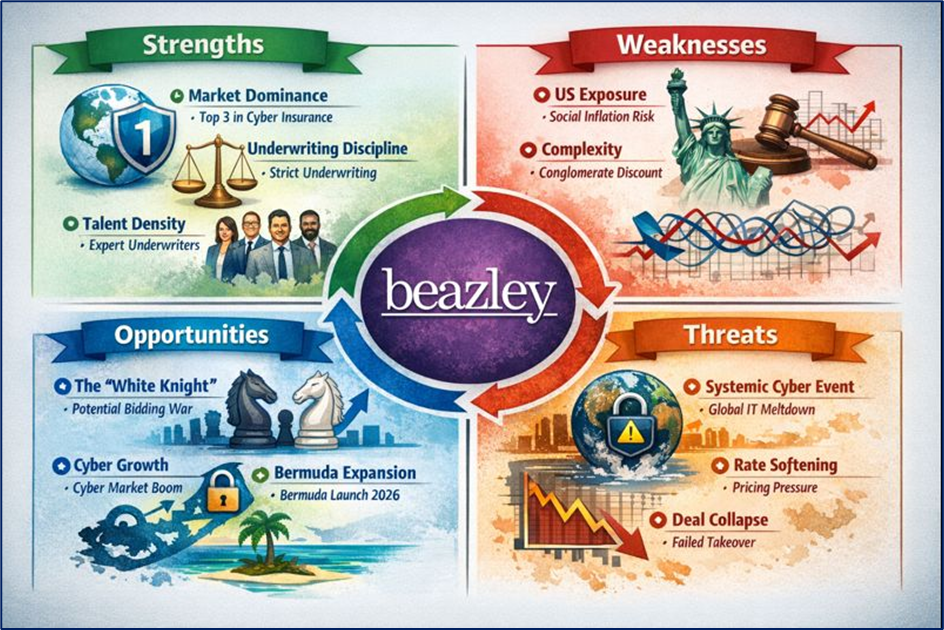
Source: Kalkine Group
- Strengths:
- Market Dominance: Top 3 global player in cyber insurance and a leading Lloyd's syndicate.
- Underwriting Discipline: A proven track record of walking away from bad business, keeping combined ratios healthy even during catastrophe-heavy years.
- Talent Density: High retention of specialized underwriters who hold deep broker relationships.
- Weaknesses:
- US Exposure: Heavy reliance on the US liability market exposes them to "social inflation" (rising jury awards in US courts).
- Complexity: The business model is complex for generalist investors to value, often leading to a "conglomerate discount" which makes them vulnerable to lowball bids.
- Opportunities:
- The "White Knight": A rival bid from another global giant (e.g., Allianz, Travelers) could ignite a bidding war.
- Cyber Growth: The global cyber insurance market is projected to triple by 2030; Beazley is perfectly positioned to capture this secular trend.
- Bermuda Expansion: The 2026 launch of their Bermuda platform offers tax efficiencies and access to alternative capital markets.
- Threats:
- Systemic Cyber Event: A global IT outage or massive ransomware attack could trigger simultaneous claims across thousands of policies, testing their reinsurance structures.
- Rate Softening: If competitors aggressively cut prices to win market share in 2026, Beazley may be forced to shrink its book to maintain profitability.
- Deal Collapse: If Zurich walks away and no other bidder emerges, the stock could retrace significantly to its pre-bid levels.
Outlook & Risks
- Outlook: The immediate future for Beazley is dominated by M&A arbitrage. If Zurich increases its offer to the 1,350p-1,400p range, the board may engage. Fundamentally, 2026 is set to be a transformative year operationally, with the new Bermuda hub coming online to handle large-scale risk transfer. The consensus view is that Beazley is "expensive" for a reason: it is a high-quality compounder in a sector filled with mediocrity.
- Risks: The primary short-term risk is "deal risk." If Zurich abandons the pursuit, short-term speculators will exit, causing volatility. Long-term, the risk remains "catastrophe accumulation"—whether from climate change-induced hurricanes or a digital pandemic—which remains the existential threat for all property and casualty insurers.
Compelling Conclusion
Beazley has transformed from a quiet Lloyd's syndicate into the belle of the ball in the global insurance M&A market. The board’s confidence in rejecting a £7.7 billion check speaks volumes about the internal data they are seeing regarding future growth. Whether they remain independent or become the crown jewel of a larger empire, Beazley has proven that disciplined, specialized underwriting is the ultimate currency in a risk-laden world. For observers, the next three weeks before the takeover deadline will be nothing short of a spectator sport.


 Jun 03, 2026




 Please wait processing your request...