
 CA
 NZ
 US
 AU
 IND

 UK

 Share
 X (Formerly Twitter)
 Whatsapp
 Facebook
 LinkedIn
 Telegram
 Email This Article
 Copy Link
 Summarize with AI
 Chat GPT
 Perplexity

Summary
AEW UK REIT plc (LSE:AEWU) is a UK commercial property REIT with a 34-asset, roughly £215 million portfolio. It is back in focus for its approximate 7.33% trailing dividend yield (8.00p annual dividend, 42 consecutive quarterly payments) and its withdrawn April 2026 bid for Alternative Income REIT. FY2026 results, for the year to 31 March 2026, showed NAV of 108.38p per share, down 1.4%, with dividend cover narrow at an EPRA EPS of 7.98p. A key risk is that tight income cover and refinancing of its £60 million facility by July 2027 could pressure future distributions.
Key takeaways
- AEWU shares traded around 107p on 13 July 2026, implying a trailing dividend yield of approximately 7.33%, per AIC data.
- NAV per share was 108.38p (total NAV £171.97 million) at 31 March 2026, down about 1.4% year-on-year.
- The trust has paid an unchanged 8.00p annualised dividend (2.00p quarterly) for 42 consecutive quarters.
- Loan-to-GAV stood at 25.21%, with a fully drawn £60 million facility fixed at 2.959% until July 2027.
- AEWU withdrew its proposed all-share approach for Alternative Income REIT on 21 April 2026 after talks over key terms failed.
Introduction
AEW UK REIT plc (LSE:AEWU) is back in focus for UK income investors, with shares near 107p implying a trailing dividend yield of approximately 7.33%, according to data compiled by the Association of Investment Companies (AIC). The trust's annual results for the year ended 31 March 2026, published 26 June 2026, confirmed net asset value of £171.97 million, or 108.38p per share, alongside an eighth consecutive year of unchanged 8p-per-share annual dividends. This note, published 13 July 2026, sets out what has changed and what has held steady.
The past few months have also brought corporate drama. AEWU tabled a non-binding all-share approach for smaller peer Alternative Income REIT (AIRE) in spring 2026, only to walk away in April after talks over "key matters" broke down. Rival bidder Glenstone has since raised its cash offer for AIRE to roughly £57.4 million, leaving AEWU's growth ambitions unresolved alongside a marginal NAV decline.
Key facts 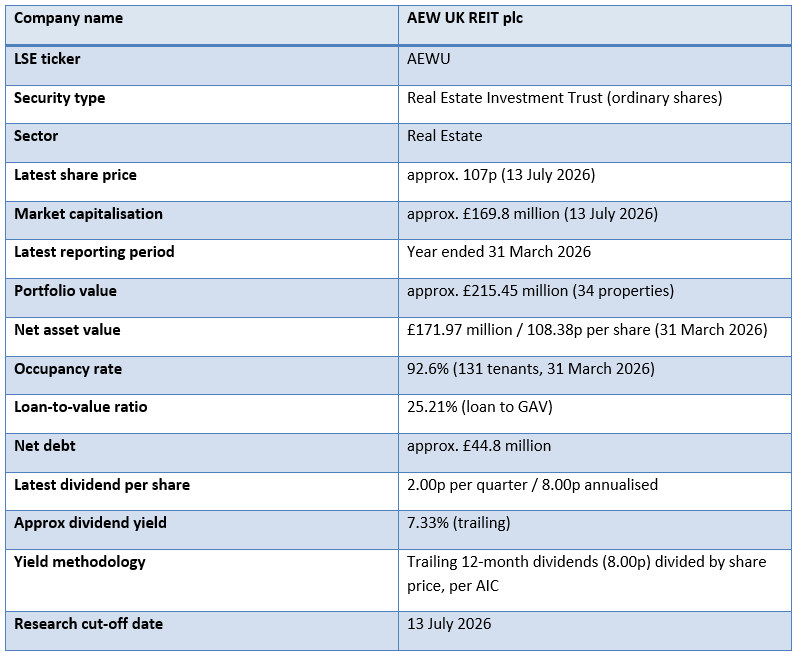
Company overview
AEW UK REIT plc has traded on the premium segment of the London Stock Exchange's Main Market since May 2015. Managed by AEW UK Investment Management LLP, part of the wider AEW real estate platform, the trust pursues a value-oriented, sector-unconstrained strategy rather than concentrating on a single property type.
Why is AEWU attracting attention?
Two developments have put AEWU in the news this summer. The first is the income story: a roughly 7.33% dividend yield, screened against a share price near 107p, remains one of the higher headline yields among UK-listed diversified REITs, a status the company has held for several quarters.
Latest financial performance
For the year ended 31 March 2026, AEWU reported NAV of £171.97 million, or 108.38p per share, down from £174.4 million a year earlier, a decline of roughly 1.4%, based on the annual report and coverage by QuotedData and Investment Week. EPRA earnings per share came in at 7.98p, marginally below the 8.00p paid in dividends.
Management reported a total accounting return of around 5.5% for the year, with an underlying investment return of 5.69%, per QuotedData. Over ten years, AEWU has generated a cumulative total return of 143.4%, versus a 24.7% average across a peer group of eight UK-listed diversified REITs, though past performance is no guide to the future.
Portfolio and operating performance
The 34-property portfolio was valued at approximately £215.45 million at the March 2026 year-end, with occupancy of 92.6% across 131 tenants, per the annual report. Management highlighted valuation gains at Queen Square in Bristol and industrial units in Runcorn and St Helens, citing continued demand for well-located industrial and office space.
Not every segment performed evenly: the company flagged headwinds within its leisure exposure, including the administration of car-park operator NCP. AEWU's own data show valuations rose in 12 of the past 13 quarters, a run management cites as evidence of the strategy's resilience, though this is a company-reported metric rather than an independently audited index.
Balance sheet and debt at AEWU
AEWU's balance sheet carries a fully drawn £60 million facility, against £15.2 million of cash at the March 2026 year-end, implying net debt of roughly £44.8 million, per the annual report. This equates to a loan-to-GAV ratio of 25.21%, generally characterised as moderate for the UK REIT sector.
The facility's cost is largely fixed, at an average rate of 2.959% locked in until July 2027. AEWU also announced on 3 June 2026 that it had acquired an interest rate cap instrument, limiting the impact of further rate volatility.
Dividend analysis
AEWU paid a quarterly dividend of 2.00p per share in the period to 31 March 2026, taking the annualised rate to 8.00p, unchanged since 2018 and extending the record to 42 consecutive quarterly payments, per AIC data. At a share price of approximately 107p to 108p, this implies a trailing yield of roughly 7.3% to 7.5%; the AIC's own calculation, matching the original screening figure, puts it at 7.33%.
Dividend cover appears close to balanced rather than comfortably ahead of distributions: EPRA earnings per share of 7.98p for FY2026 sat marginally below the 8.00p paid out, though QuotedData described the payout as "covered" for the year. Some data providers separately show an IFRS-basis payout ratio above 100%, a reminder that cover can look different depending on the earnings measure used. No dividend is guaranteed.
Property-market and economic backdrop
AEWU's fortunes remain tied to the UK commercial property cycle, where industrial and logistics assets have generally outperformed while leisure and parts of retail face more mixed conditions, illustrated by NCP's administration. Bank of England policy also matters for a geared REIT, influencing both property yields and AEWU's refinancing costs as its facility approaches its July 2027 maturity.
Wider M&A activity, including the competing bids for Alternative Income REIT, suggests smaller trusts such as AEWU continue to weigh scale, liquidity and cost efficiency against remaining independent.
Valuation context
AEWU shares have recently traded close to their EPRA NTA of 108.38p, with a price around 107p implying a discount to NAV of roughly 1%, narrower than the 3.5% average discount QuotedData reported across FY2026. A market capitalisation of approximately £169.8 million values the trust close to its £171.97 million book NAV.
On yield grounds, AEWU's approximate 7.3% level continues to sit above many diversified UK REIT peers, reflecting both its income-focused mandate and the market's assessment of growth, gearing and sector-mix risks. This is a factual observation about relative pricing, not a recommendation to buy, hold or sell the shares.
Main risks
Key company-specific risks include tenant concentration across 131 tenants, exposure to weaker segments such as leisure (illustrated by NCP's administration), and the narrow margin between EPRA earnings and dividends, which limits headroom if rental income softens. The fully drawn facility, though fixed-cost until July 2027, will eventually need refinancing at prevailing rates.
The unsuccessful AIRE approach illustrates execution risk around growth; management may face pressure to find alternative routes to scale, and any future deal carries its own pricing risks. Broader UK property valuation risk, and possible further NAV declines if yields move outward, also remain relevant.
What investors may watch next
Scheduled newsflow likely to matter includes AEWU's next quarterly shareholder update and dividend declaration, plus any further developments in the AIRE bid process now led by Glenstone. The July 2027 maturity of AEWU's £60 million facility is a medium-term date already on record for refinancing.
Investors may also watch for updates on occupancy, rent collection and portfolio valuation in AEWU's next quarterly investor report, alongside commentary on disposals or acquisitions as management seeks the "appropriate growth" referenced in recent trade coverage.
Conclusion
AEW UK REIT's approximate 7.33% yield keeps it on the radar of UK income investors, underpinned by a 42-quarter unbroken dividend record and a portfolio trading close to its stated NAV. At the same time, a marginal NAV decline over FY2026, tight dividend cover, and the unresolved question of growth after the aborted AIRE approach all warrant attention.
None of this amounts to a signal to buy, hold or sell AEWU shares; rather, it reflects a REIT balancing an attractive income profile against sector- and company-specific pressures. Income is not guaranteed and can be reduced or suspended, so shareholders may wish to monitor official announcements for the latest verified figures.


 Nov 13, 2026





 Please wait processing your request...