
 CA
 NZ
 US
 AU
 IND

 UK

 Share
 X (Formerly Twitter)
 Whatsapp
 Facebook
 LinkedIn
 Telegram
 Email This Article
 Copy Link
 Summarize with AI
 Chat GPT
 Perplexity

Summary
Big Yellow Group (LSE:BYG), the UK self-storage REIT, trades near 873p with a market capitalisation of roughly £1.71 billion as at 10 July 2026. Full-year results to 31 March 2026 showed revenue up 2% to £209.1 million and a 2% dividend increase to 47.2p, leaving the screening yield at 5.42%, unchanged from initial screening. Closing occupancy eased to 74.2% amid softer letting activity, while EPRA NTA stood at 1,370.4p per share and loan-to-value remained low at 15%. Investors are weighing pricing resilience against occupancy softness.
Key takeaways
- BYG's screening yield stands at 5.42% as of 10 July 2026, unchanged from the original screen, based on a share price near 873p.
- Full-year revenue to 31 March 2026 rose 2% to £209.1 million; the dividend rose 2% to 47.2p per share.
- Closing occupancy fell to 74.2% from 78.7% a year earlier, even as net rent per sq ft rose 4%.
- Loan-to-value stayed conservative at 15% and net debt was £476.7 million against a £3.11 billion portfolio.
- Shares trade at roughly a one-third discount to the 1,370.4p EPRA NTA per share reported at the year end.
Introduction
Big Yellow Group PLC (LSE:BYG) is one of the UK's two large listed self-storage landlords, operating stores under the Big Yellow and Armadillo Self Storage brands. As a Real Estate Investment Trust, it distributes the bulk of its rental profits to shareholders, a structure that makes it a name income investors return to when screening real estate.
A screening yield of 5.42% first drew attention to the stock. With full-year results to 31 March 2026 now published, alongside a mid-June disposal and a dividend due later this month, this article checks that yield against the latest verified numbers: occupancy, pricing, the development pipeline, and the balance sheet. It does not recommend buying, selling or holding the shares.
Key facts 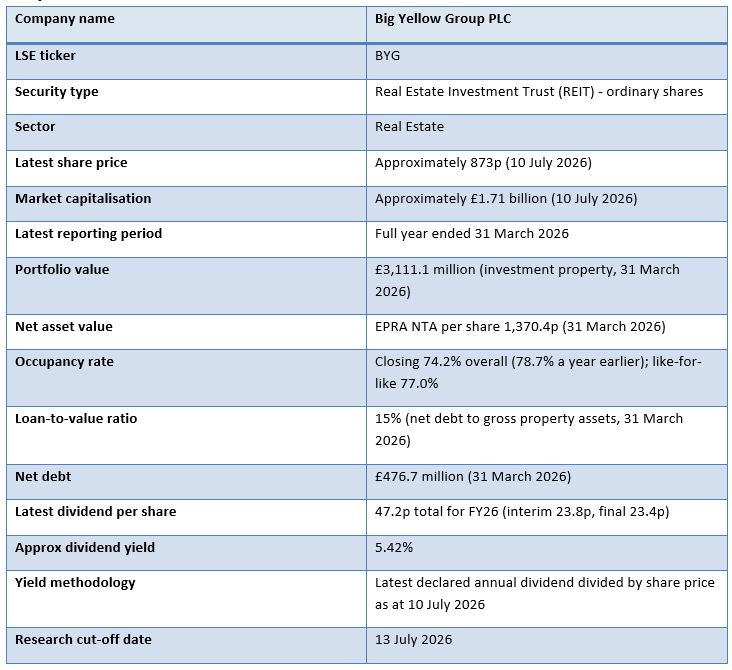
Company overview
Big Yellow Group develops, owns and operates self-storage facilities across the UK, typically in urban and suburban locations close to customers. Its estate combines wholly owned Big Yellow branded stores with the Armadillo Self Storage portfolio, serving households and small businesses needing flexible space.
Why is BYG attracting attention?
Several threads have converged around Big Yellow Group recently. It reported full-year results on 18 May 2026 showing modest revenue and earnings growth, but a more pronounced softening in occupancy than in prior years. In mid-June 2026 it announced the disposal of its Harrow industrial estate for £38.4 million, with proceeds earmarked for the development pipeline.
Latest financial performance
For the year ended 31 March 2026, Big Yellow reported total revenue of £209.1 million, up 2%, with store revenue of £207.6 million also up 2%. Store EBITDA rose 2% to £146.5 million, a 70.5% EBITDA margin.
Adjusted profit before tax rose 2% to £117.5 million, and adjusted earnings per share rose 2% to 59.0p. Management described "subdued activity levels as we navigated the global economic uncertainty," though trading improved when the Bank of England cut rates during the year, helping narrow the occupancy gap.
Portfolio and operating performance: occupancy, pricing and pipeline
Occupancy moved most in this set of results. Closing occupancy across the portfolio was 74.2% at 31 March 2026, down from 78.7% a year earlier. On a like-for-like basis the decline was narrower, at 77.0%, down 1.7 points. Big Yellow's same-store occupancy closed at 78.2%, down from 80.9%.
Pricing told a different story. Average achieved net rent per square foot rose 4% year-on-year, even as new move-in rates ran about 0.7% below last year's, suggesting the group leaned on retained-customer pricing. REVPAF, a core sector measure, was reported at £31.84.
Balance sheet and debt: how leveraged is BYG?
Big Yellow's balance sheet remained lightly geared relative to many property peers. Net debt stood at £476.7 million at 31 March 2026, putting loan-to-value at 15% of gross property assets, with net debt to EBITDA at 3.7x.
The mid-June 2026 sale of the Harrow industrial estate for £38.4 million was presented as a way to fund the development pipeline and support balance-sheet flexibility. LTV and net debt move with both borrowing and independent valuations, so the 15% figure is a snapshot, not a permanent floor.
Dividend analysis: is the payout still growing?
Big Yellow declared a total dividend of 47.2p per share for the year ended 31 March 2026, up 2%. This comprised an interim of 23.8p, paid January 2026, and a final of 23.4p, going ex-dividend 2 July 2026 and payable 24 July 2026.
Set against adjusted earnings per share of 59.0p, the dividend implies a payout ratio of roughly 80%, leaving some, though not unlimited, headroom. At a share price of approximately 873p, the current screening yield works out at 5.42%, matching this review's starting figure.
This dividend, like any REIT distribution, is set by the board each period and is not guaranteed. Growth has slowed from the pace of earlier years, and further increases will depend on occupancy stabilising. The yield should be treated as a snapshot, not a forecast.
Property-market and economic backdrop
Self-storage demand is closely tied to household mobility — moving home, downsizing, renovating, or a life event. Big Yellow's data shows move-ins split across owners and renters relocating (roughly 40% of the total), customers using storage as a spare-room substitute, and customers responding to a specific triggering event.
The broader UK backdrop has been mixed. The Bank of England held Bank Rate at 3.75% at its June 2026 meeting, following gradual cuts the company said had helped narrow the occupancy gap. Management struck a cautious tone, acknowledging "considerable challenges" and "headwinds that lie ahead," even as the chairman noted some recent improvement in the like-for-like occupancy deficit.
Valuation context: price, NAV and yield
At approximately 873p, Big Yellow trades at a substantial discount to its reported EPRA NTA per share of 1,370.4p — roughly 36%, or a price-to-NAV ratio of about 0.64x. A discount this size can reflect sector-wide caution about occupancy, higher risk premia on property assets generally, or scepticism about pipeline delivery.
The current 5.42% yield sits within the range self-storage REITs have offered over the past year, but should be read alongside the occupancy and payout-ratio context above, not in isolation. Safestore Holdings is the other major listed UK self-storage operator and a common comparator; this article does not restate unverified figures for it, so investors should check Safestore's own latest yield, NAV and occupancy independently.
Main risks
The clearest risk in the latest results is occupancy. A 4.5 percentage point fall in closing occupancy year-on-year is meaningful for a REIT whose income depends on space being let, and management's language points to genuine near-term uncertainty rather than a one-off blip.
Other risks include the pace and cost of delivering the development pipeline; sensitivity of valuations, and therefore NAV and LTV, to interest rates and cap rates; and the risk that pricing gains cannot be sustained if new-customer rates keep lagging. None of these is unique to Big Yellow, but each bears on dividend cover and NAV progression.
What investors may watch next
Attention is likely to turn to Big Yellow's next scheduled trading update, typically issued around July for the first quarter of the new financial year, for early evidence on whether the narrowing occupancy gap noted at the May results has continued. The final dividend payment on 24 July 2026 is also a near-term date.
Beyond that, investors may watch how Harrow Estate proceeds are deployed across the pipeline, progress on the six schemes under construction, and whether REVPAF and net rent per square foot keep growing even if occupancy stays below prior-year levels.
Balanced conclusion
Big Yellow Group's latest results show a business still growing revenue, earnings and its dividend, but against softer occupancy than a year ago. The screening yield of 5.42% has held steady since the original screen, supported by a further dividend increase and a share price well below its 52-week high and at a wide discount to reported NAV.
Whether that combination represents a durable income opportunity or a fair reflection of near-term uncertainty is a judgement each investor must reach independently. This article does not recommend buying, selling or holding Big Yellow Group shares, and no dividend, including the 47.2p declared for the year to 31 March 2026, should be treated as guaranteed.


 Nov 06, 2026





 Please wait processing your request...