
 CA
 NZ
 US
 AU
 IND

 UK

 Share
 X (Formerly Twitter)
 Whatsapp
 Facebook
 LinkedIn
 Telegram
 Email This Article
 Copy Link
 Summarize with AI
 Chat GPT
 Perplexity

Summary
Fermi Inc, trading as FRMI on Nasdaq, is a newly listed, pre-revenue developer building a gigawatt-scale private power campus in the Texas Panhandle to supply AI data centres with gas, solar and eventually nuclear electricity. Despite a 'Real Estate' tag on some data platforms, it is not a REIT and pays no dividend. This piece verifies its business model, Q1 2026 financials, cash position and key execution risks.
Key takeaways
- Fermi Inc (FRMI) is an energy and data-centre infrastructure developer, not a conventional property company, despite a 'Real Estate' tag on some data platforms.
- It is building a roughly 5,236-acre power campus near Amarillo, Texas, combining gas, solar and planned nuclear generation for AI data centres.
- Fermi listed on Nasdaq in October 2025 and has since traded between $4.47 and $36.99, with shares around $7.32 and market capitalisation near $4.7 billion.
- Q1 2026 results (14 May 2026) showed a $188.7 million net loss, zero revenue, $243.3 million total liquidity and $421.3 million of debt.
- Fermi pays no dividend, and its capital-intensive build-out implies further funding rounds and potential dilution risk ahead.
Introduction
Fermi Inc, trading as FRMI on Nasdaq, is one of the most closely watched newly listed US stocks tied to the AI power build-out. Readers approaching it via a property screener may be confused: some data providers, including Yahoo Finance and Simply Wall St, file FRMI under a "Real Estate — REIT Specialty" tag, apparently reflecting its very large Texas land holding rather than any rental-income business.
This article corrects that classification. Fermi Inc is not a REIT, does not collect rent, and pays no dividend. It is an early-stage energy and data-centre infrastructure developer building a gigawatt-scale power campus in the Texas Panhandle. What follows sets out, as far as verifiable, what the company does, its latest finances, and the risks of a pre-revenue, capital-intensive project.
Key facts 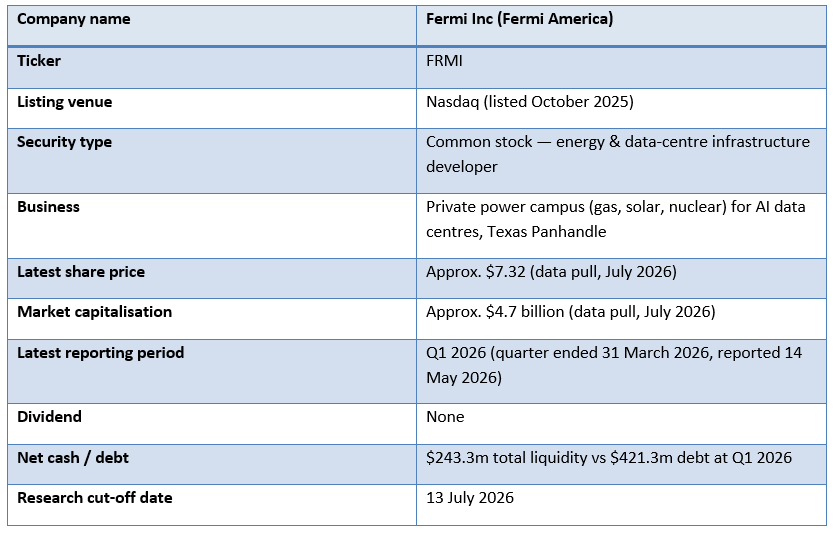
What is Fermi Inc?
Fermi Inc, operating as Fermi America, was founded in January 2025 and is based in Amarillo, Texas. It listed on Nasdaq in October 2025, pricing its IPO at $21 a share within an $18-$22 range. Co-founder and chief executive Toby Neugebauer leads the venture, with former US Energy Secretary and Texas governor Rick Perry as a prominent advisor and shareholder.
The company's core project, called "Project Matador" or the "HyperGrid" campus, sits on roughly 5,236 acres adjacent to the Department of Energy's Pantex site near Amarillo. The plan combines gas turbines, solar and battery storage, and eventually Westinghouse AP1000 nuclear reactors, supplying electricity directly to AI data centres on the same land. Fermi is targeting around 11 gigawatts of permitted capacity, with a vision of up to 17 gigawatts.
Why is FRMI attracting attention?
FRMI drew heavy investor interest at listing, briefly reaching a market capitalisation of roughly $16 billion despite no revenue, reflecting appetite for exposure to AI-driven electricity demand. Rick Perry's involvement and the campus's scale generated substantial coverage in the US energy and technology press.
Since then the shares have been volatile: the 52-week range spans $4.47 to $36.99, and the stock recently traded around $7.32, a market capitalisation near $4.7 billion, down roughly 71% from its high. Press reports of possible power-supply talks with AI developers, including speculation linking Fermi to OpenAI's capacity needs, have triggered price swings, though Fermi had not confirmed such a contract in filings as of the latest quarter.
Latest financial and corporate developments
Fermi reported Q1 2026 results on 14 May 2026, framing the update as a "Fermi 2.0" strategic evolution from start-up to a "scaled, institutional public company." The quarter showed a net loss of $188.7 million ($0.30 per diluted share), driven mainly by non-cash share-based compensation of around $134 million and a $25 million debt-extinguishment charge after repaying a Macquarie term loan.
On construction, Fermi said it had secured over 2 gigawatts of power-generation commitments, advanced roughly 11 gigawatts of permitted capacity toward its 17-gigawatt target, and obtained a 6-gigawatt Clean Air Permit from Texas regulators. The project was also named an NRC environmental-review pilot participant, with progress on gas pipelines, fencing, water lines and transmission connections.
The land, infrastructure and real-asset angle
It is worth being precise about what kind of "real asset" story this is. Fermi controls a very large parcel of Texas land, central to its business case, but the model is industrial and infrastructural, not landlord-tenant. The company is not collecting lease income from third-party occupiers as a conventional property REIT does; its value rests on building and operating power-generation and data-centre-ready infrastructure on that land.
Future "tenant" relationships, such as hyperscale AI or data-centre operators taking capacity on the campus, would likely be structured as power off-take or hosting agreements rather than traditional leases. As of the latest filing, Fermi was still working to secure binding tenant agreements, meaning this side of the business remains unproven.
Balance sheet, funding and cash
At the end of Q1 2026, Fermi reported cash and equivalents of $207.5 million plus restricted cash of $35.8 million, giving total liquidity of about $243.3 million, against debt of $421.3 million. During the quarter it arranged new financing facilities totalling around $785 million, the largest a $500 million equipment-financing facility backed by Japan's MUFG, alongside a $156 million commitment from Yorkville for general corporate purposes.
Capital expenditure on plant and equipment reached $441 million in the quarter, taking cumulative invested capital to roughly $1.4 billion since inception. Given the build-out's scale, further capital raises appear likely, a dilution risk for shareholders.
Dividend and capital-returns position
Fermi Inc pays no dividend. Data providers show its forward dividend and yield fields as blank or nil, consistent with a pre-revenue, cash-burning developer still in construction. There is no indication of any near-term plan to introduce a dividend, buyback or other capital return; retained cash is directed entirely toward construction and equipment financing.
Sector and macro backdrop
Fermi sits within a theme dominating US markets through 2025 and into 2026: surging electricity demand from AI data centres, and the search for reliable, large-scale power. Grid connections in many US regions face multi-year queues, prompting "behind-the-meter" private-power-campus models pairing generation directly with compute demand.
Nuclear power, particularly advanced designs such as the Westinghouse AP1000 units Fermi has selected, has attracted renewed political and investor support as a low-carbon complement to gas and renewables. That backdrop has fuelled enthusiasm for developers like Fermi, but has also made pre-revenue valuations unusually volatile.
Valuation context
Conventional metrics such as price-to-earnings or yield are not meaningful for FRMI given its lack of revenue; trailing twelve-month earnings per share stood at roughly negative $1.14. Analysts instead watch project-based proxies, permitted gigawatts, capital committed, financing secured, though these do not translate into a standard multiple.
The wide 52-week range, $4.47 to $36.99, shows how sensitive the market has been to newsflow. Given the absence of an earnings base, any valuation carries significant uncertainty, and this article offers no fair-value view or recommendation.
Main risks
Execution risk sits at the centre of the Fermi story: building gigawatt-scale gas, solar and nuclear capacity on a compressed timetable is demanding, and nuclear components face lengthy regulatory review. Funding risk follows closely, given the multi-billion-dollar total cost against roughly $243 million of Q1 2026 liquidity.
Further capital raises could dilute shareholders, while the business stays concentrated in a single site and few suppliers and lenders. Regulatory risk extends to environmental permitting and grid interconnection approvals. As a newly listed, pre-revenue company whose shares have fallen sharply from post-IPO highs, FRMI also carries speculative-valuation risk typical of early-stage plays.
What investors may watch next
Near-term catalysts likely include progress on binding power off-take or tenant agreements, further permitting or NRC review milestones, and updates on the $785 million of new financing being drawn down. Confirmation, or otherwise, of reports linking Fermi to major AI developers as future power customers would also likely move the shares.
Balanced conclusion
Fermi Inc is not the conventional property company its "Real Estate" data-provider tag might suggest; it is a newly listed, pre-revenue US energy and data-centre developer pursuing an ambitious gigawatt-scale power campus in Texas, backed by well-known energy-policy figures and substantial new financing. Both the opportunity and the execution challenge are unusually large for a company at this stage.
With no dividend, no revenue, a net loss exceeding $180 million last quarter, and a share price down sharply from its post-listing peak, FRMI remains a high-uncertainty, developmental story rather than an income holding. Investors may wish to track project financing, permitting progress and any confirmed customer agreements, and treat data-platform classification labels with caution given the business's complexity.


 Nov 13, 2026





 Please wait processing your request...