
 CA
 NZ
 US
 AU
 IND

 UK

 Share
 X (Formerly Twitter)
 Whatsapp
 Facebook
 LinkedIn
 Telegram
 Email This Article
 Copy Link
 Summarize with AI
 Chat GPT
 Perplexity

Summary
Grainger plc (LSE:GRI) is the UK's largest listed residential landlord and, since October 2025, a UK REIT focused on build-to-rent housing. It is in focus after half-year results to 31 March 2026 showed net rental income up 7.8% to £66.1m and a 3% higher 2.94p interim dividend. The trailing yield is roughly 4.7%-4.9%. The main catalyst is expanding rental demand; the main risk is a 40.2% loan-to-value ratio against a falling asset base.
Key takeaways
- Grainger reported half-year (to 31 March 2026) net rental income of £66.1m, up 7.8% year on year, with EPRA earnings of £31.4m.
- The company completed its conversion to a UK REIT during the period, reshaping how its rental profits are taxed and distributed.
- EPRA net tangible assets eased to 290p per share, leaving the roughly 175p share price at a wide discount to stated asset value.
- The interim dividend rose 3% to 2.94p; the FY2025 total was 8.31p, putting the trailing yield near 4.7%-4.9%.
- Loan-to-value climbed to 40.2% and net debt to £1,524m, and management is targeting £300-350m of deleveraging by FY29.
Introduction
Grainger plc (LSE:GRI) is drawing renewed attention from income and property investors as Britain's build-to-rent (BTR) market continues to expand and the company settles into its new life as a real estate investment trust. As at the research cut-off of 13 July 2026, the shares traded at roughly 175p, giving a market capitalisation of about £1.29 billion and a trailing dividend yield in the region of 4.7% to 4.9%, broadly in line with the screening snapshot that first flagged the stock.
The immediate trigger is Grainger's half-year results for the six months to 31 March 2026, published on 14 May 2026, which showed net rental income rising 7.8% to £66.1m even as the valuation of its portfolio slipped slightly. With the group now reporting as a UK REIT, having completed its conversion during the period, the results offer a first look at how the tax change interacts with a business still investing heavily in new rental homes. The story matters now because rental demand remains firm while borrowing costs and asset values are still adjusting.
Key facts 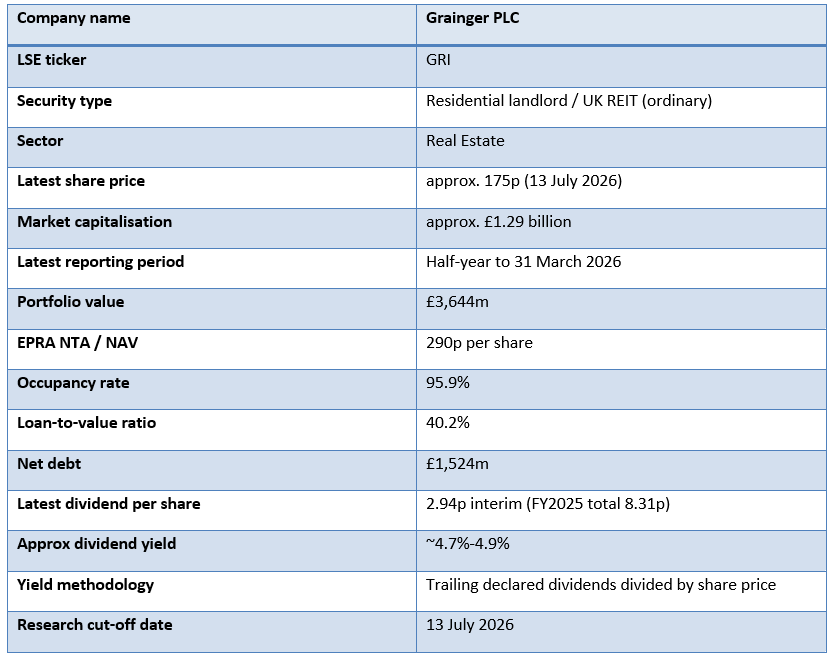
Company overview
Grainger describes itself as the UK's largest listed residential landlord. Its strategy has shifted over the past decade from a legacy portfolio of regulated and reversionary tenancies towards purpose-built, professionally managed private rented sector (PRS) housing, commonly branded build-to-rent. These are apartment blocks designed specifically for renting, with on-site management, communal amenities and longer-term tenancy options.
Why is GRI attracting attention?
The clearest reason is the combination of resilient rental growth and a share price sitting well below stated net asset value. Grainger's half-year net rental income rose 7.8%, and the company reiterated guidance for full-year EPRA earnings of around £60m, up roughly 12% on the prior year, pointing to the operational leverage that comes as newly built schemes fill up.
Latest financial performance
For the six months to 31 March 2026, Grainger reported net rental income of £66.1m, up 7.8% from £61.3m a year earlier, and EPRA earnings of £31.4m, up 4.0% from £30.2m. Like-for-like rental growth was 3.1%, moderating from 4.4% in the comparable period as headline rental inflation across the sector cooled from its earlier peaks.
Management maintained guidance for full-year FY26 EPRA earnings of about £60m, an increase of roughly 12% year on year, and set a medium-term target of about £72m by FY29, a rise of around 35%. These figures are company guidance rather than editorial forecasts. The trajectory depends on new schemes reaching stabilised occupancy and on rents holding up, so investors may treat the targets as ambitions supported by a visible pipeline rather than as certainties.
Portfolio and operating performance
Occupancy across the portfolio was 95.9% at the half-year, down from 98.0% a year earlier, a level management attributed partly to the lease-up phase of newly delivered buildings. The total portfolio was valued at £3,644m, down 1.1% over the six months, reflecting the wider repricing of property assets rather than any collapse in demand.
Balance sheet and debt (GRI)
Grainger's loan-to-value ratio rose to 40.2% at 31 March 2026 from 38.4% at the previous year-end, while net debt increased to £1,524m from £1,463m. The rise reflects continued investment in the pipeline against a modestly lower asset base, and it is the metric most likely to concern cautious investors.
The average cost of debt eased slightly to 3.2% from 3.3%, which is relatively low versus current market rates and reflects historic fixed-rate borrowing. Management has flagged a deleveraging plan targeting a £300m to £350m reduction in net debt by FY29, to be achieved through a mix of asset sales and retained cash flow. Whether that plan proceeds smoothly will depend on transaction markets and on rents continuing to support cash generation; covenant headroom and refinancing timing are worth monitoring.
Dividend analysis
Grainger declared an interim dividend of 2.94p per share for the first half of FY26, up 3.0% year on year. For the prior financial year (FY2025) the total dividend was 8.31p, comprising a 2.85p interim and a 5.46p final. Against a share price of about 175p, that FY2025 total equates to a trailing yield of roughly 4.7% to 4.9%; data providers such as DividendMax quoted a yield close to 4.9% at the research date.
This is a trailing calculation based on declared dividends and the current price. Dividend cover on an EPRA earnings basis has historically been around 1.9 times, which provides some cushion, and the REIT structure obliges the group to distribute the bulk of its qualifying rental profits. Even so, the dividend is progressive rather than guaranteed: it competes for cash with a sizeable development pipeline and a deleveraging goal, so future growth could be measured. No distribution should be regarded as certain.
UK housing and build-to-rent backdrop
The wider backdrop remains supportive for rental landlords in demand terms. A persistent shortfall of new homes, constrained mortgage affordability and steady household formation have kept rental demand firm across much of the UK, underpinning occupancy and rent growth for professionally managed portfolios.
Set against that, the sector is sensitive to interest rates and to the valuation cycle. Higher gilt yields raise the discount rates applied to property and can pressure asset values, as Grainger's small half-year valuation decline illustrates. Policy is another variable: rental regulation, planning rules and any changes to the tax treatment of housing can all affect returns. The build-to-rent segment specifically continues to attract institutional capital, which supports long-term values but also increases competition for sites.
Valuation context
The most striking valuation feature is the gap between the share price and asset value. With EPRA NTA at 290p and the shares near 175p, Grainger traded at a discount of roughly 40% to stated net tangible assets at the research date. Such a discount is not unusual across UK-listed property in the current cycle and can reflect leverage, development risk and scepticism about carrying valuations.
Main risks
Key company-specific risks include the elevated loan-to-value ratio of 40.2% and net debt of £1,524m, which increase sensitivity to interest rates and refinancing conditions. A further decline in residential values would raise LTV mechanically and could slow the deleveraging plan. Development risk is also material: schemes in the pipeline must be completed on budget and let up to deliver their expected returns.
Other risks include softer rental growth if affordability tightens, a lower occupancy drag during lease-up phases, and policy or regulatory changes affecting the private rented sector. The dividend, while covered, could grow more slowly if cash is prioritised for debt reduction. Finally, the persistent discount to NTA may endure, limiting share-price re-rating even if operations perform well.
What investors may watch next
Near-term monitoring points include Grainger's full-year results for the year to 30 September 2026, typically reported in November, which will show whether the £60m EPRA earnings guidance was met and how the dividend is set. Investors are also likely to track progress on the £300m-£350m deleveraging target, occupancy as new schemes stabilise, and any updates to the committed development pipeline.
Balanced conclusion
Grainger enters the second half of its first year as a REIT with rental income growing, a maturing build-to-rent pipeline and a share price at a wide discount to stated asset value. The half-year results showed the operational momentum that management is relying on to hit its earnings targets, and the modestly higher interim dividend signals continued confidence in cash generation.


 Nov 13, 2026





 Please wait processing your request...