
 CA
 NZ
 US
 AU
 IND

 UK

 Share
 X (Formerly Twitter)
 Whatsapp
 Facebook
 LinkedIn
 Telegram
 Email This Article
 Copy Link
 Summarize with AI
 Chat GPT
 Perplexity

Summary
Harworth Group plc (LSE:HWG) is a UK land regeneration and development company that buys, improves and sells strategic land for industrial, logistics and residential use. It is in focus after 2025 full-year results showed EPRA net disposal value of 224.4p per share and a 10% dividend increase to 1.775p. Shares traded near 127p, a wide discount to asset value, with a modest ~1.4% yield. The main catalyst is logistics and data-centre land demand; the key risk is development and planning timing.
Key takeaways
- Harworth reported EPRA net disposal value of 224.4p per share (£727.3m) for the year to 31 December 2025.
- The 2025 total dividend rose 10.0% to 1.775p, though the yield remains modest at roughly 1.4%.
- Loan-to-value was conservative at 15.6% (net debt £145.9m), giving balance-sheet capacity for investment.
- The portfolio was valued at £937.2m, delivering a total property return of 8.4%, ahead of the MSCI UK benchmark of 5.6%.
- Harworth is positioning land for industrial, logistics, residential and emerging data-centre uses, with around 0.8GW of power connections secured or in the pipeline.
Introduction
Harworth Group plc (LSE:HWG) is attracting fresh interest as the uses for large parcels of British land evolve, from traditional housing and logistics towards power-hungry data centres. As at the research cut-off of 13 July 2026, the shares traded at roughly 127p, giving a market capitalisation of about £417m and a trailing dividend yield near 1.4%, close to the screening figure that highlighted the stock.
The current focus follows Harworth's full-year results for 2025, published on 17 March 2026, which reported EPRA net disposal value of 224.4p per share and a 10% increase in the dividend. Unlike a rental REIT, Harworth is primarily a land-value business, so the story matters less for income and more for how it turns raw and brownfield land into serviced, consented sites that others pay to develop. That model is being tested by shifting demand across UK real estate.
Key facts 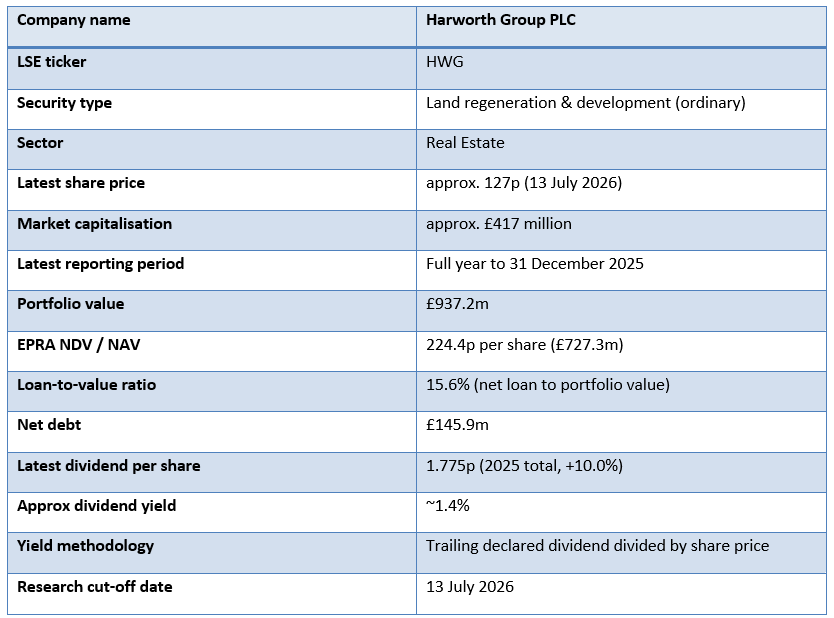
Company overview
Harworth acquires land, secures planning permissions, remediates and services sites, and then either sells serviced plots or retains completed industrial and logistics assets. Its two core activities are capital growth, from moving land through the planning and infrastructure process, and income, from a growing portfolio of investment properties.
Why is HWG attracting attention?
Harworth sits at the intersection of several strong structural themes: demand for modern logistics space, the shortage of housing land, and the rapid growth of data centres that need large, well-located sites with access to power. The company highlighted around 0.8GW of power connections either conditionally secured or in its pipeline for data-centre opportunities, a notable pivot that broadens the potential buyer base for its land.
Latest financial performance
In its 2025 results, Harworth reported EPRA net disposal value of 224.4p per share, equivalent to about £727.3m in total. The total accounting return for the year was 1.7%, a modest outcome that reflected the mix of valuation movements, transaction timing and dividends, even as the underlying property return was a stronger 8.4%.
Operationally, the company completed residential plot sales totalling 1,837 plots in 2025, comprising 1,112 freehold plots and 725 through planning promotion agreements, and reported around 1.6m sq ft of active interest across its industrial and logistics pipeline. These figures are drawn from company disclosures. Because Harworth's earnings depend heavily on the phasing of individual deals, single-year returns can understate or overstate the longer-run trajectory management targets.
Portfolio and pipeline
The total portfolio was valued at £937.2m at the end of 2025. Harworth's strategy has increasingly tilted towards retaining and building out industrial and logistics assets, repositioning the business towards recurring income alongside its traditional land-trading activity.
Balance sheet and debt (HWG)
Harworth maintains a conservative balance sheet relative to many property companies. Net loan to portfolio value stood at 15.6% at the end of 2025, with net debt of £145.9m against the £937.2m portfolio. That modest gearing gives the company headroom to fund infrastructure spending and selective acquisitions without over-stretching.
A lower leverage profile is appropriate for a business with an inherently cyclical, transaction-driven earnings stream, since it reduces the risk of forced sales in a downturn. Investors nonetheless watch how much capital is committed to speculative infrastructure ahead of confirmed sales, and how quickly that capital is recycled, because tied-up cash in unsold sites is the principal working-capital risk in this model.
Dividend analysis
Harworth raised its total 2025 dividend by 10.0% to 1.775p per share, continuing a progressive policy. Against a share price of about 127p, that equates to a trailing yield of roughly 1.4%, in line with the screening snapshot and low by real-estate standards.
The modest yield reflects Harworth's identity as a capital-growth vehicle rather than an income stock: most of the value it aims to create shows up in net disposal value per share, not in distributions. The dividend is progressive but not guaranteed, and it is funded from a business whose cash flows are inherently uneven. Income-focused readers should recognise that dividends are a secondary part of the total-return proposition here.
UK development and logistics backdrop
The backdrop for Harworth blends supportive demand with familiar frictions. Occupier and investor appetite for modern logistics space has been resilient, the UK continues to face a structural housing shortfall, and data centres represent a fast-growing new source of land demand tied to cloud computing and artificial intelligence.
Working against these tailwinds are planning delays, construction-cost inflation and the sensitivity of land values to interest rates. Higher borrowing costs can slow the pace at which housebuilders and developers commit to new sites, affecting the timing of Harworth's plot sales. Power availability and grid connections have also become a decisive factor in where large-scale development can happen, which is precisely why Harworth's secured power capacity is strategically relevant.
Valuation context
With the shares near 127p and EPRA net disposal value at 224.4p, Harworth traded at a discount of roughly 43% to stated asset value at the research date. Discounts of this size are common across UK land and development companies, reflecting the uncertainty of realising asset values and the cyclicality of the sector.
Because Harworth is a land-value rather than a yield play, price-to-NDV, the track record of growing NDV per share and total accounting return are the most relevant yardsticks, rather than dividend yield. The five-year cumulative total accounting return of 44.5% gives longer-term context. Readers should weigh the discount against execution and timing risks; nothing here is a recommendation.
Main risks
The principal risks are development and planning timing: sites can take years to secure consents, and delays push back the realisation of value. Construction-cost inflation and infrastructure spend can erode margins, while a weaker housing or logistics market would slow plot sales and pressure valuations.
Other risks include the cyclicality of land values, concentration in individual large projects, and the capital tied up in sites ahead of sale. The move into data-centre-related land, while promising, is relatively new and depends on power availability and demand holding up. The low dividend yield also means the stock offers limited income cushion if capital growth stalls.
What investors may watch next
Investors are likely to focus on Harworth's half-year results for the six months to 30 June 2026, usually published in September, for updates on land sales, the industrial and logistics build-out, and progress on data-centre opportunities and power connections. Growth in EPRA net disposal value per share will be a key measure.
Beyond the company, planning decisions, interest-rate moves affecting developer appetite, and demand signals from logistics occupiers and data-centre operators will shape the outlook. No specific transaction dates should be assumed beyond scheduled reporting.
Balanced conclusion
Harworth Group offers exposure to UK land regeneration at a time when the uses for large, well-located and power-connected sites are broadening. The 2025 results showed steady growth in net disposal value to 224.4p per share, a 10% dividend increase and a conservative balance sheet, alongside a total property return that beat the market benchmark.
The trade-offs are a low income yield, earnings that swing with transaction timing, and the execution risk inherent in planning and development. The shares' wide discount to net disposal value reflects that uncertainty. For readers, the key questions are whether Harworth can keep compounding net disposal value per share, how quickly its logistics and data-centre pipeline converts, and whether the discount narrows. This article is information only and not investment advice.


 Nov 13, 2026





 Please wait processing your request...