
 CA
 NZ
 US
 AU
 IND

 UK

 Share
 X (Formerly Twitter)
 Whatsapp
 Facebook
 LinkedIn
 Telegram
 Email This Article
 Copy Link
 Summarize with AI
 Chat GPT
 Perplexity

Summary
Helical plc (LSE:HLCL) is a central London office development and investment REIT that works mainly through joint ventures. It is in focus after full-year results to 31 March 2026 showed EPRA net tangible assets of 351p per share and a large development pipeline, including a partnership with Transport for London's Places for London. The shares near 190p sit at a wide discount to NAV. The main catalyst is London's office supply-demand imbalance; the key risks are development execution and a low recurring dividend.
Key takeaways
- Helical's EPRA net tangible assets edged up to 351p per share at 31 March 2026, against a share price near 190p.
- The ordinary dividend was cut to 2.5p (from 5.0p), but a one-off return of capital of about £17m (13.9p per share) was proposed.
- See-through loan-to-value rose to 36.5% during the development phase, with a pro-forma figure of 20.7% after a large forward sale.
- Helical forward-sold 100 New Bridge Street, EC4 to State Street for £333m (its share £166.5m), de-risking a key scheme.
- Its pipeline runs largely through the Places for London joint venture with Transport for London, targeting best-in-class central London offices.
Introduction
Helical plc (LSE:HLCL) is back in investors' sights as central London's office market navigates a two-speed recovery, with strong demand for the best buildings and weakness in secondary space. At the research cut-off of 13 July 2026, the shares traded near 190p, giving a market capitalisation of about £238m and an ordinary dividend yield of roughly 1.3%, close to the screening snapshot.
The focus follows Helical's annual results for the year to 31 March 2026, published in May 2026, which reported EPRA net tangible assets of 351p per share and progress across a substantial development pipeline. Helical also proposed a return of capital after forward-selling a major scheme. The story matters now because the group is midway through building a new generation of London offices through joint ventures, and the market is judging how much value that pipeline can unlock.
Key facts 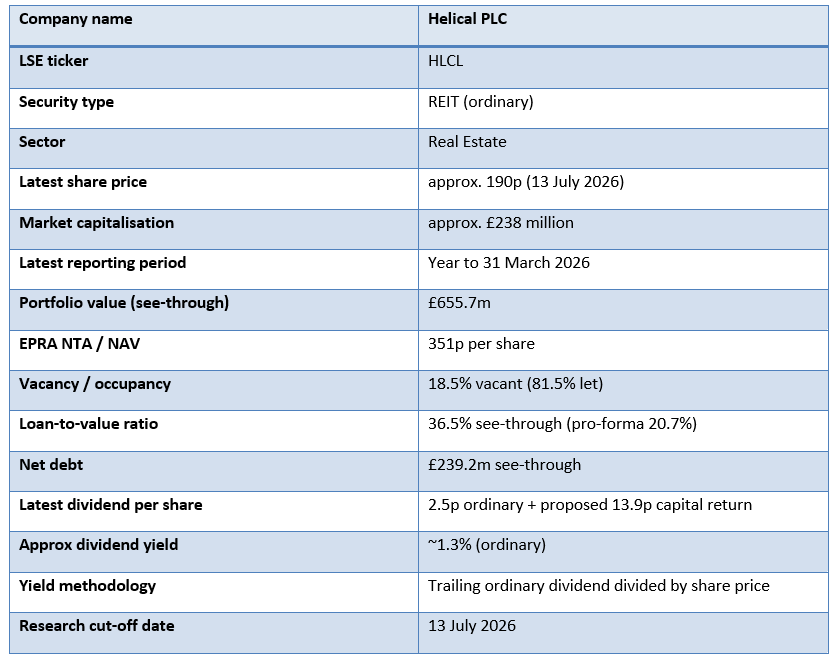
Company overview
Helical is a specialist central London office developer and investor. Rather than owning a large standing portfolio outright, it increasingly operates through capital-efficient joint ventures, most notably with Places for London, the property arm of Transport for London, sharing both the cost and the risk of large schemes.
Why is HLCL attracting attention?
Helical offers geared exposure to a specific thesis: that central London faces a shortage of modern, low-carbon office space while demand from occupiers concentrates on the highest quality buildings. Management pointed to resilient occupier demand and a constrained development pipeline, and even flagged artificial-intelligence adoption as a net positive for office demand.
Latest financial performance
For the year to 31 March 2026, Helical reported EPRA net tangible assets of 351p per share, up modestly from 348p, and a total accounting return of 2.3%, down from 6.0% the prior year. EPRA earnings per share were 4.5p, up from 2.2p, helped by development and leasing progress.
The headline shareholder returns were reshaped: the ordinary dividend was set at 2.5p, half the prior year's 5.0p, while a separate return of capital of about £17m, equivalent to 13.9p per share, was proposed following the New Bridge Street sale. These are company decisions reflecting a shift from recurring dividends towards returning realised development gains. As always, such distributions depend on completing sales and are not guaranteed to recur.
Portfolio and development activity
Helical's see-through portfolio was valued at £655.7m. The completed investment portfolio was 81.5% let, implying a vacancy of 18.5%, though the company said this would fall towards 11.3% once agreed lettings at The Bower, EC1 complete.
Balance sheet and debt (HLCL)
Helical's see-through loan-to-value rose to 36.5% at 31 March 2026 from 20.9% a year earlier, reflecting spending on developments, with see-through net borrowings of £239.2m (IFRS net borrowings were lower at £140.8m). On a pro-forma basis, after the New Bridge Street sale proceeds and the proposed capital return, management put see-through LTV at about 20.7%.
That gap between reported and pro-forma leverage matters: it shows the balance sheet is expected to de-gear sharply as sales complete. Investors will nonetheless watch financing on ongoing schemes, joint-venture funding commitments and the pace of asset sales, since development-phase leverage raises sensitivity to any slippage in timing or values.
Dividend analysis
Helical's recurring income is modest. The ordinary dividend for FY26 was 2.5p, down from 5.0p, giving a trailing yield of roughly 1.3% against a 190p share price. The reduction reflects Helical's development-led model, where returns come more from crystallising gains than from steady rents.
Separately, the proposed £17m return of capital, about 13.9p per share, would deliver a one-off boost to shareholders funded by the New Bridge Street forward sale. Investors should treat that as a special, non-recurring distribution rather than a sustainable yield. The recurring dividend is not guaranteed and is likely to remain low while capital is tied up in development.
Central London office-market backdrop
The backdrop is a polarised market. Occupiers are competing for the best, most sustainable space, supporting rents and values at the top end, while older, less efficient buildings face rising vacancy and obsolescence. A constrained development pipeline, driven by high build costs and financing hurdles, limits new supply of prime space, which favours well-located new schemes of the kind Helical builds.
Set against that, higher interest rates and elevated construction costs weigh on development viability and valuations, and any softening in London employment or financial-sector demand would hit the market Helical serves. The pace of the recovery remains uneven and sensitive to the wider economy.
Valuation context
With the shares near 190p and EPRA NTA at 351p, Helical traded at a discount of roughly 46% to net tangible assets at the research date, one of the wider discounts among London office names. Such a gap reflects development risk, the lag before schemes complete, and scepticism about carrying valuations.
For a development-led company, the relevant lenses are the discount to NTA, the visible pipeline of value creation, and the track record of realising gains through sales, rather than dividend yield. The proposed capital return narrows the effective entry cost. None of this is a recommendation; it is context for readers to weigh against execution risk.
Main risks
The principal risks are development execution and timing: schemes such as Delta Paddington and the Southwark project complete years out, and delays or cost overruns would hit returns. Vacancy in the standing portfolio, at 18.5%, must be leased up to support income, and joint-venture arrangements add complexity and shared control.
Other risks include the sensitivity of London office values to interest rates and demand, financing needs on active schemes, and the low recurring dividend, which offers little income cushion. A weaker office market could also delay the profitable sales on which Helical's returns and capital distributions depend.
What investors may watch next
Near-term watch points include completion and leasing of 10 King William Street and Brettenham House, further lettings at The Bower, and shareholder approval and payment of the proposed capital return. Progress on Delta Paddington and the Southwark scheme will shape the medium-term value creation story.
Helical's interim results, typically in the autumn, will update on NTA, leasing and the pipeline. Broader signals such as London office take-up, prime rents and interest-rate moves will also influence sentiment. No specific dates beyond disclosed scheme timelines should be assumed.
Balanced conclusion
Helical offers a focused, development-led play on the recovery of prime central London offices, executed through capital-efficient joint ventures. Its FY26 results showed a slightly higher net asset value, a major de-risking sale to State Street, and a shift towards returning realised gains via a proposed capital return rather than a large recurring dividend.
The counterpoints are a low ordinary yield, development-phase leverage, standing-portfolio vacancy still to be leased, and the multi-year timelines on its biggest schemes. The wide discount to net tangible assets captures that uncertainty. For readers, the questions are whether Helical can deliver its pipeline profitably, lease up existing space, and keep converting projects into cash. This article is information only and not investment advice.


 Nov 13, 2026





 Please wait processing your request...