
 CA
 NZ
 US
 AU
 IND

 UK

 Share
 X (Formerly Twitter)
 Whatsapp
 Facebook
 LinkedIn
 Telegram
 Email This Article
 Copy Link
 Summarize with AI
 Chat GPT
 Perplexity

Summary
Henry Boot PLC's 5.25% Cumulative Preference Shares (LSE: BD82) traded at 75.50p on 13 July 2026, putting the running yield at roughly 6.95%, matching the original screening figure. Only 400,000 shares exist, so trading is thin. The coupon ranks ahead of Henry Boot's ordinary dividend and is cumulative, but is not guaranteed. Group net debt and gearing rose in FY2025, and 2026 profit guidance has been trimmed.
Key takeaways
- BD82 is Henry Boot PLC's 5.25% Cumulative Preference Shares of £1 each, separate from the BOOT ordinary shares.
- At 75.50p on 13 July 2026, the fixed 5.25p coupon gives a running yield of approximately 6.95%, matching the original screening figure.
- The dividend is cumulative and ranks ahead of ordinary dividends, but payment still depends on Henry Boot declaring it; it is not guaranteed.
- Henry Boot's net debt rose to £108.0m and gearing to 25.7% in FY2025, above its 10-20% target range, and 2026 profit guidance has been reduced.
- Only 400,000 shares are in issue and recent trading appears sparse, so liquidity is limited and spreads can be wide.
Introduction
Henry Boot PLC is best known through its ordinary shares, ticker BOOT, a diversified land, property and construction group on the London Stock Exchange. Fewer investors know it also has a small class of preference shares, ticker BD82, which behave more like a fixed-income instrument.
These shares carry a fixed 5.25% coupon on their £1 nominal value and trade at a discount to par, lifting the running yield above the coupon. This article sets out what BD82 is, how its coupon and priority work, and the issuer and liquidity risks worth weighing.
Key facts 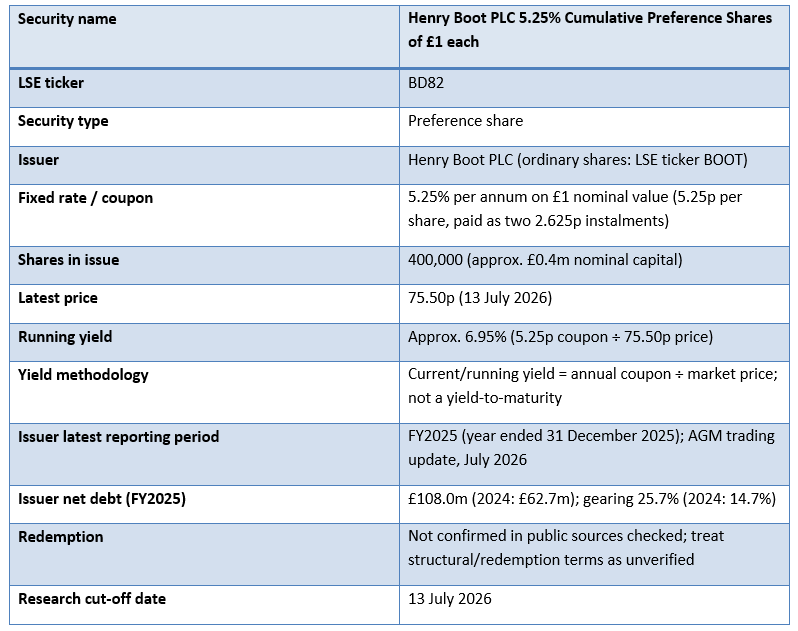
What are the Henry Boot preference shares?
BD82 is the ticker for Henry Boot PLC's 5.25% Cumulative Preference Shares of £1 each, per the exchange's own listing and data providers such as LSE.co.uk. There are 400,000 shares in issue, a nominal value of around £400,000 — a tiny slice of Henry Boot's capital.
The fixed dividend equals 5.25% of nominal value, or 5.25p per share yearly, paid as two semi-annual 2.625p instalments. Being cumulative, any dividend the board does not declare accrues rather than lapsing, and must be paid before any ordinary dividend.
Public sources checked did not confirm a redemption date, capital-return terms in a winding-up, or voting rights for this class. Legacy UK cumulative preference shares are often structured without a fixed redemption date, but that is general context, not a confirmed fact for BD82.
Why is BD82 attracting attention?
The appeal is simple: a fixed, cumulative coupon trading below its £1 par value produces a yield above the 5.25% coupon rate. At 75.50p, that works out at roughly 6.95%, which is what put BD82 on income investors' radar.
That said, BD82 is a niche holding. With only 400,000 shares in issue and, per LSE.co.uk, little recent dealing, this is not a security most investors could buy or sell in size without moving the price.
The issuer: how is Henry Boot PLC performing?
Henry Boot reported profit before tax of £29.1m for the year to 31 December 2025 (2024: £30.7m), with continuing operations at £26.4m, per results published 24 March 2026. The figure was flattered by profit recognition on the disposal of Henry Boot Construction, treated as discontinued.
NAV per ordinary share was broadly stable at 312p, while the total ordinary dividend rose 2.1% to 7.86p. Net debt rose sharply to £108.0m from £62.7m, pushing gearing to 25.7%, above the group's 10-20% target range, on higher land acquisition and planning spend.
The July 2026 AGM update said 2026 profit before tax is expected in line with reduced consensus, weighted to the second half, citing Middle East conflict and political uncertainty affecting confidence — more cautious than March, when 2026 consensus stood near £33.6m.
On the positive side, Hallam Land had a record 2025 with 3,957 plot sales, up almost 50% on 2024, and had exchanged on 465 plots with a further 2,181 under offer by July.
How do the preference shares differ from the ordinary shares?
The ordinary shares (BOOT) give full exposure to Henry Boot's land, property and housebuilding businesses, including capital growth or loss, plus a variable dividend the board can raise, hold or cut — it rose 2.1% to 7.86p in FY2025.
The preference shares (BD82) offer none of that upside. Holders get a fixed 5.25p coupon regardless of trading performance and do not participate in NAV growth (312p per ordinary share). In exchange, they generally rank ahead of ordinary shareholders for their dividend, with unpaid coupons accumulating rather than being forfeited.
In short, BOOT is a play on UK land and property markets, while BD82 behaves closer to a fixed-income instrument.
How is the coupon and yield calculated, and where does it rank?
The 5.25% rate applies to £1 nominal value, giving a fixed 5.25p per share yearly. Because BD82 trades below par, at 75.50p, the running yield — coupon divided by price — comes to approximately 6.95%. This is a current yield, not a yield-to-maturity, since no confirmed redemption date was identified.
The cumulative structure means preference dividends, including arrears, must be paid before any ordinary dividend. The total annual preference dividend across all 400,000 shares is only around £21,000, negligible against Henry Boot's £29.1m FY2025 profit before tax — so the real question is the group's overall financial health, not affordability of this one line item.
How sensitive is BD82 to interest rates, and how liquid is it?
As a fixed coupon with no confirmed maturity, BD82's price should in principle be sensitive to UK gilt yields, much like other long-dated fixed-income securities: rising rates tend to pressure prices lower, pushing the running yield up, and vice versa. The 52-week range of roughly 75.00p to 79.00p suggests modest movement.
Liquidity is the more immediate constraint. With only 400,000 shares in issue and LSE.co.uk showing no recent trades at research time, BD82 appears to trade rarely. Investors should expect wide bid-offer spreads and possible difficulty dealing at the quoted price.
What is the property-market and economic backdrop?
Henry Boot's July 2026 update describes resilient early-year demand dented more recently by Middle East tension and domestic political uncertainty, with larger transactions taking longer. Land values and house prices were broadly flat through 2025, though industrial property outperformed with 4.8% rental growth.
For a fixed-income-style holding like BD82, the property market matters less directly than for the ordinary shares, since the coupon does not vary with trading performance. It matters indirectly insofar as a softer market and rising leverage could affect the group's financial flexibility over time.
How does BD82's price compare with par and the coupon on offer?
At 75.50p, BD82 trades roughly 24.5% below its £1 nominal value, the source of the uplift from the 5.25% coupon to the approximately 6.95% running yield. This reflects income relative to today's price only; it does not imply the shares will trade back to par.
As a rough comparator, benchmark UK gilt yields have sat in the mid-single digits through 2026; BD82's approximately 6.95% running yield sits above that, broadly consistent with compensation for corporate credit risk, cumulative-but-not-guaranteed terms, and thinner liquidity than gilts.
What are the main risks to weigh?
Issuer risk is central: the dividend depends on Henry Boot trading profitably enough, with distributable reserves, for its board to declare it. FY2025 net debt and gearing rose above target range, while 2026 guidance has been cut — not distress, but a less comfortable starting point than a year earlier.
Liquidity risk is significant: sparse trading means investors may struggle to deal at a fair price. Interest-rate risk applies as for any long-dated fixed coupon. Structural risk around redemption and winding-up priority could not be fully confirmed from public sources — a gap worth noting. None of the yield figures here is a guarantee.
What might investors watch next?
Henry Boot's next scheduled newsflow is likely half-year results, which should clarify how the second-half weighting flagged in July is materialising, and update net debt and gearing after the FY2025 rise. Investors in BD82 may also watch RNS announcements for dividend declarations and UK gilt yield trends.
Because BD82 trades so rarely, any pickup in volume or a wider spread on data providers could itself be worth noting.
Conclusion: a fixed coupon, not a guaranteed one
Henry Boot's 5.25% Cumulative Preference Shares (BD82) offer a running yield of around 6.95% at a 75.50p price, consistent with the original screening figure. The coupon is fixed, cumulative and ranks ahead of the ordinary dividend, and the amount involved is small relative to group profits.
Against that, this is a thinly traded, small-issue security in a company whose net debt and gearing rose materially in FY2025 and whose 2026 guidance has been trimmed. This is not a recommendation to buy, sell or hold BD82. Investors should weigh the income on offer against issuer credit risk, thin liquidity, and the unresolved redemption terms, and seek independent advice.


 Nov 13, 2026





 Please wait processing your request...