
 CA
 NZ
 US
 AU
 IND

 UK

 Share
 X (Formerly Twitter)
 Whatsapp
 Facebook
 LinkedIn
 Telegram
 Email This Article
 Copy Link
 Summarize with AI
 Chat GPT
 Perplexity

Summary
Hongkong Land Holdings (LSE:HKLB) is a Jardine Matheson group property company that owns premium offices and luxury retail in Hong Kong Central and Singapore and reports in US dollars. It is in focus after 2025 results showed underlying profit of US$458m, a 9% dividend rise to 25 US cents, and Hong Kong Central values growing for the first time since 2019. The shares yield about 3.6% and trade far below NAV of US$14.30. The catalyst is a strategy pivot; the main risk is Asian property weakness.
Key takeaways
- Hongkong Land reported 2025 underlying profit of US$458m (down 8%) and lifted its full-year dividend 9% to 25.0 US cents.
- Net asset value rose 5% to US$14.30 per share, and the Hong Kong Central portfolio grew in value for the first time since 2019.
- Hong Kong Central office vacancy improved to 6.0%, from 7.1% a year earlier.
- The group recycled US$3.6bn of capital (90% of its 2027 target) and bought back over US$330m of shares, cutting the count by 2.4%.
- At around US$7 the London-listed shares trade at roughly half of stated NAV, giving a trailing yield near 3.6%.
Introduction
Hongkong Land Holdings Limited (LSE:HKLB) is back on investors' radar as its multi-year strategic overhaul begins to show in the numbers and Hong Kong's prime office market stabilises. A member of the Jardine Matheson group, the company reports in US dollars and is listed in London, Singapore and Bermuda. At the research cut-off of 13 July 2026, the London line traded around £5.55 (roughly US$7), with a trailing dividend yield near 3.6%, a touch above the 3.37% screening snapshot, which is retained in the headline.
The renewed focus follows Hongkong Land's 2025 results, published on 5 March 2026, which reported underlying profit of US$458m, a 9% increase in the dividend, and, notably, the first rise in the value of its Hong Kong Central portfolio since 2019. The story matters now because it tests whether the group's pivot towards recurring income, asset management and capital recycling can revive returns after a difficult period for Asian property.
Key facts 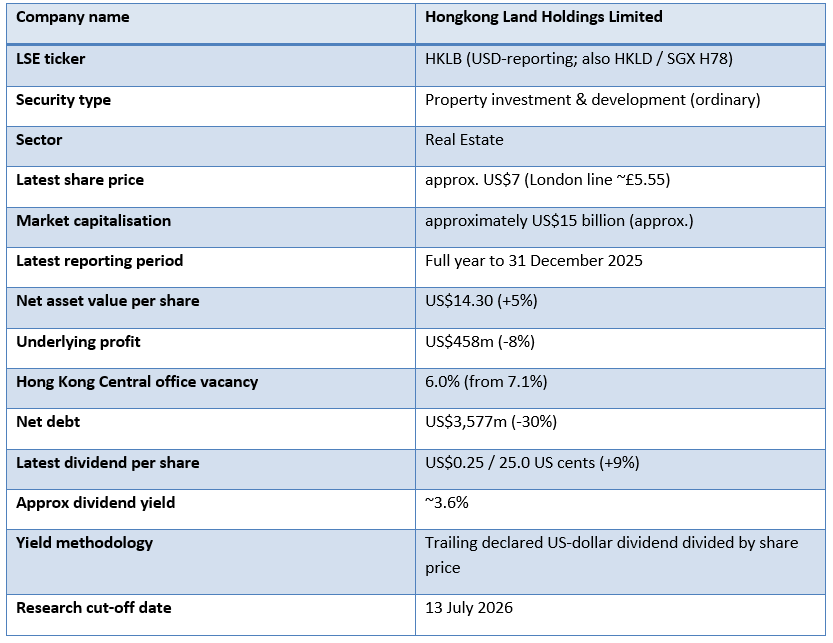
Company overview
Hongkong Land owns and manages a portfolio of high-quality commercial property, anchored by around 12 buildings in Hong Kong's Central district, including the prestigious LANDMARK luxury-retail and office complex, and prime assets in Singapore's central business district such as its interests at Marina Bay. It also has a build-to-sell residential development business, principally on the Chinese mainland, and a growing investment-management arm.
Why is HKLB attracting attention?
Two things have drawn attention: evidence that the strategy is working, and a very wide discount to asset value. The 2025 results showed Hong Kong Central values rising for the first time in six years, office vacancy improving, and rapid progress on capital recycling, with US$3.6bn realised, equal to 90% of the 2027 target.
Latest financial performance
For the year to 31 December 2025, Hongkong Land reported underlying profit of US$458m, down 8%, with underlying earnings per share of 20.98 US cents, down 7%, the decline reflecting a weaker contribution from residential development. Net asset value per share rose 5% to US$14.30, helped by the recovery in Central valuations.
Management framed 2025 as a turnaround year and guided that 2026 underlying profit should be broadly unchanged. It also advanced its transformation, launching a strategic property fund (SCPREF) with US$6.4bn of assets under management and lifting group AUM to about US$50bn. These are company disclosures; the shift from a pure developer-landlord towards an asset manager is central to the investment case but remains in progress.
Portfolio and operating performance
The prime investment portfolio grew about 3% in value net of disposals, and the Hong Kong Central estate returned to value growth for the first time since 2019, a symbolically important turning point. Central office vacancy improved to 6.0% from 7.1%, indicating firmer demand for the highest-quality space even as the wider Hong Kong office market remained soft.
Balance sheet and debt (HKLB)
Hongkong Land strengthened its balance sheet materially in 2025. Net debt fell about 30% to US$3,577m, driven by the US$3.6bn capital-recycling programme, which reduced leverage and funded buybacks and investment. Lower debt gives the group more flexibility to pursue its asset-management ambitions and to keep returning cash.
A stronger balance sheet is significant for a company exposed to the Asian property cycle, since it reduces refinancing pressure and provides resilience if valuations soften again. Investors will watch whether net debt continues to fall as further capital is recycled, and how the group balances buybacks, dividends and reinvestment in its funds platform.
Dividend analysis
Hongkong Land raised its 2025 full-year dividend by 9% to 25.0 US cents per share, comprising a 19.0-cent final and a 6.0-cent interim. Against a share price of about US$7, that equates to a trailing yield of roughly 3.6%, slightly above the 3.37% screening figure. Because the dividend is declared in US dollars, the sterling value received by London holders varies with the exchange rate.
The group also set a long-term ambition to grow the dividend towards 44.0 US cents by 2035, alongside continued buybacks. The payout is supported by recurring rental income, but 2025 underlying profit fell and 2026 is guided flat, so cover is a consideration. As with any distribution, it is not guaranteed and depends on rents, development profits and capital-recycling proceeds.
Asian property-market and macro backdrop
The backdrop is improving at the top end but still cautious overall. Hong Kong's Central office market has been oversupplied and weak since 2019, so the return to value growth in Hongkong Land's estate is an encouraging sign that prime demand is stabilising, even if secondary space remains under pressure. Singapore has been a relative bright spot for prime offices and retail.
The mainland Chinese residential market remains the biggest uncertainty, having been through a prolonged downturn that has hit developers across the region. Interest rates, the pace of any Chinese recovery, and currency movements between the US dollar, Hong Kong dollar and sterling all influence reported returns and the shares' appeal to UK-based investors.
Valuation context
The standout feature is valuation. With the shares near US$7 and net asset value at US$14.30, Hongkong Land traded at roughly half of stated NAV, a discount of around 50% at the research date. Such a gap reflects years of Asian property weakness, scepticism about carrying valuations, and the drag from China development.
Main risks
The principal risks are a renewed downturn in Hong Kong or mainland Chinese property, which would pressure valuations and development profits, and the execution risk in transforming into an asset manager. The China residential business remains a source of potential write-downs.
Other risks include the persistence of the wide discount to NAV, the sensitivity of a leveraged property owner to interest rates, and currency translation for sterling-based investors given US-dollar reporting. Underlying profit fell in 2025 and is guided flat for 2026, so near-term earnings growth is limited, and the dividend, while rising, depends on the cycle.
What investors may watch next
Investors are likely to focus on Hongkong Land's 2026 interim results, typically released around late July or early August, for updates on Central rents and vacancy, capital recycling towards the US$3.6bn-plus target, buyback progress, and the build-out of the SCPREF fund and wider asset-management platform.
Signals from the Hong Kong and Singapore office markets, any recovery in Chinese residential demand, and US dollar interest-rate moves will also shape sentiment. The pace of dividend growth towards the 2035 ambition is another marker. No specific future dates should be assumed beyond scheduled reporting.
Balanced conclusion
Hongkong Land's 2025 results marked a tentative turning point: Hong Kong Central values rose for the first time since 2019, the dividend increased 9%, net debt fell sharply, and the group pushed ahead with its shift towards recurring income and asset management. The shares' roughly 50% discount to net asset value and a yield near 3.6% capture both the opportunity and the lingering caution around Asian property.
For readers, the key questions are whether the recovery in prime Hong Kong and Singapore assets can be sustained, whether the China residential drag can be contained, and whether disciplined capital recycling and buybacks can narrow the discount over time. This article is information only, presents US-dollar figures as reported, and is not a recommendation to buy, sell or hold.


 Nov 13, 2026





 Please wait processing your request...