
 CA
 NZ
 US
 AU
 IND

 UK

 Share
 X (Formerly Twitter)
 Whatsapp
 Facebook
 LinkedIn
 Telegram
 Email This Article
 Copy Link
 Summarize with AI
 Chat GPT
 Perplexity

Summary
Supermarket Income REIT plc (LSE:SUPR) is a London-listed, internally managed REIT owning grocery property let mainly to Tesco and Sainsbury's in the UK and Carrefour in France. On 15 July 2026 it agreed to buy three supermarkets — a Sainsbury's in Manchester and Tesco stores in Edinburgh and Halifax — for about £118 million at a 6.9% net initial yield, and launched a roughly £100 million equity raise to help fund a £216 million, nine-asset pipeline at a 6.6% average yield. At 31 December 2025 the portfolio was valued near £2.06 billion, EPRA NTA was 87.5p and loan-to-value was 45%. The FY2026 dividend target is 6.18p. Key risks include equity dilution, elevated gearing, interest-rate sensitivity and tenant concentration. Shareholders vote on the issue around 3 August 2026.
Five Key Takeaways
- SUPR is acquiring a Sainsbury's in Manchester and Tesco stores in Edinburgh and Halifax for £118m at a 6.9% net initial yield.
- A roughly £100m equity raise, combining a placing and a RetailBook retail offer, will part-fund a £216m, nine-asset pipeline.
- The wider pipeline carries a 6.6% average net initial yield and management guides to earnings accretion with minimal NTA dilution.
- At 31 December 2025 the portfolio was valued at c.£2.06bn, with EPRA NTA of 87.5p and loan-to-value of 45%.
- The FY2026 dividend target is 6.18p, paid as four quarterly instalments of 1.545p, keeping SUPR among the income-oriented UK REITs.
Company Overview
Supermarket Income REIT plc is a London-listed real estate investment trust that owns and lets grocery property. Its strategy is straightforward: acquire large, omnichannel supermarkets let to strong operators on long leases, collect index-linked rent, and distribute the bulk of that income to shareholders. The trust listed in 2017 and has grown into a FTSE 250 constituent with a portfolio spread across the United Kingdom and France, anchored by the UK's leading grocers, with Tesco and Sainsbury's the two largest sources of rent, alongside continental exposure through a Carrefour portfolio. A defining feature of the income is indexation: leases are structured so that rents rise with inflation, typically with caps and collars, giving the trust protection against rising costs while limiting the upside in very high-inflation periods. A significant change came in March 2025, when SUPR internalised its management function, removing external fees and lowering its EPRA cost ratio; a lower cost base means a greater share of rental income flows through to earnings as the portfolio grows, improving the operational leverage of any expansion. As a REIT, the company benefits from tax-efficient treatment of its property income provided it distributes the required proportion, which is why the stock is held for yield rather than rapid capital growth.
What Has Happened Recently?
On 15 July 2026 the company announced two linked developments. First, it agreed to acquire a portfolio of three supermarkets for approximately £118 million at a net initial yield of 6.9%. The assets are a Sainsbury's in Manchester of about 71,000 square feet with roughly 12 years unexpired, a Tesco in Edinburgh of about 128,000 square feet with around five years unexpired, and a Tesco in Halifax of about 41,000 square feet with some eight years unexpired. The weighted average unexpired lease term across the three is around eight years, and the company describes the income as 100% inflation-linked and 100% investment-grade, with completion targeted for September 2026. Second, and on the same day, SUPR launched a fundraise of approximately £100 million in gross proceeds through a placing alongside a retail offer made via the RetailBook platform. The equity is intended to part-fund not only the £118 million portfolio but also a further six UK grocery assets earmarked for around £98 million, taking the combined near-term pipeline to roughly £216 million at an average net initial yield of about 6.6%. The company said the acquisitions are expected to be accretive to earnings per share from the first full financial year, with minimal dilution to net tangible assets. Shareholder approval for the issue is expected at a general meeting scheduled for around 3 August 2026.
Analysis of the Latest Development
The logic behind the deal is scale and income quality. Buying at a 6.9% net initial yield on the three-asset portfolio, and 6.6% across the wider pipeline, gives SUPR an income return that comfortably exceeds its dividend cost, provided its financing remains under control. Funding part of the growth with fresh equity rather than debt alone is a deliberate signal about the balance sheet: with loan-to-value already at 45% at the end of 2025, the trust has limited room to lever up further without straining its stated maximum, so issuing shares keeps gearing in check while still expanding the asset base. The key tension for investors is the price at which new shares are issued. If the raise is completed close to net asset value, the enlarged share count is easily justified by the incremental, accretive income. If the shares are placed at a meaningful discount to EPRA NTA, existing holders face dilution that erodes some of the deal's appeal. Management's framing — accretive to earnings, minimal NTA dilution — is encouraging, but it is a forward-looking claim that depends on execution, pricing and completion of every pipeline asset. The internalisation of management adds a supportive backdrop: a leaner cost ratio means each pound of new rent contributes more to distributable earnings, strengthening the case for growing the portfolio now.
Financial Performance and Balance Sheet
At 31 December 2025 the portfolio was valued at roughly £2.06 billion, with EPRA net tangible assets of 87.5 pence per share. Annualised passing rent was about £132 million, and the weighted average unexpired lease term across the whole portfolio stood at around 12 years — considerably longer than the eight-year average on the newly acquired trio, a reminder that the latest purchases sit at the shorter end of SUPR's lease profile. Loan-to-value was 45% at the period end, easing to roughly 43% pro forma once post-period transactions were reflected, against a stated maximum LTV policy of 45%. On the income side, the trust targets a dividend of 6.18 pence per share for the 2026 financial year, delivered as four quarterly payments of 1.545 pence; the fourth-quarter payment covering April to June 2026 was declared for payment on or around 21 August 2026, with an ex-dividend date of 23 July 2026. Against a share price broadly in the mid-80s pence range around the period end, that implies a running yield of roughly 3.7%, modest by the standards of some UK property peers but backed by long, indexed and investment-grade income. The EPRA cost ratio, reported at about 9% following internalisation and down from roughly 13% previously, is central to the earnings story.
Principal Assets, Products and Operations
SUPR's assets are large-format, omnichannel supermarkets — stores that serve both in-person shoppers and online fulfilment, which the company argues makes them strategically important, hard-to-replace parts of the grocers' distribution networks. The portfolio spans around 130 grocery assets across the UK and France as described in the July 2026 update, with the French exposure held through a Carrefour portfolio of roughly 31 assets. Occupancy has historically been very high, reflecting the essential nature of the tenants and the long lease structures. Tenant concentration is a defining characteristic: Tesco is the single largest source of rent, with Sainsbury's the next largest, so the covenant strength of the two dominant UK grocers is a major determinant of income security. The newly agreed assets deepen exposure to both names. Geographically, the additions in Manchester, Edinburgh and Halifax reinforce a nationwide UK footprint, while the indexed rent reviews on the new leases fit the trust's core model of capturing inflation over time. The operational appeal rests on the defensive nature of grocery spending: food retail tends to be resilient through economic cycles, and well-located stores that support online fulfilment are less exposed to the structural pressures weighing on other retail property.
Potential Growth Catalysts
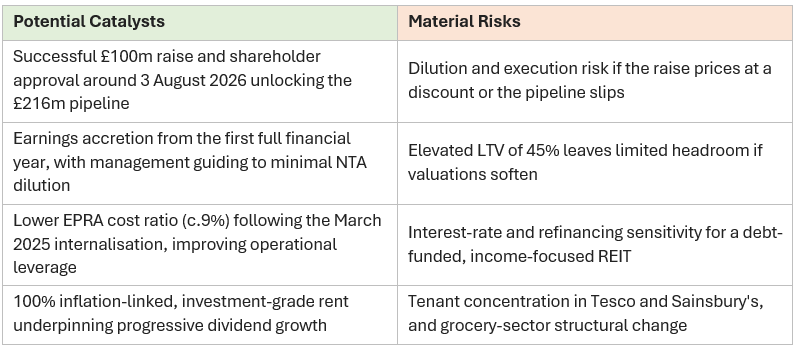
The most immediate catalyst is the fundraise itself and the general meeting expected around 3 August 2026; a well-supported raise priced close to asset value would validate the growth plan and remove overhang uncertainty. Beyond that, completion of the £118 million acquisition in September 2026, followed by the further £98 million of UK pipeline assets, would demonstrate that management can convert stated intentions into deployed capital at the yields advertised. The earnings accretion guided from the first full financial year is a potential re-rating trigger if delivered, particularly when combined with the lower post-internalisation cost ratio, which amplifies the benefit of each new asset. Continued indexation of existing rents provides a slower-burn catalyst, lifting income as inflation feeds through lease reviews. Finally, a narrower discount between the share price and EPRA NTA would improve the trust's ability to raise further accretive equity, a virtuous circle for a company whose model depends on periodic capital raising.
Material Risks and Challenges
The clearest risk is dilution and execution: issuing equity to fund acquisitions only works cleanly if the shares are placed near net asset value and every pipeline asset completes on the stated terms. A discounted issue, a delayed or aborted purchase, or yields that drift would blunt the accretion case. Balance-sheet risk is material too. With loan-to-value at 45%, the trust is operating at the upper end of its policy, leaving limited cushion if property valuations soften; falling values raise LTV mechanically and can pressure debt covenants. Interest rates remain a central sensitivity for any income-focused REIT, affecting both refinancing costs and the yield at which property is valued. Tenant concentration in Tesco and Sainsbury's means the fortunes of two companies drive a large share of income, and while both are strong covenants today, that dependence is a genuine concentration risk. The grocery sector faces its own structural change, from shifting consumer habits to the economics of online fulfilment, which could alter long-term demand for particular store formats. Currency and jurisdictional risk attach to the French Carrefour exposure. None of these is unusual for a property trust, but collectively they mean the stock is not a substitute for cash and carries real capital risk.
Catalysts versus Risks at a Glance
What Investors Should Monitor Next
Investors should watch the outcome and pricing of the £100 million raise, and the general meeting vote expected around 3 August 2026, as the first tests of the plan. Thereafter, confirmation that the £118 million acquisition has completed in September 2026, and progress on the further £98 million of pipeline assets, will show whether capital is being deployed at the promised yields. The next set of results will be important for tracking EPRA NTA, loan-to-value and the EPRA cost ratio, which together reveal whether the growth is genuinely accretive and whether gearing is being held within policy. Dividend declarations will indicate whether the 6.18 pence FY2026 target is maintained and whether progressive growth continues into the following year. Finally, any commentary on rent indexation, tenant health and property valuations will help gauge the durability of the income that underpins the whole investment case.
Balanced Conclusion
The July 2026 announcements capture Supermarket Income REIT doing what its model is designed to do: recycling and raising capital to add long, inflation-linked, investment-grade grocery income at yields above its cost of funding. The £118 million acquisition and the wider £216 million pipeline, part-funded by a roughly £100 million equity raise, offer a credible route to greater scale and, if executed as guided, earnings accretion with limited NTA dilution — helped by a leaner cost base after internalisation. Set against that are real risks: dilution if shares are issued cheaply, a loan-to-value already at the top of policy, sensitivity to interest rates and property values, and heavy reliance on two dominant tenants. The result is a defensively positioned income vehicle rather than a growth stock, whose appeal rests on the reliability of its rent and the discipline of its balance sheet. How the raise prices and how cleanly the pipeline completes will ultimately determine whether this proves an accretive step forward or a dilutive stretch.


 Nov 13, 2026





 Please wait processing your request...