
 CA
 NZ
 US
 AU
 IND

 UK

 Share
 X (Formerly Twitter)
 Whatsapp
 Facebook
 LinkedIn
 Telegram
 Email This Article
 Copy Link
 Summarize with AI
 Chat GPT
 Perplexity

Summary
MTI Wireless Edge (LSE:MWE) is an AIM-quoted, Israel-based group operating three divisions: military and commercial antennas, Mottech water control, and MTI Summit electronics distribution. Full-year 2025 results, reported 4 March 2026, showed revenue up 13% to US$51.5m, operating profit up 29% to US$5.81m and EPS up 17% to 5.86 US cents, with net cash of US$9.4m and a dividend of 3.4 US cents. Q1 2026, reported 26 May 2026, saw revenue rise 6% to US$12.8m, though the antenna division fell 20% on weaker Indian 5G demand while Mottech and Summit grew. Defence is roughly half of sales; April 2026 order intake exceeded US$9m. On 20 July 2026 MTI launched a defence-grade flat-panel antenna and Allenby Capital published a TMT update. Key risks include customer concentration, antenna volatility and geopolitical exposure.
Five Key Takeaways
- FY2025 revenue rose 13% to US$51.5m, with operating profit up 29% and EPS up 17%.
- Defence now accounts for roughly half of group sales, and April 2026 order intake exceeded US$9m.
- Q1 2026 revenue grew 6% to US$12.8m, but the antenna division fell 20% on weaker Indian 5G demand.
- The group carried US$9.4m net cash at year-end and lifted its dividend 3% to 3.4 US cents.
- Allenby Capital published a fresh TMT update on MWE on 20 July 2026, coinciding with a new flat-panel antenna launch.
Company Overview
MTI Wireless Edge Ltd is an Israel-based technology group whose shares trade on London's AIM market under the ticker MWE. The business is built on three operating divisions that give it an unusually broad footprint for a company of its size. The Antenna division designs and manufactures antennas for military, commercial and RFID applications, a heritage business that has increasingly leaned towards defence customers. Mottech, the water-control and management arm, supplies remote irrigation and water-network control systems used by municipalities, farms and utilities internationally. The third leg, distribution and professional consulting services delivered through MTI Summit Electronics, distributes electronic components and provides engineering and consultancy work. Together these units span defence electronics, agricultural technology and industrial distribution, which spreads the group's end-market risk while keeping it anchored in radio-frequency and wireless engineering. The company is led by chief executive Moni Borovitz. Its diversified structure means no single division dominates group revenue, a point management frequently emphasises when describing the resilience of the model. Importantly, the three divisions serve largely unrelated end markets — defence procurement, water infrastructure and electronics distribution — so a downturn in one does not automatically coincide with weakness in the others, which has historically helped smooth group performance through individual soft patches. Reporting is in US dollars, reflecting the international nature of its customer base, even though a meaningful share of its cost base sits in Israel.
What Has Happened Recently?
The most recent dated developments cluster around 20 July 2026. On that day MTI introduced a new defence-grade flat-panel antenna, extending its military product portfolio, while Allenby Capital, the group's nominated adviser and broker, published a technology, media and telecom update referencing MWE. That coverage follows an eventful spring. In early April 2026 the company disclosed a series of defence-related orders worth around US$6m, spanning communications infrastructure for the Israeli Ministry of Defence, military antennas for international and local defence companies, and component supply through MTI Summit. All came from existing customers and are scheduled for delivery across 2026 and 2027. Later in April the group announced a further antenna order of roughly US$2m from a local defence company, taking the month's disclosed intake to around US$8m; in its subsequent quarterly statement management referenced defence orders exceeding US$9m secured in April, with the majority expected to be fulfilled during 2026. The pattern of repeat orders from established defence clients has been a defining feature of the past 18 months, echoing an earlier US$4m military antenna contract from an Israeli system house announced in February 2025 that ranked among the largest in the company's history.
Analysis of the Latest Development
The investment narrative around MTI Wireless Edge has shifted decisively towards defence. Management has stated that defence-related activity now represents approximately half of group sales, a structural change driven by rising government defence budgets globally and by Israel's own elevated procurement needs. That tilt has two implications. On the upside, it exposes MWE to a spending cycle with strong political and fiscal momentum, and the order flow disclosed through the first half of 2026 suggests the pipeline is converting into firm backlog rather than remaining aspirational. The orders being repeat business from existing customers is a quality signal: it points to entrenched supplier relationships and qualified products that are difficult for competitors to displace. On the other hand, a heavier defence weighting concentrates revenue in a smaller number of large, lumpy contracts, which makes quarter-to-quarter comparisons volatile and can mask the underlying trend. The first quarter of 2026 illustrates the point neatly. Group revenue still grew, yet the headline masked a sharp 20% decline in the antenna division, offset by double-digit growth at both Mottech and MTI Summit. In other words, the diversified structure did its job, cushioning a weak patch in one unit with strength elsewhere. For a company this size, that internal balance is arguably as important as the defence order headlines, because it is what keeps group profitability progressing even when a single division stumbles.
Financial Performance and Balance Sheet
The financial trajectory has been firmly positive. For the full year to 31 December 2025, reported on 4 March 2026, MTI delivered revenue of US$51.5m, up 13% year on year. Operating profit rose 29% to US$5.81m and net profit advanced 11% to US$4.66m, with basic earnings per share up 17% at 5.86 US cents. Cash generation was a standout, with operating cash flow of US$7.0m, more than double the prior year, lifting net cash to US$9.4m at the year-end from US$6.0m twelve months earlier. Divisionally, antennas contributed US$15.6m (up 11%), water control and management US$18.5m (up 10%), and distribution and professional consulting US$17.4m (up 20%). The board raised the final dividend by 3% to 3.4 US cents per share, payable on 14 April 2026, continuing a track record of shareholder distributions. The first quarter of 2026, reported on 26 May 2026, extended the momentum: revenue of US$12.8m was up 6%, operating profit rose 21% to US$1.5m, net profit increased 18% to US$1.2m, and earnings per share reached 1.40 US cents. Net cash eased slightly to US$8.5m, consistent with the timing of the dividend payment. Within the quarter, Mottech revenue climbed 19% on international demand from North America, Italy and the Arabian Gulf, and MTI Summit grew 20%, while the antenna division's 20% decline reflected reduced E-band 5G backhaul sales in India, with military antennas remaining its principal revenue driver.
Principal Assets, Products and Operations
MTI's operational base is its Israeli engineering and manufacturing capability, which underpins all three divisions. The antenna business runs on in-house design and production of radio-frequency products, a capital-light but intellectual-property-rich model that allows it to bid for specialised military programmes as well as commercial RFID and 5G backhaul work. Mottech operates as an international water-technology supplier, selling remote-control and telemetry systems for irrigation and water networks, with the Q1 2026 commentary highlighting North America, Italy and the Gulf as growth regions; this division gives the group a foothold in agricultural technology and municipal infrastructure, markets with long replacement cycles and recurring service potential. MTI Summit provides distribution and consulting services, adding a lower-margin but steady revenue stream and useful relationships across the electronics supply chain. The balance sheet is a genuine asset in its own right: net cash of US$9.4m at the year-end, combined with strong operating cash flow, gives management flexibility to fund the dividend, invest in product development such as the newly launched flat-panel antenna, and pursue bolt-on acquisitions, which the company has cited as a strategic option. Order backlog is another operational lever; management describes an increased backlog and pipeline across all three divisions, with the April defence orders materially strengthening cover for 2026 and 2027.
Potential Growth Catalysts
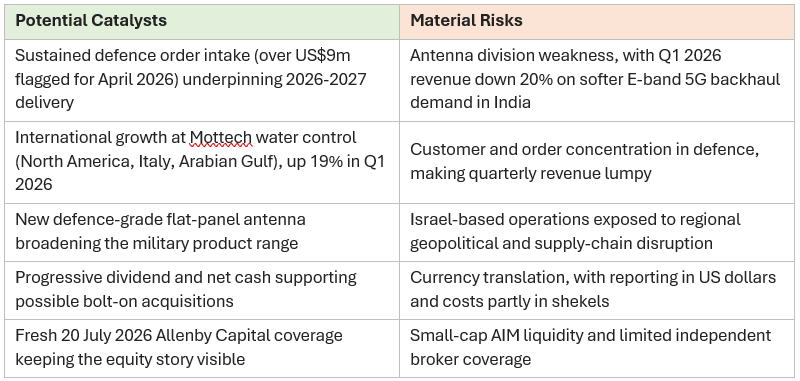
Several identifiable factors could support the equity story from here. The clearest is sustained defence order intake. With more than US$9m flagged in April 2026 alone and delivery weighted to the current year, revenue visibility for 2026 looks better than usual, and any further contract announcements would reinforce that. The international expansion of Mottech is a second catalyst; if the North American, Italian and Gulf momentum seen in Q1 2026 persists, water control could become a more consistent growth engine that is less exposed to defence lumpiness. Product development is a third, with the defence-grade flat-panel antenna launched on 20 July 2026 potentially broadening the addressable military market. The group's net cash position and progressive dividend provide a supportive floor for total shareholder return and leave room for value-accretive acquisitions. Finally, continued analyst engagement, evidenced by Allenby Capital's 20 July 2026 TMT update, helps keep the equity visible to the specialist investor base that follows small-cap defence and technology names, although investors should note that broker views and any forecasts are Allenby's own and should be treated as such.
Material Risks and Challenges
The risks are equally concrete and deserve full weight. The antenna division's 20% first-quarter decline is a live reminder that commercial demand, particularly E-band 5G backhaul in India, can weaken quickly and offset defence strength. Concentration is a structural concern: a defence-heavy order book built on a limited number of large customers makes revenue lumpy and exposes the group to the timing and cancellation risk inherent in government and prime-contractor procurement. Geopolitical exposure is unavoidable, as MTI's manufacturing and much of its cost base sit in Israel, leaving it vulnerable to regional instability, potential supply-chain disruption and reputational or trade complications in certain markets. Currency is a further factor, with results reported in US dollars but costs partly incurred in shekels, so exchange-rate movements can affect margins. As an AIM-quoted small-cap, the shares carry liquidity risk and are covered by relatively few independent analysts, which can amplify price moves around news. None of these risks is disqualifying on its own, but collectively they argue for a measured reading of the recent order momentum.
Catalysts versus Risks at a Glance
What Investors Should Monitor Next
The next scheduled milestone to watch is the half-year report covering the six months to 30 June 2026; the equivalent H1 2025 statement, published on 26 August 2025, showed revenue of US$24.1m, providing a useful comparative. Investors should look for whether the April defence orders begin translating into reported revenue, and for signs of stabilisation or recovery in the antenna division after its weak first quarter. Progress at Mottech in North America, Italy and the Gulf will indicate whether that international strength is durable. Further contract announcements, updates on the new flat-panel antenna's commercial traction, and any move on the acquisition front would all be material. Finally, commentary on defence budgets and order timing from management, together with any revised expectations from Allenby Capital, will help frame the second-half outlook. Dividend policy and net cash trends are worth tracking as indicators of capital-allocation discipline, as is any progress on the bolt-on acquisitions management has flagged as a potential use of the group's cash resources.
Balanced Conclusion
MTI Wireless Edge presents a genuinely diversified small-cap technology group riding a favourable defence spending cycle while retaining meaningful exposure to water technology and electronics distribution. The record 2025 figures, a positive first quarter and a spring surge of defence orders give the story real substance, and the net cash balance sheet with a progressive dividend adds ballast. Yet the antenna division's recent softness, the lumpiness of a defence-weighted order book and the group's Israeli operational base are material considerations that any assessment must hold alongside the growth. The 20 July 2026 product launch and fresh Allenby Capital coverage keep the narrative topical without changing that balance. As ever, the investment case rests on execution against the order book and on how the various risks evolve.


 Nov 27, 2026





 Please wait processing your request...