
 CA
 NZ
 US
 AU
 IND

 UK

 Share
 X (Formerly Twitter)
 Whatsapp
 Facebook
 LinkedIn
 Telegram
 Email This Article
 Copy Link
 Summarize with AI
 Chat GPT
 Perplexity

Key facts
Summary
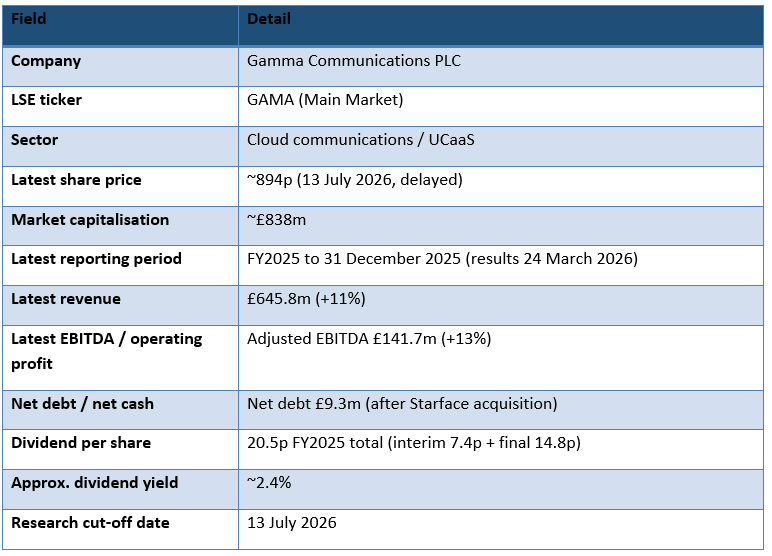
Gamma Communications is a UK-based cloud communications and unified-communications provider trading on the London Stock Exchange Main Market under the ticker GAMA. For the year to 31 December 2025 it reported revenue of £645.8m, up 11%, with adjusted EBITDA of £141.7m and 89% recurring revenue. Growth is increasingly driven by Germany, where cloud seats rose sharply following the Placetel and Starface acquisitions. The shares eased after in-line March 2026 results amid caution over UK small-business demand. This article summarises the figures for information only and is not advice.
Five key takeaways
- FY2025 revenue reached £645.8m, up 11%, with adjusted EBITDA of £141.7m, up 13%.
- Recurring revenue stood at 89%, and cash conversion was a robust 93%.
- Germany now contributes roughly 23% of group gross profit, or £78.4m.
- The company moved from AIM to the LSE Main Market, with first dealings on 2 May 2025.
- Shares fell on the March 2026 results despite in-line numbers, reflecting UK SME caution.
Introduction
Gamma Communications is one of the London market's quieter compounders. The business rarely dominates headlines, yet it has built a highly cash-generative franchise in cloud communications and unified communications, the software-led telephony that has replaced traditional office phone systems. For July 2026, its relevance rests on a full set of FY2025 results, an accelerating push into Germany, and a share price that has drifted despite steady earnings.
The appeal, for those who favour quality growth, is the recurring nature of the income. Around 89% of FY2025 revenue was recurring, giving a degree of visibility that many industrial or consumer businesses lack. This piece examines the numbers, the strategy and the risks, without offering any recommendation.
Company overview
Gamma provides communications services largely to businesses, chiefly through a network of channel partners and resellers rather than directly to end users. That indirect model keeps the cost base relatively light and lets partners handle much of the customer relationship, while Gamma supplies the underlying platforms and network.
The group reports across three segments. Calling, which spans a network reaching roughly 27 countries, contributes about 36% of gross profit. Cloud Communications, covering voice, video, messaging and contact-centre services, is the largest at around 41%. Connectivity, comprising broadband, ethernet and mobile, makes up about 18%.
Products and the GAMA channel model
At the centre of the product range sits Horizon, Gamma's cloud PBX and unified-communications platform, which includes contact-centre capability. Alongside it, the company offers SIP trunking, integrations with Microsoft Teams and Operator Connect, the small-business PhoneLine+ service and mobile. UK Teams voice users reached 555,000 in FY2025, up 19%, illustrating how demand is shifting toward software-based calling embedded in everyday collaboration tools.
Latest financial performance
The FY2025 results, published on 24 March 2026 and covering the year to 31 December 2025, showed revenue of £645.8m, up 11% from £579.4m. Gross profit rose 16% to £348.2m, lifting the gross margin to 54%. Adjusted EBITDA increased 13% to £141.7m, a margin of about 22%.
Adjusted profit before tax rose 7% to £119.4m, while statutory profit before tax fell 8% to £87.7m, the gap reflecting acquisition-related and other adjusting items. Adjusted diluted earnings per share came in at 94.5p, up 11%; basic earnings per share were 69.5p.
Cash generation
Cash generation remains a defining feature. Adjusted cash generated by operations was £131.8m, up 9%, with cash conversion of 93%. Adjusted free cash flow reached £80.8m, up around 4.5%, after capital expenditure of £24.3m, equivalent to 3.8% of revenue. That capital-light profile is central to the compounder framing: the business turns a high share of profit into cash that can fund dividends, buybacks and acquisitions.
For FY2026, management guidance is described as in line with expectations. Consensus points to adjusted EBITDA of £138.0m to £144.6m and adjusted EPS of 90.0p to 96.6p, with cash conversion above 90% and capital expenditure near 4% of revenue.
Balance sheet and financial position
Gamma entered FY2025 with net cash of £153.7m and ended it with net debt of £9.3m. That swing is not a sign of strain but a reflection of the £152.2m acquisition of Starface in February 2025, which absorbed much of the cash pile. At the half-year stage, net debt stood at £21.6m, so the position improved over the second half.
A modest net debt figure against annual adjusted EBITDA of £141.7m leaves the balance sheet lightly geared. That gives the group meaningful capacity to pursue further acquisitions, sustain its progressive dividend and continue returning capital through buybacks, without obvious pressure on its financial position.
Growth drivers
Several structural forces support Gamma's revenue base, and management has leaned into each of them.
UCaaS, CCaaS and Microsoft Teams
The migration of business telephony from on-premise hardware to cloud-delivered unified communications (UCaaS) and cloud contact centres (CCaaS) remains the core opportunity. UK cloud seats grew 5% to 1,087,000, UK CCaaS seats rose 7% to 48,000, and UK Teams voice users climbed 19% to 555,000. Integration with Microsoft Teams positions Gamma within a platform that many organisations already use daily.
German and European expansion
Germany is the standout growth story. European cloud seats rose 64% to 711,000, with German cloud seats up 91% on a reported basis to 594,000, an increase of 283,000, though organic growth was a more modest 11%. Germany now represents roughly 23% of group gross profit, at £78.4m. The Placetel and Starface acquisitions, together with Allnet and Desatel, have built a substantial German footprint, and the group also operates in the Netherlands and Spain.
Recurring revenue and the PSTN tailwind
With 89% recurring revenue, Gamma enjoys a predictable income base. The UK's ongoing PSTN switch-off, which is retiring the legacy analogue telephone network, provides a further tailwind by pushing businesses toward the cloud-based alternatives Gamma supplies. In the first quarter of 2026, the group also launched service-provider operations in Australia, Singapore and the Philippines, opening an early foothold in the Asia-Pacific region.
Telecommunications-sector outlook
The wider backdrop for cloud communications remains constructive, if competitive. Demand for UCaaS and CCaaS continues as businesses modernise legacy systems, and the retirement of copper-based telephone networks across the UK and Europe accelerates that shift. The PSTN switch-off in particular removes a technology that many small firms have relied on for decades, effectively forcing a migration decision.
Set against this, competition is intense. Fibre providers, large software platforms and specialist rivals all target the same customers, and pricing pressure is a persistent feature. European markets are also consolidating, which creates both acquisition opportunities and the risk of larger, better-resourced competitors emerging. Gamma's channel-led model and its growing German scale position it within these currents rather than above them.
Valuation and share-price context
At around 890p and on adjusted diluted EPS of 94.5p, the shares trade on a price-to-earnings multiple in the region of nine to ten times historic adjusted earnings. That is a relatively modest rating for a business with high recurring revenue and strong cash conversion, though the market appears to be weighing softer UK demand and margin caution against those qualities.
Notably, the shares fell on 24 March 2026 when the FY2025 results were published, despite the numbers being broadly in line with expectations. The reaction reflected concern over weakness in UK small and medium-sized enterprise (SME) demand and questions about margin progression, rather than any miss on the headline figures. On enterprise value against adjusted EBITDA of £141.7m, and with net debt of just £9.3m, the group looks lightly valued relative to its cash-generative profile, though multiples alone do not capture execution risk. These figures are provided for context only and are not a recommendation.
Dividend analysis
Gamma pursues a semi-annual, progressive dividend policy. The FY2025 total was around 20.5p, comprising an interim dividend of 7.4p, paid on 16 October 2025, and a final dividend of 14.8p, up 14%, paid on 18 June 2026 after going ex-dividend on 28 May 2026.
Against adjusted diluted EPS of 94.5p, the payout is covered roughly 4.6 times, a conservative level that leaves ample room for reinvestment. The approximate yield sits near 2.4%. Total shareholder returns in FY2025 came to £64.0m, split between £45.1m of buybacks and £18.9m of dividends.
Capital returns outlook
Looking ahead, the group intends up to £85m of combined buybacks across FY2026 and FY2027. Dividends over the same period are set to be held at FY2025 levels rather than increased, a decision that channels a larger share of returns through buybacks while keeping the distribution stable. For income-focused holders, that implies a flat cash dividend in the near term, offset by share repurchases.
Main risks
Several risks warrant attention. The PSTN switch-off is a tailwind, but fibre and full-fibre competition could erode pricing and share. Gamma's reliance on a channel and partner model concentrates a degree of dependence on third parties for customer acquisition and retention.
The clearest near-term concern is softness in UK SME demand, which weighed on sentiment at the March 2026 results. European expansion, while a growth engine, brings integration and execution risk, particularly as recent acquisitions are absorbed. Beyond these, the group faces intense competition in UCaaS and CCaaS, cyber-security and service-disruption threats, supplier and technology dependency, talent retention pressures and regulatory change. None is unusual for the sector, but each could affect the trajectory of earnings.
What investors may watch next
Attention now turns to the half-year 2026 interim results, which should indicate whether UK demand has stabilised. German seat growth will be a key gauge of whether the European strategy is sustaining momentum beyond the boost from acquisitions. Progress in the newly launched Asia-Pacific service-provider operations offers an early read on international diversification.
Execution of the buyback programme, and the pace at which up to £85m is deployed, will show how management balances returns against acquisition ambitions. Above all, the trend in UK SME demand is likely to shape sentiment, given how central that concern proved to the market's reaction earlier in 2026.
Conclusion
Gamma Communications fits the profile of a quiet compounder: highly cash-generative, underpinned by recurring revenue, and steadily building scale in a growth market. FY2025 delivered double-digit revenue and EBITDA growth, a resilient 93% cash conversion, and a step-change in its German presence, all while the balance sheet stayed lightly geared following the Starface deal.
The tempered market reaction to in-line results underlines that execution, particularly in the UK SME segment and in integrating European acquisitions, will determine whether the compounding continues. The move to the Main Market in May 2025 raised the company's profile, and the coming interims will test its momentum. This article is for information only and does not constitute advice or a recommendation.


 Nov 26, 2026





 Please wait processing your request...