
 CA
 NZ
 US
 AU
 IND

 UK

 Share
 X (Formerly Twitter)
 Whatsapp
 Facebook
 LinkedIn
 Telegram
 Email This Article
 Copy Link
 Summarize with AI
 Chat GPT
 Perplexity

Key facts
Summary
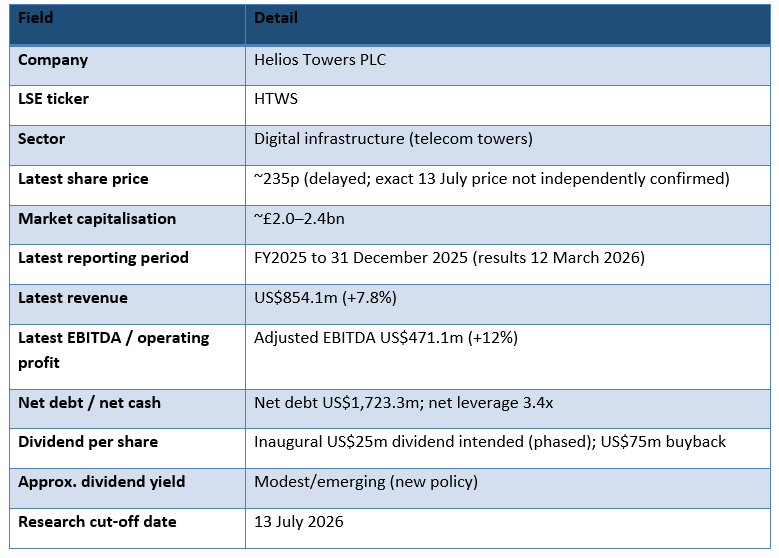
Helios Towers PLC (LSE:HTWS) is a London-listed operator of digital infrastructure across Africa and the Middle East, owning nearly 15,000 telecom towers. Its model rests on adding more mobile network tenants to each existing tower, lifting margins at low incremental cost. In FY2025 the group grew revenue to US$854.1m, expanded adjusted EBITDA to US$471.1m and cut net leverage to 3.4x. It also launched an inaugural dividend and US$75m buyback under a new IMPACT 2030 plan, a move towards cash returns tempered by roughly US$1.7bn of debt and currency and political risk.
Five key takeaways
- Helios Towers owns 14,746 sites and 31,944 tenancies across nine markets, with a tenancy ratio of 2.17x.
- FY2025 revenue rose 7.8% to US$854.1m and adjusted EBITDA rose 12% to US$471.1m, a tenth consecutive year of growth.
- Net leverage fell to 3.4x from 4.0x, prompting a Moody's upgrade to Ba3 in February 2026.
- The group launched its first-ever shareholder returns: a US$75m buyback and an intended US$25m maiden dividend.
- High absolute debt of about US$1.7bn, currency exposure and political risk remain the principal counterweights.
Introduction
The story of Helios Towers digital infrastructure is, at its core, about the pipes beneath Africa's mobile boom. While attention often falls on handset makers and app developers, the physical towers carrying mobile signals across the continent are a quieter, more durable asset class. Helios Towers PLC (LSE:HTWS) owns nearly 15,000 of them, leasing space to operators on long contracts.
July 2026 finds the company at a notable juncture. FY2025 results, published on 12 March 2026, suggest the group has reached a cash-compounding inflection: leverage falling, credit ratings rising and, for the first time in its history, cash being returned to shareholders.
Company overview
Helios Towers is an independent tower company. Rather than each operator building and maintaining its own masts, Helios owns the towers and leases capacity to multiple customers at once. Its footprint spans Tanzania, the DRC, Ghana, South Africa, Senegal, Madagascar, Malawi, Congo Brazzaville and Oman, blending African markets with a Middle Eastern presence.
The model has two engines. Build-to-suit involves constructing new towers, typically over roughly 102 days. Colocation, the higher-margin activity, adds further tenants to existing structures in around two days. Its customers are predominantly multinational operators, including Airtel, MTN, Vodacom and Orange.
The contractual backbone is substantial. Helios reports contracted future revenue of US$5.3bn, with an average remaining initial contract life of 6.6 years. Around 98% comes from multinational operators and roughly 70% from investment-grade customers. Contracts typically run for initial terms of 10 to 15 years, with escalators linked to inflation and power costs, lending the top line a defensive, index-linked quality.
Latest financial performance
FY2025, covering the year to 31 December 2025, marked a tenth consecutive year of adjusted EBITDA growth. Revenue rose 7.8% to US$854.1m from US$792.0m. Adjusted EBITDA climbed 12% to US$471.1m, with the margin expanding two percentage points to 55%. Operating profit increased 18% to US$286.0m.
Below the operating line, the numbers are more modest, reflecting financing costs. Profit after tax was US$39.4m, up from US$27.0m, with basic earnings per share of 3.7 US cents against 3.2 cents. The gap between EBITDA and slimmer profit is typical of a capital-intensive, debt-financed operator.
Cash generation is where the FY2025 story sharpens. Cash from operations rose 21% to US$480.5m. Recurring, or portfolio, free cash flow jumped 40% to US$207.5m, while headline free cash flow reached US$66.4m, up from US$18.7m. Total capital expenditure was US$179.5m, of which growth capex of US$109.6m represented 61%, showing that most spending is still directed at expansion. Return on invested capital improved to 13.5%.
Guidance for FY2026 points to further progress: adjusted EBITDA of US$510m to US$525m, recurring free cash flow of US$210m to US$225m, discretionary capex of US$110m to US$140m and tenancy additions of 2,000 to 2,500. Coverage suggested guidance was raised at the Q1 2026 update on 7 May 2026, though the revised figures are not independently confirmed.
Balance sheet and financial position for HTWS
The balance sheet is where the cash-compounding thesis is tested. Net debt edged down to US$1,723.3m from US$1,735.5m, but the more meaningful measure is net leverage, which fell to 3.4x from 4.0x. That places the group within its 2.5x to 3.5x target range for the first time, a threshold that unlocks the capacity to return capital.
The improving profile has been recognised by rating agencies: Moody's upgraded Helios to Ba3 in February 2026, with S&P and Fitch both at BB-. The reported cost of debt was 7.1%, with an average remaining debt life of around four years and cash of US$217.3m.
Active liability management has accompanied the deleveraging. In October 2025 Helios tendered US$120m of convertible bonds below par, removing roughly 41m potentially dilutive shares. In 2024 the HTA Group subsidiary issued US$850m of 7.50% notes, alongside earlier US$500m 6.75% notes due 2031. A further senior notes issue in 2026 aimed to reduce financing costs, though the exact coupon and maturity are not independently confirmed.
Growth drivers
Tenancy ratio and lease-up economics
The single most important lever is the tenancy ratio, average tenants per tower. In FY2025 it rose to 2.17x from 2.05x, reaching the 2.2x target a year early. Each additional tenant carries minimal incremental cost, so higher tenancy translates almost directly into margin. Tenancies grew 8.6% to 31,944, including a record 2,538 additions.
New site builds and network densification
Helios added 421 new sites in FY2025, taking the portfolio to 14,746. As African operators densify networks to handle rising data traffic, demand for new towers and colocation space is expected to persist, with build-to-suit providing anchor tenancies that can later be layered with more customers.
Mobile penetration and data demand
Underlying demand is structural. African mobile penetration and data consumption expand as smartphone adoption spreads and 4G, and increasingly 5G, networks roll out. Towers are the neutral-host infrastructure enabling it.
Power efficiency and MENA expansion
Energy is a large cost line, and efficiency is a growth driver in its own right. Project 100, into which US$44m had been invested with a US$100m target by 2030, aims to cut fuel and power costs. The Oman operation, part of a broader MENA push, adds geographic and currency diversification, with the MENA segment carrying a 74% margin.
Telecommunications-sector outlook
The wider backdrop is an African connectivity boom. Rising incomes, urbanisation and cheaper devices are driving mobile data growth, and operators need denser, more reliable network infrastructure to serve it. Independent tower companies have become the preferred model, letting operators shed capital-intensive assets while sharing costs.
Yet the sector carries distinct pressures. Energy costs, particularly diesel for off-grid sites, are a persistent challenge, making efficiency programmes central to profitability. Currency volatility can erode reported earnings, and permitting frictions vary by country. The 4G-to-5G transition, still early across much of the region, offers a multi-year demand runway.
Valuation and share-price context
Tower companies are typically assessed on enterprise value to EBITDA, given heavy debt loads and steady cash flows, and on net debt to EBITDA, which for Helios stands at 3.4x. The shares traded at around 235p on a delayed quote, though the exact 13 July price is not independently confirmed, implying a market capitalisation of roughly £2.0bn to £2.4bn depending on the source.
The share-price path has not been linear. FY2025 came in ahead of guidance, accompanied by rating upgrades and the launch of capital returns. However, some coverage noted the shares dipped at points on higher-capex concerns. One-year performance is not verified numerically here, and no judgement is offered on whether the shares are cheap or expensive; the figures are for context only.
Dividend analysis
The most striking development is that Helios is returning cash for the first time; no dividend was paid before FY2025. The group launched a US$75m buyback, announced in November 2025, of which US$23.8m was executed in 2025, leaving roughly US$51m outstanding. Alongside this, it intends to pay a maiden dividend of US$25m, phased around one-third in FY2026 and two-thirds in FY2027.
The sequencing matters. Management has set a clear order of priorities: fund organic growth first, deleverage to the 2.5x to 3.5x range, and only then return capital. Reaching 3.4x is what enabled the shift, and the sustainability of returns is tied to portfolio free cash flow, which grew 40% to US$207.5m in FY2025.
The longer-term ambition sits within IMPACT 2030, the plan for 2026 to 2030. It targets cumulative recurring free cash flow above US$1.3bn, organic growth investment above US$0.5bn, shareholder returns above US$0.4bn, an adjusted EBITDA compound annual growth rate of at least 9% and return on invested capital of 15% to 20%. The emerging yield remains modest given the policy is new, and returns depend on cash flows holding up.
Main risks
The most prominent risk is the debt itself. Net debt of about US$1.72bn at a 7.1% cost, with an average life of around four years, means refinancing is a recurring necessity, and higher-for-longer interest rates could raise financing costs. The 2026 bond activity aimed to mitigate this, but the exposure remains material.
Currency is a second concern. Much of the revenue originates in African local currencies that can depreciate against the US dollar, though roughly 71% of adjusted EBITDA is generated in hard or pegged currency, with CPI and power escalators providing partial protection.
Political, regulatory and economic instability across the footprint is inherent, spanning permitting delays, tax changes and broader country risk. Customer concentration is also notable: while no single customer exceeds 28% of revenue, the top four operators account for around 72%, so distress at a major counterparty would be significant. Power and diesel costs, competition, technological disruption and climate exposure round out the disclosed risks.
What investors may watch next
Several near-term markers will indicate whether the inflection holds. The Q1 2026 trading update on 7 May 2026, where guidance was reportedly raised on a record tenancy pipeline, is a reference point, though the figures are not independently confirmed. Beyond that, the commencement and cadence of the maiden dividend during FY2026 will show how firmly the capital-returns policy embeds.
Progress on further deleveraging towards the lower end of the 2.5x to 3.5x range would strengthen the balance-sheet narrative. New site additions and, crucially, further gains in the tenancy ratio will drive the margin story. The terms of continued bond refinancing will determine how much cash flow is absorbed by interest rather than growth and returns.
Conclusion
Helios Towers enters the second half of 2026 with a changed profile. A decade of EBITDA growth has been joined by falling leverage, credit-rating upgrades and the first cash returns in its history, framed within IMPACT 2030. For an infrastructure investor focused on cash flow and balance-sheet trajectory, the FY2025 numbers describe a business transitioning from build-out to compounding.
The counterweights are real: roughly US$1.7bn of debt to refinance over time, exposure to volatile African currencies and the ever-present backdrop of political and regulatory risk. Whether the tenancy-led model can sustain cash generation while funding both growth and returns is the question the coming quarters will answer. This article is for information only and is not a recommendation.


 Nov 27, 2026





 Please wait processing your request...