
 CA
 NZ
 US
 AU
 IND

 UK

 Share
 X (Formerly Twitter)
 Whatsapp
 Facebook
 LinkedIn
 Telegram
 Email This Article
 Copy Link
 Summarize with AI
 Chat GPT
 Perplexity

Key facts
Summary
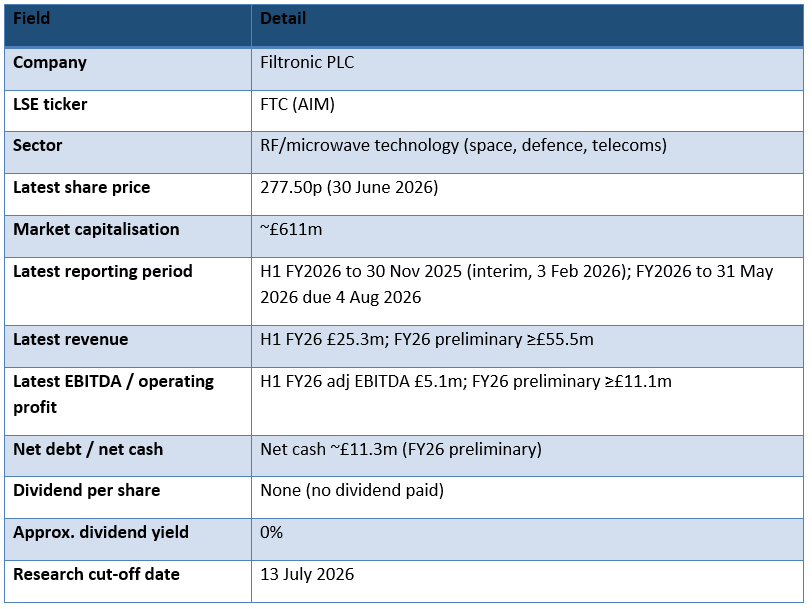
Filtronic PLC (LSE:FTC) is an AIM-listed British designer and manufacturer of radio-frequency and microwave components transformed by the commercial space economy. Its gallium nitride (GaN) E-band solid-state power amplifiers are used in SpaceX's Starlink ground-station network, driving a re-rating that lifted the shares roughly 130% in 2026 before a June pullback to 277.50p. H1 FY2026 revenue was £25.3m and preliminary FY2026 revenue at least £55.5m. Filtronic pays no dividend, retaining cash to fund Sedgefield capacity. Concentration on SpaceX and the Americas is the dominant risk.
Five key takeaways
- Filtronic re-rated sharply through 2026 on demand for E-band GaN amplifiers used in SpaceX/Starlink ground stations, before a roughly 20% "sell-the-news" fall in late June.
- H1 FY2026 revenue was broadly flat at £25.3m, with adjusted EBITDA margin compressing to 20.2% as the group invested ahead of higher SpaceX volumes.
- Preliminary FY2026 figures point to revenue of at least £55.5m and adjusted EBITDA of at least £11.1m; audited results are due on 4 August 2026.
- Sedgefield is fully operational and sized for more than £200m of annual revenue, with an order book covering around 90% of FY2027 consensus revenue.
- Concentration (Americas near 90% of H1 sales), warrant dilution of up to 15% and a high valuation frame this as a high-beta situation.
Introduction
Filtronic shares have been among the most talked-about names on London's junior market this year. A once-overlooked radio-frequency minnow has become a direct supplier to the fastest-growing part of the commercial space economy: the ground infrastructure that keeps low-Earth-orbit constellations connected. Its E-band gallium nitride power amplifiers feed the gateway antennas that link SpaceX's Starlink network to the terrestrial internet, and that relationship has redrawn the investment case.
The AIM-listed company (LSE:FTC) entered July 2026 after a dramatic run, roughly doubling before a sharp June setback. This article examines the space-economy story, the financials behind it, and the concentrated risks that make Filtronic a momentum-and-risk narrative rather than a steady compounder. It carries no recommendation.
Company overview
Filtronic designs and manufactures radio-frequency and microwave products, including transceivers, filters and solid-state power amplifiers (SSPAs). Its output spans several demanding end-markets: space and satellite communications, aerospace and defence, telecoms infrastructure and critical communications. The common thread is high-frequency signal engineering, where generating powerful transmissions at millimetre-wave frequencies is hard to replicate.
The recent transformation rests on gallium nitride technology and E-band SSPA modules, which operate at the high frequencies used by modern satellite gateways. This capability positioned Filtronic to supply SpaceX with amplifier modules for Starlink ground stations, a deployment that scales with the constellation.
Manufacturing is centred on a new facility at Sedgefield in north-east England, fully operational following a self-funded relocation around November 2025. The company says the site has capacity to support more than £200m of annual revenue, so near-term demand can be met without a further step-change in fixed investment.
Latest financial performance
Filtronic's most recent audited interim results cover H1 FY2026, the six months to 30 November 2025, reported on 3 February 2026. Revenue was £25.3m, broadly flat against £25.6m a year earlier, reflecting the timing of contract deliveries and a reminder that revenue is lumpy and programme-dependent.
Profitability was more nuanced. Adjusted EBITDA fell to £5.1m from £8.7m, and the margin dropped to 20.2% from 34.0%. Operating profit was £2.6m, a 10.3% margin, and basic earnings per share fell to 1.20p from 3.08p. Management attributed the compression to scale-up investment ahead of higher SpaceX volumes, not structural deterioration.
Cash generation reflected the same phase. Operating cash flow was £3.4m, but capital expenditure of £5.6m plus £1.3m of capitalised development left free cash flow at roughly negative £2.2m. Net cash, excluding leases, was £8.2m.
For the full year to 31 May 2026, only preliminary, unaudited figures exist. A late-June 2026 trading update indicated revenue of at least £55.5m (in line) and adjusted EBITDA of at least £11.1m (slightly ahead), with net cash of around £11.3m; audited results are scheduled for 4 August 2026. FY2025 revenue rose 121% to £56.3m, so the preliminary FY2026 numbers suggest a year of consolidation with margins normalising.
Balance sheet and financial position
Filtronic ended FY2026, on a preliminary basis, with net cash of around £11.3m. The Sedgefield relocation and capacity build were self-funded from operating cash flow and retained profits rather than debt or a large equity raise. For a company scaling into major contracts, net cash cushions the working-capital swings that come with lumpy order delivery. Capital expenditure has been elevated during the scale-up, which explains why free cash flow turned slightly negative in the first half.
A distinct feature of the capital structure is warrant dilution. Warrants issued in April 2024 (21,712,109 shares at 33p, expiring April 2029) and a March 2025 tranche (10,949,079 shares at 92.8p) together represent up to 15% of the enlarged share capital, roughly 32.7m warrant shares. As these are exercised, per-share metrics could be diluted meaningfully.
Growth drivers
RF, microwave and SSPA technology (FTC's core edge)
Filtronic's position rests on decades of RF and microwave engineering, sharpened by gallium nitride and E-band SSPA capability. Producing high-power amplification at millimetre-wave frequencies with reliability and yield is a real technical barrier, and Sedgefield adds the scale to convert that strength into volume revenue.
SpaceX and the Starlink ground network
The largest driver is the SpaceX relationship. In August 2025 Filtronic secured a $62.5m (about £47.3m) multi-year contract for GaN E-band SSPA modules, its largest ever award, supplying amplifiers for Starlink gateway ground stations. As the constellation and its ground network expand, demand scales with them. This is the engine behind the re-rating, and also the source of the concentration risk.
Aerospace, defence and satellite communications
Beyond SpaceX, recent awards include a €7.0m European aerospace contract and European defence orders of £13.4m plus an £11.0m follow-on. These bring longer-duration work and help broaden the base beyond one anchor customer.
Diversification: US satellite, mmWave and Ka-band
Management has prioritised diversification. In March 2026 Filtronic won an $8m mmWave development contract with a US satellite customer, plus a $0.5m order, and is pursuing opportunities in Taiwan. It also received a £1.2m UK Space Agency NSIP award for Ka-band development. Deepening non-SpaceX relationships is central to reducing dependence.
Sedgefield capacity and order-book conversion
Sedgefield's capacity for more than £200m of annual revenue provides operating leverage if the order book converts. At the half year the order book was a record, with around 90% of FY2026 revenue contracted; the year-end update indicated it covered roughly 90% of FY2027 consensus revenue. Converting that visibility into profitable sales is the key operational task.
Telecommunications-sector outlook
The backdrop favours specialist RF suppliers. The rapid expansion of low-Earth-orbit satellite constellations has created sustained demand for ground-station infrastructure, and each new gateway requires the high-frequency amplification Filtronic supplies.
Defence is a second supportive current: elevated geopolitical tension has lifted spending on secure communications, radar and electronic systems, all of which draw on advanced RF components. Terrestrial telecoms provides a third strand, as the build-out of 5G and, over time, millimetre-wave infrastructure relies on high-frequency components, though this market is competitive and cyclical. Together they give Filtronic several exposures to demand, even if commercial space is currently doing the heavy lifting.
Valuation and share-price context (FTC)
Filtronic's shares closed at 277.50p on 30 June 2026, for a market capitalisation of roughly £611m on about 219.94m shares. The 52-week range is wide, from 114.50p in September 2025 to 475.00p in May 2026, underscoring the volatility of the re-rating; the stock rose approximately 130% over 2026 before a June pullback.
That pullback followed the late-June trading update. Despite figures described as in line to slightly ahead, the shares fell around 20% in a "sell-the-news" reaction after such a strong run, then rose 11.2% intraday on 30 June, choppiness characteristic of a high-beta, momentum-driven stock.
On reported numbers, Filtronic trades on a high earnings multiple of around 43 times, reflecting expectations of growth. A rating of that order leaves limited margin for disappointment: it can be sustained if order-book conversion and volume growth deliver, but it is sensitive to any wobble in the SpaceX relationship or Sedgefield execution. This article makes no judgement on whether the shares are cheap or expensive.
Capital allocation (no dividend)
Filtronic pays no dividend, and there is no stated dividend or share-buyback policy, giving a prospective yield of 0%, so the entire return proposition rests on capital growth.
Instead, cash is directed into the business: manufacturing capacity, R&D and the working capital needed for larger contracts. The self-funded Sedgefield relocation is the clearest example, and retained net cash of around £11.3m provides a buffer against lumpy delivery.
Prioritising reinvestment over distributions is a defensible choice at this stage, but it concentrates the outcome: shareholders are backing management to compound value through capacity and technology, with no income cushion to soften share-price weakness.
Main risks
The defining risk is concentration. In H1 FY2026, Americas revenue was £22.7m of the £25.3m total, roughly 89.8%, dominated by SpaceX. The exact SpaceX proportion is not separately disclosed, but Americas exposure near 90% is a fair proxy. Any change in SpaceX's ordering patterns, supplier strategy or deployment schedule would have an outsized effect.
Contract timing adds volatility, as the flat H1 against a strong FY2025 illustrates. Warrant dilution is a related structural risk: outstanding warrants represent up to 15% of the enlarged capital and could dilute per-share metrics as they are exercised.
Execution at Sedgefield is a live risk during the scale-up, where margin compression has already been visible. The high valuation leaves little room for disappointment, competition in millimetre-wave products is intensifying, and a large share of sales in US dollars introduces currency exposure. Together these factors make Filtronic a higher-risk holding than its net-cash balance sheet might suggest.
What investors may watch next
The immediate catalyst is the audited FY2026 results on 4 August 2026, which will confirm or revise the preliminary figures and detail margins and outlook. The pace of order-book conversion also matters, with around 90% of FY2027 consensus revenue reportedly covered.
Investors will also watch for follow-on orders from SpaceX and the Sedgefield ramp. Most important for the longer-term quality of the story will be diversification wins: further US satellite contracts, progress in Taiwan, and traction in Ka-band and mmWave, which would gradually reduce the concentration that defines the risk profile.
Conclusion
Filtronic has undergone a transformation, from an overlooked RF component maker into a re-rated supplier to the commercial space economy. Its E-band GaN power amplifiers for SpaceX's Starlink ground stations drove a roughly 130% share-price run in 2026, a record order book, and a Sedgefield facility sized for more than £200m of revenue, with preliminary FY2026 revenue of at least £55.5m.
Yet the same relationship that powered the re-rating defines the risk. Near-90% dependence on the Americas and SpaceX, warrant dilution of up to 15%, and a high valuation leave the shares exposed to any disappointment, as June's pullback showed. With no dividend to cushion volatility, Filtronic is a high-beta, momentum-and-risk proposition, and the 4 August 2026 results and the pace of diversification will be the key tests. This article is for information only and is not a recommendation.


 Nov 26, 2026





 Please wait processing your request...