
 CA
 NZ
 US
 AU
 IND

 UK

 Share
 X (Formerly Twitter)
 Whatsapp
 Facebook
 LinkedIn
 Telegram
 Email This Article
 Copy Link
 Summarize with AI
 Chat GPT
 Perplexity

Summary
Datang International Power Generation (LSE:DAT, 0991.HK, 601991.SS) is a large Chinese state-influenced coal-fired generator moving into renewables. As of 13 July 2026, a final FY2025 dividend of reportedly RMB 0.093 per share has been flagged by moomoo, alongside an earlier interim payout, but a verified current share price, exact dividend dates and a calculable yield could not be confirmed this session. Reported 2025 net profit rose sharply. Investors should treat any dividend as historically variable, not guaranteed.
Key takeaways
- Datang International is a large, state-influenced Chinese power generator, traditionally coal-heavy but expanding renewables, listed in Hong Kong (0991.HK), Shanghai (601991.SS) and via a London line (LSE:DAT).
- A final dividend for the year ended 31 December 2025 has been announced, reportedly RMB 0.093 per share according to moomoo, alongside a separate interim 2025 payout — but neither figure was independently cross-verified against a primary filing this session.
- 2025 net profit reportedly surged around 64% year-on-year to roughly RMB 7.39 billion, according to BigGo Finance, with clean energy said to now exceed 30% of installed capacity — figures not independently corroborated from a second primary source here.
- No reliable current share price across the HKD, RMB or GBP-quoted lines could be confirmed this session, so a dividend yield cannot responsibly be stated — this is explicitly flagged rather than estimated.
- Material gaps remain around EPS, revenue, net debt, gearing, exact dividend dates and credit standing; treat this as a preliminary, conservative briefing rather than a complete financial picture.
Introduction
Datang International Power Generation Co., Ltd. — trading as LSE:DAT on its London line, alongside primary listings 0991.HK in Hong Kong and 601991.SS in Shanghai — is one of mainland China's larger listed power generators. It is affiliated with China Datang Corporation, a central state-owned enterprise and one of China's principal power-generation groups, according to the parent's own investor pages.
This article, researched on 13 July 2026, sets out what can currently be verified about Datang International's dividend position, recent earnings signals and key risks. The company receives comparatively limited Western coverage, and several planned sources were inaccessible this session. Figures that could not be independently confirmed are therefore flagged explicitly rather than estimated or assumed.
Company overview
Datang International is principally a thermal (coal-fired) electricity generator that has been diversifying into renewable and clean-energy capacity, according to background material referenced via Wikipedia and the China Datang Corporation investor pages. It reports in renminbi (RMB) and carries a dual H-share/A-share structure, with Hong Kong (0991.HK) and Shanghai (601991.SS) as its primary trading venues.
A London-quoted line under the ticker DAT also exists and receives periodic RNS-style announcements, including dividend notices republished by Investegate, ADVFN and Yahoo Finance UK. This confirms some UK market visibility, even though detailed UK-facing analyst coverage appears limited.
Coverage from ad-hoc-news.de describes Datang as "China's state-backed power generator," consistent with its structural link to China Datang Corporation. State affiliation can bring both stability — policy support, access to financing — and constraints, such as tariff regulation and capital-allocation priorities shaped partly by state objectives, a theme explored below.
Latest dividend position (LSE:DAT)
The company has announced a final dividend for the financial year ended 31 December 2025. This is confirmed by an official-style announcement titled "Final dividend for the year ended 31 December 2025 (updated)," republished by Investegate, MarketScreener and Yahoo Finance UK. A separate report from moomoo states the final dividend is RMB 0.093 per share, with a payment date reported as on or around 28 August.
Separately, TipRanks' announcements feed references both an "interim dividend for 2025" being announced and later "updated" — indicating Datang paid, or intended to pay, more than one instalment during the 2025 financial year. The exact interim amount could not be verified this session.
Because a reliable current share price across any of the three venues could not be confirmed during this session, a dividend yield cannot responsibly be calculated or quoted here. Readers should treat any yield seen elsewhere with caution until cross-checked against the company's own filings and a live quote.
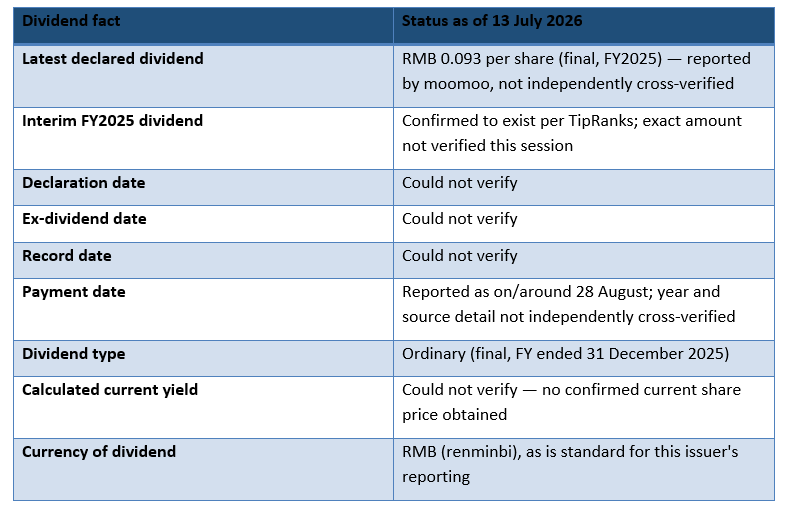
Given the limited depth of Western coverage and the multiple currencies and venues involved, this table is a snapshot of what is currently verifiable rather than a complete record. Investors should consult the company's own HKEX and Shanghai Stock Exchange filings, or its investor relations pages, for authoritative dates and amounts before making decisions.
Dividend history
A comprehensive multi-year dividend history could not be fully reconstructed from the sources accessible this session. What can be said, cautiously, is that the company declared dividends in relation to 2025 — both an interim and a final payment, per TipRanks and moomoo.
This is consistent with the profile flagged in the brief for this article: Datang International's dividend has historically been described elsewhere as variable, and Chinese thermal generators as a group have in past years seen dividends fluctuate, or occasionally be reduced or omitted, in response to volatile coal costs, regulated tariffs and profitability swings. Without verified figures for prior years (2021–2024) from this session's research, no specific historical trend, payout-ratio trajectory or omission year can responsibly be cited.
Investors wanting the full historical run of interim and final dividends should consult the company's Shanghai Stock Exchange and HKEX filing archives directly, since third-party aggregators differ in how they record and annualise Chinese dual-listed dividends.
Earnings and cash-flow analysis
The most concrete earnings signal retrieved this session comes from BigGo Finance, which reported that 2025 net profit rose sharply — by roughly 64% year-on-year — to around RMB 7.39 billion (about US$1.1 billion at the rate implied in that report). The same source stated that clean-energy capacity now exceeds 30% of installed capacity.
TipRanks separately headlined that "power output and dividends" both rose in 2025, consistent with an improving picture. However, this session could not verify supporting detail: exact revenue, operating profit, earnings per share, free cash flow, capital expenditure or a calculated payout ratio. These are standard inputs for judging dividend durability, and their absence is a genuine limitation.
For thermal and renewable generators of this type, profit swings are frequently driven by coal input costs relative to regulated on-grid tariffs — a dynamic that can move faster than dividend policy can adjust. The reported 64% profit rise is a positive signal on its face, but a single strong year does not by itself establish a stable, well-covered dividend.
Balance-sheet analysis
Detailed balance-sheet metrics — net debt, gearing, liquidity and any formal credit rating — could not be verified during this session. This is a material gap, because thermal generators of Datang's scale typically carry substantial debt to fund plant construction, environmental retrofits and, increasingly, renewable build-out.
Without confirmed net debt or gearing, it is not possible to responsibly assess dividend cover from a balance-sheet-strength perspective, nor to judge sensitivity to rising financing costs or tariff-setting changes. Investors should treat balance-sheet risk as an open question requiring direct reference to the company's interim and annual reports, rather than assuming either strength or weakness.
Company-specific growth drivers
The clearest growth signal is the reported expansion of clean-energy capacity beyond 30% of the installed base, per BigGo Finance. This suggests an active shift away from a pure coal model toward a more diversified mix, consistent with China's broader decarbonisation direction under successive five-year plans.
Reported 2025 profit growth, and confirmation of both an interim and final dividend for the year, point to improved trading conditions — potentially reflecting higher demand, more favourable coal costs, or tariff conditions during the period, though the precise drivers were not detailed in sources accessible here.
As an affiliate of China Datang Corporation, the company may also benefit from group-level support on financing, project allocation or policy access — a structural advantage sometimes seen among China's state-owned power groups, though it also means capital-allocation decisions can reflect considerations beyond shareholder return.
Industry and economic backdrop
China's power sector has been undergoing a multi-year transition, balancing continued reliance on coal for grid stability with rapid build-out of wind, solar and other renewables. State-owned generators such as those under China Datang Corporation are central actors, tasked with both maintaining supply reliability and meeting national decarbonisation targets.
Regulated or semi-regulated tariff structures mean generator profitability is not purely a function of demand; it also depends on government-set pricing and periodic coal-price volatility. This creates a distinct risk-and-reward profile versus generators in deregulated Western markets, and helps explain why profit and dividend patterns at companies like Datang International can appear less predictable to overseas investors than those at comparable UK or European utilities.
Valuation and share-price context (LSE:DAT)
This session could not obtain a verified current share price for Datang International on any of its three venues — Hong Kong (0991.HK), Shanghai (601991.SS) or the London line (LSE:DAT) — nor confirmed price-to-earnings, price-to-book or market-capitalisation figures. No valuation comparison against peers can therefore be responsibly made here.
It is worth stating why yield and valuation figures differ across websites for a stock like this: the shares trade in different currencies (HKD, RMB and typically GBP-equivalent pricing in London), providers use trailing versus forward dividend assumptions, and dual-listed Chinese shares can diverge in price between their A-share and H-share lines due to differing investor bases and capital-flow restrictions. Any single "yield" quoted elsewhere should be checked for which listing, currency and dividend basis it uses.
Given the source stock table showed no yield, and this session's independent verification also could not establish one, readers are strongly encouraged to check a live, dated quote and the company's own announcements before forming a valuation view.
Main risks
Dividend variability is the most immediate risk. The payout has historically been described as inconsistent, and this session could not confirm a stable multi-year pattern. An attractive-looking yield calculated elsewhere could simply reflect a depressed share price or a one-off payment, not a durable income stream — and the absence of confirmed regular payments is itself a risk factor, not a neutral data gap.
Coal-price and tariff exposure is structural: as a thermal-heavy generator transitioning toward renewables, profitability can swing with input costs and regulatory tariff decisions largely outside management's control.
Balance-sheet risk is unverified but plausible, given the sector's capital intensity; without confirmed net debt or gearing, financial resilience cannot be assessed with confidence.
State-influenced governance is a further consideration. As an entity affiliated with a central state-owned enterprise, capital allocation, dividend policy and strategy may reflect policy objectives as well as shareholder interests, which can differ from a purely commercially driven utility.
Finally, data and disclosure limitations for Western investors are notable: this session found sparse detailed English-language financial coverage, reinforcing the need for independent verification before any decision.
What investors may watch next
Investors may wish to monitor: confirmation of the exact final dividend amount, declaration, ex-dividend, record and payment dates directly from HKEX or Shanghai Stock Exchange filings; the full-year 2025 annual report detail on revenue, EPS, free cash flow and net debt; further disclosure on the pace of renewable build-out relative to the reported 30%-plus clean-energy share; and any tariff or coal-policy announcements from Chinese regulators affecting near-term profitability. Any credit-rating commentary would also help clarify balance-sheet risk.
Balanced conclusion
Datang International presents a genuinely mixed and, in places, incompletely verifiable picture as of 13 July 2026. On the positive side, reported 2025 net profit appears to have grown substantially, both an interim and final dividend were declared for the year, and the company appears to be increasing its renewable footprint within a state-influenced portfolio.
Against this, meaningful gaps remain: no verified current share price, no calculable yield, no confirmed balance-sheet metrics, and no independently cross-checked dividend dates. The dividend history has, in the past, been described as variable, and nothing here overturns that. Investors considering this name should treat any headline yield or valuation figure with scepticism until checked against primary HKEX, Shanghai Stock Exchange or company investor-relations sources, and should weigh the structural risks of coal-price exposure, tariff regulation and state-influenced governance alongside the more encouraging profit and clean-energy signals reported here. This article does not constitute a recommendation to buy, sell or hold the shares.


 Nov 13, 2026





 Please wait processing your request...