
 CA
 NZ
 US
 AU
 IND

 UK

 Share
 X (Formerly Twitter)
 Whatsapp
 Facebook
 LinkedIn
 Telegram
 Email This Article
 Copy Link
 Summarize with AI
 Chat GPT
 Perplexity
Summary
Helios Towers PLC (LSE: HTWS) delivered the kind of first quarter that tends to get noticed. Revenue for the three months to March 2026 rose 12% year-on-year to US$229 million, the group’s tenancy ratio reached 2.2 tenants per tower, and management lifted full-year guidance across tenancy additions, earnings and cash flow.
The upgrade followed a strong 2025. Full-year results published in March 2026 showed adjusted EBITDA of US$471 million — a tenth consecutive year of growth — record tenancy additions of around 2,500, and net leverage cut from 4.0x to 3.4x, comfortably inside the company’s target range.
Perhaps most symbolically, the tower operator has begun returning cash. Alongside a buyback programme unveiled at its November 2025 capital markets event, Helios Towers initiated a US$25 million dividend programme with its full-year results — a first for a business that spent its early listed life ploughing every dollar into growth.
Valued at roughly £2.1 billion, Helios Towers is one of the few London-listed telecommunications stocks offering direct exposure to emerging-market digital infrastructure. The question now being asked is whether Africa’s mobile boom can convert that exposure into sustained market interest.
Inside the Helios Towers business model
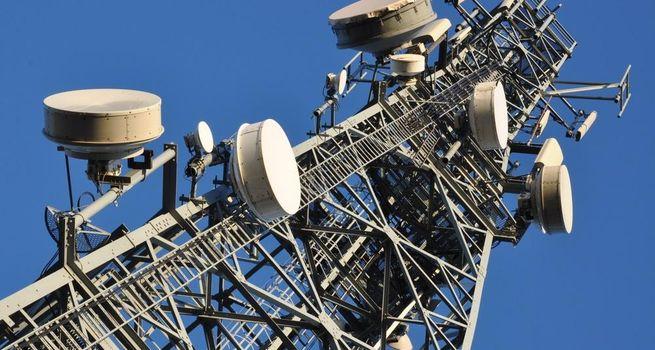
Helios Towers is an independent telecommunications tower company. It builds, acquires and operates the steel masts, rooftops and power systems on which mobile network operators hang their antennas, then leases that vertical space back to them under long-term contracts. The group runs more than 14,000 sites across nine markets: Tanzania, the Democratic Republic of Congo, Congo Brazzaville, Ghana, Senegal, Madagascar, Malawi and South Africa in Africa, plus Oman in the Middle East, entered through a US$495 million acquisition of 2,519 sites from Omantel.
The economics rest on colocation. A tower’s costs — land, steel, security, power — are largely fixed, so the first tenant typically covers the base economics while each additional tenant delivers revenue at a small incremental cost. That makes the tenancy ratio, the average number of paying tenants per tower, the single most-watched metric in the sector. Helios reached 2.2x in early 2026, a target it had originally set for later, after finishing 2025 at 2.17x, up from 2.05x a year earlier.
The customer base consists of the large mobile network operator groups active in each market, several of which are subsidiaries of major regional and international telecom companies. Serving them is as much an operational task as a financial one: Helios differentiates itself on site uptime, investing in power systems, batteries and increasingly solar and hybrid energy solutions to keep networks live in markets where grid electricity can be unreliable.
Revenue visibility is another pillar. Contracts with mobile operators run for many years, carry inflation-linked escalators and typically include power-cost pass-through mechanics. At the last quarterly update, contracted future revenue stood at around US$5.3 billion with an average remaining life of 6.7 years — the kind of order book more often associated with utilities than with telecoms.
For UK investors, this makes HTWS a distinctive telecom infrastructure stock: listed in London since 2019, reporting in US dollars, and earning its keep thousands of miles from the domestic broadband and mobile markets that occupy most LSE telecom shares.
The demand backdrop: Africa’s connectivity build-out
The structural story is straightforward. Africa has one of the world’s youngest and fastest-growing populations, and the GSMA has estimated that mobile subscriptions across the continent could exceed 1.3 billion by 2030 as smartphone adoption accelerates. Voice coverage came first; the current wave is about data.
Large coverage gaps persist too. Significant rural populations across the group’s African markets still lack reliable mobile broadband, and governments increasingly treat connectivity as core economic infrastructure. Closing those gaps requires more towers, not just busier ones — a dynamic that plays directly to companies that can build and power sites in hard-to-reach places.
That wave requires hardware. As subscribers migrate from 2G and 3G to 4G and 5G, operators must densify networks and add equipment to existing sites — activity that shows up for Helios as new tenancies and lease amendments. Industry forecasts cited by the company suggest 4G and 5G’s share of connections in markets such as Senegal and Ghana could rise sharply by 2030, from around half to three-quarters in Senegal’s case.
Management has also pointed to increasingly data-hungry applications, including AI-driven services, as an emerging driver of mobile traffic across its footprint. At the same time, capital-constrained mobile operators continue to prefer leasing tower space over building their own, reinforcing the independent tower model that Helios and its peers operate.
The Middle East adds a different dimension. Oman, the group’s first market outside Africa, has among the highest mobile penetration in the portfolio and is furthest along the technology curve, offering steadier, contract-backed growth alongside the higher-octane African markets.
What could be drawing fresh investor attention
The simplest answer is that Helios Towers appears to be shifting from a build phase to a harvest phase. Years of heavy investment created the platform; the current chapter is about sweating it. Tenancy growth now drops through to cash: the company more than tripled its free cash flow generation in 2025 and guided to recurring free cash flow of US$215–230 million for 2026, a range it raised at the first-quarter stage.
Guidance elsewhere moved the same way. Expected tenancy additions for 2026 were upgraded to 3,000–3,500 from 2,000–2,500, and adjusted EBITDA guidance was nudged up to US$515–530 million. Upgrades this early in a financial year tend to attract attention, though they are never a promise of what follows.
Deleveraging is the second strand. Net leverage of around 3.4x sits within the stated 2.5x–3.5x medium-term range, down markedly from 4.0x a year before, giving the balance sheet more room than at any point since the 2019 flotation.
The third strand is shareholder returns. A roughly US$75 million buyback announced in late 2025, ongoing repurchases of about US$50 million a year, and the maiden US$25 million dividend programme — intended to be paid one-third in FY2026 and two-thirds in FY2027, with a progressive ambition thereafter — mark a change of identity for a stock long viewed purely as a growth vehicle.
There is also a scarcity argument. Few London-listed telecommunications stocks offer pure-play exposure to emerging-market digital infrastructure, and global peers with comparable models have historically commanded premium ratings during periods of strong execution. Whether that translates into a re-rating for HTWS is unknowable, but it helps explain why the shares feature in more screening conversations than their index weight alone would suggest.
Watchlist: metrics and milestones
For those tracking the HTWS investment case, several data points may prove informative:
• Tenancy additions against the upgraded 3,000–3,500 guidance for 2026, including the roughly 500 new sites within it.
• Tenancy ratio progression beyond 2.2x, the core driver of returns on the existing tower base.
• Net leverage relative to the 2.5x–3.5x target range, and the cost of refinancing debt as it matures.
• Execution of the maiden US$25 million dividend programme and the pace of ongoing share buybacks.
• The mix of hard-currency and local-currency revenue, and the impact of African currency movements on reported dollars.
• Power costs and the effectiveness of contractual escalators and pass-throughs in protecting margins.
• Any new market entries or portfolio acquisitions across Africa and the Middle East, and how they are funded.
Where the risks lie
Emerging-market infrastructure carries risks that developed-market tower stocks do not. Currency is the most obvious: while a substantial portion of revenue is dollar-linked or protected by escalators, Helios still earns in markets whose currencies have historically depreciated against the dollar, and sharp devaluations can dent reported results and local purchasing power.
Country risk follows closely. The portfolio includes markets that have experienced political instability, and parts of the Democratic Republic of Congo — one of the group’s largest markets — have seen armed conflict. Disruption to operations, logistics or customers in any major market could affect performance.
Customer concentration is inherent to the model. Helios serves a small number of large mobile operator groups; consolidation among them, network-sharing agreements, or financial stress at a key tenant could reduce tenancies or pricing power. Contract renegotiations at renewal are a related consideration.
Regulatory and fiscal risk should not be overlooked either. Tax regimes, licensing requirements and local-ownership rules in the group’s markets can change with limited notice, and disputes with authorities are not uncommon for infrastructure owners operating across multiple African jurisdictions.
The balance sheet, though improving, still carries meaningful debt in a world of elevated interest rates, and the company’s growth plans require continued capital expenditure. Diesel and grid power costs, supply-chain frictions and security expenses can all pressure margins if pass-through mechanisms lag. Finally, sentiment towards emerging-market assets can swing for reasons unrelated to the company, moving the shares regardless of operational delivery.
The road ahead
If current trends hold, 2026 could be the year Helios Towers completes its transformation from expansion story to cash-returning infrastructure compounder. The upgraded guidance, the early achievement of the 2.2x tenancy target and the first dividend all point in that direction, and the long-dated, inflation-linked contract base may continue to provide a measure of insulation from macro noise.
Equally, investors might remember that the drivers here — African data demand, operator investment cycles, currency stability — are outside the company’s full control. The strategy may deliver, targets could be met early again, or conditions might turn. No outcome is preordained, and this article makes no forecast about where the share price could go.
Final thoughts
Helios Towers pairs one of the more compelling structural narratives on the London market — the digitisation of Africa and the Gulf — with an operating model built on colocation economics and contracted, inflation-linked revenue. The recent addition of buybacks and a maiden dividend gives the equity story a dimension it previously lacked.
Against that stand real currency, country and customer-concentration risks that deserve as much attention as the growth numbers. For observers of LSE telecom shares, HTWS is likely to remain one of the more closely watched names in the telecom infrastructure space — for reasons both exciting and cautionary.
Frequently asked questions about Helios Towers


 Nov 13, 2026





 Please wait processing your request...