
 CA
 NZ
 US
 AU
 IND

 UK

 Share
 X (Formerly Twitter)
 Whatsapp
 Facebook
 LinkedIn
 Telegram
 Email This Article
 Copy Link
 Summarize with AI
 Chat GPT
 Perplexity

Summary
RWE AG (LSE:0HA0), the German utility, paid a €1.20 per share annual dividend for financial year 2025, approved at its 30 April 2026 AGM and paid on 6 May 2026. Against a recent share price near €56.39, that gives a trailing yield of roughly 2.13% — consistent with this article's starting reference. Management targets 10% annual dividend growth and has flagged a €1.32 indicative payout for FY2026, though this is guidance, not a guarantee, as research on 13 July 2026 confirms.
Key takeaways
- RWE's FY2025 dividend rose 9.1% to €1.20 per share, approved on 30 April 2026 and paid on 6 May 2026 — the fifth consecutive annual increase.
- Recalculated against a recent share price of around €56.39 on the London 0HA0 line, the trailing yield is approximately 2.13%, matching this article's starting reference point.
- Management has flagged an indicative €1.32 dividend for FY2026, implying roughly 10% further growth if delivered — but this is a target, not a promise.
- Q1 2026 adjusted EBITDA rose 25% year-on-year to €1.6 billion, and the group confirmed full-year 2026 guidance of €5.2bn-€5.8bn adjusted EBITDA.
- Net debt climbed to €15.6 billion by end-March 2026 as renewables capex continued, alongside a near-complete €1.5 billion share buyback.
Introduction
RWE AG (LSE:0HA0), Germany's largest power generator and one of the world's biggest renewables developers, has spent much of 2026 rebuilding its case as an income stock as well as a growth story. The Essen-based group's shares trade primarily on Xetra in Frankfurt as RWE.DE, with a secondary London line under ticker 0HA0.
This article, researched on 13 July 2026, examines RWE's dividend position, financial health and share-price context using recently published sources. The starting reference yield for this piece — approximately 2.13% — matches our own recalculation once the confirmed FY2025 dividend of €1.20 per share is applied to a recent London-line price near €56.39.
Because RWE pays only one dividend a year, shortly after its spring AGM, headline yields published by different providers can diverge sharply, depending on whether they have updated for the newest declared dividend and on the EUR/GBP rate used for the London line. We unpack both effects below.
Company overview
RWE is a diversified European utility aiming to be among the world's leading renewables players. Its portfolio spans offshore and onshore wind, solar, battery storage and flexible (including hydrogen-capable) gas-fired generation, alongside a legacy conventional generation and energy trading business.
The group has reshaped itself around a multi-year investment programme, described in company materials as "Growing Green," directing capital toward renewables and flexible generation while reducing its reliance on coal and lignite. Management has also said it is trimming and refocusing planned capital expenditure amid a tougher market for some offshore wind projects, notably in the United States, while continuing to expand elsewhere.
At its 12 March 2026 full-year results and strategy update, RWE said it had delivered "strong financial performance in 2025" and set out plans for earnings growth through to 2031, per its own press release headline. Detailed FY2025 profit-and-loss figures beyond this framing could not be independently corroborated from primary sources this session, and readers should treat third-party citations of exact FY2025 revenue or EBITDA with caution until cross-checked against RWE's annual report.
Latest dividend position
RWE distributes a single annual dividend, proposed by the Executive Board, endorsed by the Supervisory Board, and approved by shareholders at the spring AGM.
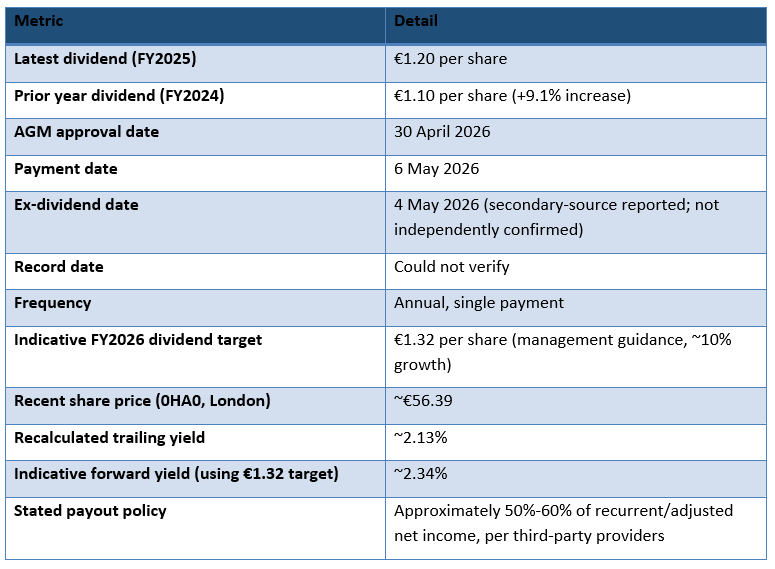
RWE's AGM press release stated that "for the coming years, the dividend is to increase by 10% annually" — a policy statement, not a contractual commitment. The €1.32 "dividend target" referenced in RWE's Q1 2026 results release for the current year is consistent with that growth rate.
On yield discrepancies: at the time of research, the London Stock Exchange's own data feed for 0HA0 displayed a yield near 1.95%, apparently still referencing the prior €1.10 dividend. Applying the confirmed €1.20 gives roughly 2.13%, aligned with this article's starting reference. GBP-based yields also move whenever the pound-euro rate shifts, a further reason platforms show different numbers for the same payment.
Dividend history
RWE's per-share dividend has grown for five consecutive years, per DividendMax data:
- 2021: €0.85
- 2022: €0.90
- 2023: €1.00 (+11.1%)
- 2024: €1.10 (+10.0%)
- 2025: €1.20 (+9.1%)
This marks a turnaround from RWE's more volatile earlier history, when payouts fluctuated with commodity cycles and portfolio restructuring, including periods of much lower distributions. The recent run of high-single-digit to double-digit increases reflects a deliberate shift toward a more predictable, growth-oriented dividend, underpinned by rising renewables earnings. A multi-year growth run is not, by itself, a guarantee of future increases, given the capital intensity of the build-out.
Earnings and cash-flow analysis
RWE's most recent quarter, Q1 2026 (January-March), showed clear momentum. Adjusted EBITDA rose 25% year-on-year to €1.6 billion from €1.3 billion, adjusted net income increased 20% to €0.6 billion from €0.5 billion, and adjusted EPS climbed 25% to €0.85 from €0.68, per RWE's press release.
Chief Financial Officer Michael Müller said the group had "already achieved one third of our forecast earnings per share" in the quarter and confirmed that earnings guidance and dividend targets remained on track.
For full-year 2026, RWE has guided to adjusted EBITDA of €5.2bn-€5.8bn, adjusted net income of €1.55bn-€2.05bn, and adjusted EPS of €2.20-€2.90. These are guidance ranges, not results; the width — especially on net income and EPS — signals meaningful uncertainty around trading conditions, commodity prices and project timing.
Applying the recent ~€56.39 price to the guided EPS range implies a forward P/E of roughly 19 to 26 times — a wide span reflecting the guidance breadth rather than a precise signal. The guided net income range comfortably covers RWE's target dividend outlay at current share count, consistent with the 50%-60% payout policy, though actual cover depends on where results land.
Capex remains heavy: RWE invested €2.3 billion net in the first quarter and guides to €6bn-€8bn net for the full year, funding wind, solar, battery and flexible generation. The group added 2.3 GW of new capacity since March 2025, had 10.4 GW under construction at the Q1 update, and expects to commission more than 4 GW during 2026.
Balance-sheet analysis
Net debt rose to €15.6 billion as of 31 March 2026, reflecting investment pace, and is expected to increase further this year. RWE said its leverage ratio, while rising, should stay at the lower end of its 3.0-3.5 times target range.
The group's credit standing remains solidly investment grade across the three major agencies. Moody's rates RWE Baa2 with a stable outlook (an upgrade, per a Yahoo Finance report), Fitch rates it BBB+/F1 stable, and S&P Global Ratings has affirmed BBB-/A-3, per an S&P publication. RWE states it has held investment-grade ratings from Moody's since 2000 and Fitch since 2003.
Alongside capex, RWE has returned cash via a buyback of up to €1.5 billion, launched in November 2024 across three tranches into 2026. Per RWE's own page, the first two tranches (to May and December 2025) were completed, with the third running January-April 2026. A separate ad-hoc-news.de report carried a headline that the €1.5 billion programme had been "successfully completed," though the precise completion date could not be independently confirmed this session. Running a buyback alongside rising net debt and heavy capex is a capital-allocation choice investors may wish to weigh.
Company-specific growth drivers
RWE's growth case rests principally on its renewables pipeline. The 10.4 GW under construction at the Q1 2026 update — offshore wind, onshore wind, solar and battery storage — represents a substantial near-term earnings pipeline as projects reach operation.
Flexible, dispatchable generation, including hydrogen-capable gas plants, is positioned as a complement to intermittent renewables, supporting grid reliability as coal and lignite retire. The group has also highlighted offshore wind approvals expanding its UK pipeline, per industry reporting, alongside a US push — though US offshore wind has faced a harder policy and permitting backdrop that has contributed to capex being reprioritised in that segment, per energy trade press.
Industry and economic backdrop
European utilities are navigating elevated but moderating capital costs, continued EU and UK decarbonisation support, and volatile wholesale power and gas prices that affect trading and flexible generation earnings. Renewables auctions, grid-connection queues and offshore leasing frameworks all shape how fast developers convert pipeline into operating capacity.
Interest rates matter directly: higher-for-longer financing costs raise the cost of debt-funded build-out, while future rate declines would ease pressure on leverage ratios such as RWE's 3.0-3.5 times target. Euro-sterling moves also directly affect what UK holders of the 0HA0 line receive and how the yield appears in GBP, independent of RWE's underlying EUR dividend.
Valuation and share-price context
RWE shares have traded broadly in a range over the past year, with the London 0HA0 line recently quoted around €56.39, per London Stock Exchange data. Applying the FY2026 adjusted EPS guidance of €2.20-€2.90 implies a forward P/E of roughly 19 to 26 times — a wide band reflecting guidance breadth rather than a single consensus.
Separately, aggregator platform eToro listed an analyst consensus target near €64.61 with a "strong buy" characterisation when this research was compiled; such targets vary between platforms, update frequently, and are not a recommendation or a guarantee of future performance.
No share-price move is assured in either direction, and a rising yield can reflect a falling share price as easily as a rising dividend — so the yield should be read alongside earnings cover, guidance and balance-sheet trends, not in isolation.
Main risks
Several risks bear on both the share price and dividend sustainability. Commodity and power-price volatility can swing trading and generation earnings materially, as the wide FY2026 guidance shows. Rising net debt, now €15.6 billion and set to increase further, could pressure leverage and, in a stress scenario, ratings, even though agencies currently rate RWE investment grade with stable outlooks.
Execution risk on the 10.4 GW pipeline is material — delays, cost overruns or permitting setbacks (as in parts of the US offshore market) could slow the earnings growth underpinning the dividend policy. The 10% growth target and €1.32 indicative FY2026 payout are aspirations, not guarantees, and could be revised if earnings disappoint. Currency risk affects UK holders of the 0HA0 line specifically. Finally, a high or rising yield can warn of a weakening share price rather than signal strength, and RWE's dividend, like any equity dividend, is not guaranteed or risk-free.
What investors may watch next
Attention is likely to turn to RWE's half-year 2026 results for an updated read on whether guidance is trending toward the top or bottom of the disclosed ranges. Pipeline progress — gigawatt additions against the 10.4 GW under construction — will be a tangible growth indicator. Net debt and leverage relative to the 3.0-3.5 times target, capital-allocation commentary once the €1.5 billion buyback concludes, and any update to the €1.32 FY2026 dividend target as the year unfolds are all plausible near-term catalysts.
Balanced conclusion
RWE's dividend story has strengthened, with five consecutive increases culminating in €1.20 per share for FY2025 and an ambition toward an indicative €1.32 for FY2026. Recalculated against a recent price near €56.39, the trailing yield of about 2.13% matches this article's starting reference, even though some feeds have yet to catch up with the newly confirmed dividend.
Set against that is a capital-intensive strategy, rising net debt, and 2026 earnings guidance spanning a notably wide range. Investment-grade ratings and confirmed guidance offer some reassurance, but neither the pace of dividend growth nor the share-price direction can be assumed. As with any income holding, investors should weigh the yield against earnings cover, balance-sheet trends and execution risk, rather than in isolation.


 Nov 13, 2026





 Please wait processing your request...