
 CA
 NZ
 US
 AU
 IND

 UK

 Share
 X (Formerly Twitter)
 Whatsapp
 Facebook
 LinkedIn
 Telegram
 Email This Article
 Copy Link
 Summarize with AI
 Chat GPT
 Perplexity

Summary
SSE plc (LSE:SSE) trades around an indicated dividend yield of roughly 2.9%, close to the 2.83% reference level, with shares near 2,383p as of early June 2026. Its final dividend of 47.3p goes ex-dividend on 23 July 2026, taking the FY2025/26 total to 68.7p, up about 7% year-on-year. The dividend is backed by regulated networks and renewables cash flows but sits alongside record capex, rising net debt and a 2030 renewable target the company itself now says is unlikely to be met.
Key takeaways
- SSE's final dividend of 47.3p goes ex-dividend on 23 July 2026, with the record date 24 July and payment due 17 September 2026, taking total FY2025/26 dividends to 68.7p.
- The indicated yield sits close to 2.9%, broadly in line with the supplied 2.83% snapshot; small differences reflect timing and calculation method.
- SSE has rebased its dividend twice this decade, most recently cutting from 96.7p to 60p around FY2023/24 to fund investment, before resuming 5-10% annual growth guidance to 2026/27.
- FY2025/26 adjusted operating profit fell an estimated 4% to around £1.8bn on lower grid revenue, even as adjusted EPS reached 153.5p, described as towards the top of guidance.
- SSE has flagged it is unlikely to meet its 2030 renewable generation target, citing a difficult market, policy uncertainty and grid-connection delays, while capex hits record levels.
Introduction
SSE plc (LSE:SSE) is one of Britain's largest listed utilities, spanning electricity transmission and distribution networks, a substantial renewables portfolio anchored by the Dogger Bank offshore wind project, and flexible thermal generation. As of this research on 13 July 2026, the shares carry an indicated dividend yield near 2.9%, close to the 2.83% level supplied as a starting reference. With the final dividend for the year to 31 March 2026 due to go ex-dividend on 23 July, income investors are watching SSE's payout trajectory and the capital-intensive strategy that underpins it.
This article draws on SSE's investor relations disclosures, recent results commentary and independent data providers to set out where the dividend, earnings and balance sheet stand, and what risks and catalysts may shape the picture ahead.
Company overview
SSE plc is built around three pillars. SSEN Transmission and SSEN Distribution own and operate regulated electricity networks in the north of Scotland and, for transmission, into northern England. SSE Renewables develops and operates wind, hydro and other low-carbon assets, including stakes in the Dogger Bank offshore wind farm. A flexible thermal business, including gas-fired plant, helps balance the grid.
The group divested its retail supply arm some years ago, leaving a portfolio weighted toward regulated and contracted cash flows alongside merchant renewables and thermal exposure. Regulatory asset value (RAV) growth of more than 20% was reported in the latest results, reflecting the scale of network investment, according to commentary summarised by GuruFocus.
Latest dividend position for LSE:SSE
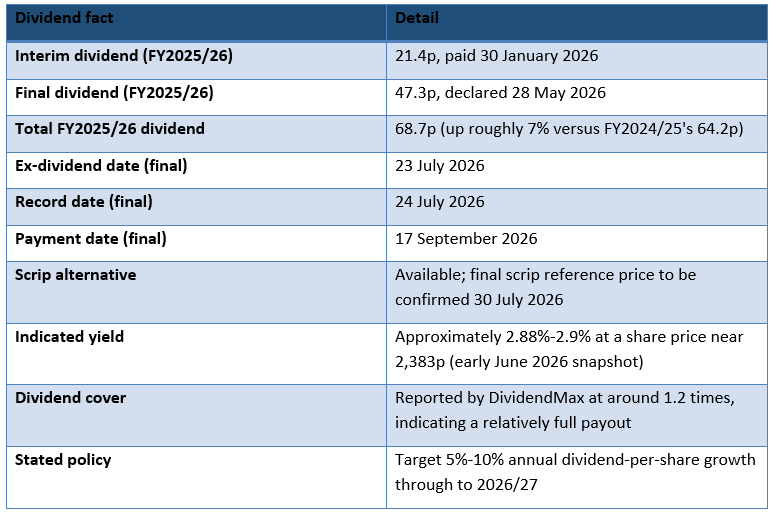 Source: SSE plc dividend timetable
SSE pays a semi-annual dividend, with an interim payment typically in January and a final in September following the AGM. The 23 July ex-dividend date is the key near-term event: shares bought on or after that date will not receive the 47.3p final payment. A scrip alternative lets shareholders take new shares instead of cash, with the final scrip reference price due on 30 July 2026.
Different providers may quote slightly different yields at any moment. This usually reflects whether a site uses the last 12 months of dividends actually paid (a trailing yield) or the latest announced annualised dividend (an indicated or forward yield), plus differences in the timing of price snapshots. The 2.83% reference and the roughly 2.88%-2.9% figures found here are consistent once those methodological differences are accounted for.
Dividend history
SSE's dividend has not followed a smooth line. Around FY2019/20, it rebased down from close to 97.8p to 80p, a cut of roughly 18%, as part of a strategic reset that included exiting energy retail. Dividends then grew modestly, reaching 96.7p by FY2022/23, according to DividendMax's historical table.
A second, larger rebasing followed. As SSE committed to its Net Zero Acceleration Programme (NZAP+) and a fast-expanding investment plan, the board cut the total dividend to 60.0p for FY2023/24, a reduction of roughly 38%, explicitly to prioritise reinvestment over near-term payout growth.
Since then, SSE has guided to and delivered increases toward the upper end of a stated 5%-10% range: 64.2p for FY2024/25 and 68.7p for FY2025/26, each up about 7%. Commentary reported by DirectorsTalk Interviews confirms management's reiterated commitment to this corridor through FY2026/27, after which the framework has previously been associated with an RPI-linked approach, though this research could not independently confirm the precise wording of any post-2026/27 policy from a primary source accessed this session.
Earnings and cash-flow analysis
SSE's FY2025/26 results, published in late May 2026, showed a mixed underlying picture. Adjusted earnings per share reached 153.5p, described in earnings-call commentary summarised by GuruFocus as towards the top end of guidance. Yet several outlets — including Power Technology, Yahoo Finance and IndexBox — reported adjusted operating profit falling around 4% to roughly £1.8bn, with Bloomberg noting this took underlying earnings to their lowest since 2022, chiefly on lower grid revenue.
Resilient adjusted EPS alongside softer operating profit points to factors below the operating line, such as financing, tax or portfolio mix, though this research could not independently verify the bridge between the two figures. Income investors should note that dividend cover of around 1.2 times, per DividendMax, implies the payout consumes most of adjusted earnings, leaving a thin margin if earnings disappoint.
Group revenue was not independently confirmed to a specific figure this session; SSE's revenue has historically been volatile owing to wholesale trading within its flexible generation business, so readers wanting a precise figure should consult the full annual report.
Capital expenditure hit a record in FY2025/26, reported at around £3.6bn, with transmission investment alone said to have risen roughly 80% year-on-year, per GuruFocus's summary of the earnings call. This scale of investment is central to both the growth case and the balance-sheet risks below.
Balance-sheet analysis
Net debt to EBITDA was reported as stable at around 3.3 times in the FY2025/26 commentary, reflecting the heavy capital programme rather than weaker trading. Some 92% of debt is said to be fixed-rate, at an average cost of roughly 4.1%, which should limit near-term interest-rate sensitivity, per the same GuruFocus summary. Liquidity looked comfortable, with about £7.4bn reported available at the year-end.
On credit quality, Moody's affirmed SSE's Baa1 rating with a stable outlook on 11 February 2026, per SSE's newsroom. Notably, Moody's revised the threshold underpinning that rating — moving its funds-from-operations-to-net-debt guidance to "at least 18%" from a prior "not materially below 20%" — which SSE described as reflecting the changing business mix and financial strength expected out to 2030. Separately, S&P Global Ratings has affirmed SSE at BBB+/A-2, per its own disclosure "U.K. Utility SSE PLC 'BBB+/A-2' Ratings Affirmed." Both agencies therefore continue to rate SSE solidly investment-grade, though the loosened Moody's threshold is worth watching as a signal of rising, not falling, leverage tolerance.
Company-specific growth drivers
SSE's growth case rests heavily on regulated and contracted infrastructure. Management points to RAV growth of more than 20% in the latest year and to a five-year investment plan now framed at around £33bn across networks, renewables and flexible generation, as reported by Proactive Investors. This is a further step up from the original NZAP+ envelope of roughly £20bn-plus outlined a few years earlier, showing how SSE's ambitions and capital needs have grown.
Guidance cited on the earnings call points to index-linked earnings rising from around 60% of the group total currently to about 80% by 2030, alongside a longer-range adjusted EPS target of 225-250p by FY2030, equivalent to targeted 10-13% annual growth. These are company targets and should be read as guidance rather than guaranteed outcomes.
Dogger Bank, in which SSE holds a stake alongside partners, remains a flagship renewables asset as phases progress, supporting the group's low-carbon credentials, though this research did not surface fresh, dated operational updates this session.
Industry and economic backdrop
UK utilities operate within a framework set largely by Ofgem, which determines allowed returns on regulated network assets. This gives companies like SSE more revenue visibility than unregulated industrials, but also exposes returns to periodic price-control resets.
More broadly, the sector faces a tension between the scale of grid and renewables investment needed for decarbonisation and the cost of funding it amid still-elevated interest rates. SSE's own disclosure that it is unlikely to meet its 2030 renewable generation target — citing, per Financial Post reporting, a difficult market environment, policy uncertainty and grid-connection delays — shows even well-capitalised players face supply-chain, planning and connection bottlenecks affecting the wider UK build-out.
Valuation and share-price context (no recommendation)
At the most recent verified snapshot, dated 8 June 2026, SSE shares traded near 2,383p, giving a market capitalisation of roughly £28.7bn, a trailing price-to-earnings ratio of about 22.6 times and a forward P/E closer to 13 times, according to stockanalysis.com. Treat this as a point-in-time reference rather than a live quote, and check a real-time source for the current level, since utility shares can move on rate expectations, regulatory news and sentiment.
The gap between a trailing P/E in the low twenties and a forward P/E nearer 13 implies the market is pricing in a meaningful earnings step-up, consistent with management's own FY2030 ambitions — though forward multiples rest on analyst estimates. No comparison to specific listed peers' multiples could be independently verified this session; readers wanting a peer-relative view should consult a live data terminal or broker research.
Main risks
A resilient-looking yield can reflect a depressed share price or elevated perceived risk rather than strength, and SSE's two rebasings this decade are a reminder that payouts here are board policy, not an entitlement. Key risks include: execution risk on a record and growing capex programme; rising net debt and possible faster-than-tolerated deterioration in credit metrics; regulatory risk around future Ofgem price controls; the acknowledged risk of missing the 2030 renewable target on grid delays and policy uncertainty; and sensitivity to interest rates, given reliance on debt funding. No SSE dividend should be considered guaranteed, and past growth is not a promise of future increases.
What investors may watch next
Near-term catalysts include the 23 July ex-dividend date and 17 September payment date for the final dividend, confirmation of the scrip reference price around 30 July, and any further commentary from SSE, Ofgem or the rating agencies on funding the £33bn plan. Longer term, progress toward the FY2030 EPS target range and any formal update to the 2030 renewables ambition will likely shape sentiment.
Balanced conclusion
SSE plc (LSE:SSE) offers a dividend yield in the high-2% range, underpinned by a large base of regulated and contracted infrastructure and a stated policy of 5%-10% annual growth through FY2026/27. The 23 July ex-dividend date is a near-term focal point. Yet dividend cover near 1.2 times, record capex, rising net debt and management's own admission that the 2030 renewable target is unlikely to be met all point to a business balancing ambition against financial discipline. The dividend has been rebased twice this decade, underscoring that current yield levels and growth guidance reflect company policy and market conditions rather than any guarantee. Prospective investors should weigh the scale of SSE's capital programme and balance-sheet trajectory alongside its income appeal.


 Nov 13, 2026





 Please wait processing your request...