
 CA
 NZ
 US
 AU
 IND

 UK

 Share
 X (Formerly Twitter)
 Whatsapp
 Facebook
 LinkedIn
 Telegram
 Email This Article
 Copy Link
 Summarize with AI
 Chat GPT
 Perplexity

Summary
Telecom Plus (LSE:TEP), which trades as Utility Warehouse, cut its FY26 final dividend to 12p from 57p, taking the full-year payout to 50p, down roughly 47% from 94p. Shares fell more than 30% on the 23 June 2026 results day. A 5.81% yield figure reflects an earlier, pre-cut snapshot; recalculated against the reduced dividend and a lower share price, the trailing yield is closer to 4.6%, as of 13 July 2026.
Key takeaways
- Telecom Plus cut its FY26 final dividend to 12p from 57p, taking the total ordinary dividend to 50p, down about 47% from 94p a year earlier.
- Shares reportedly fell more than 30% on 23 June 2026, the day the results and dividend cut were announced, despite record headline revenue and profit.
- The 5.81% starting-reference yield appears to predate the cut; recalculated on current data, the trailing yield looks closer to 4.6%.
- The board has paired a £40 million share buyback with the reduced dividend, lifting total shareholder returns to 100p per share, up 6.4% year-on-year.
- Telecom Plus has guided FY27 adjusted pre-tax profit sharply lower, to fund a five-year growth plan targeting roughly £175 million of adjusted pre-tax profit by FY31.
Introduction
Telecom Plus PLC (LSE:TEP), the company behind the Utility Warehouse (UW) brand, has become one of the more talked-about names on UK income screens this July. As of this research date of 13 July 2026, the shares have been sitting near multi-year lows following a dramatic results day on 23 June 2026, when the board simultaneously reported record annual revenue, cut the dividend sharply, and warned that next year's profits would be markedly lower.
That combination has pushed the stock into "top dividend yield" conversations, partly because a starting-reference yield of 5.81% has circulated across data platforms. As this article sets out, that figure looks to be a snapshot taken before the June announcement. Recalculated against the new, lower dividend and the post-results share price, the picture for income investors is materially different — and more nuanced than the headline yield alone suggests.
Company overview
Telecom Plus is not a utility network owner. It is a multi-utility reseller that buys energy, broadband, mobile and insurance products wholesale and bundles them for retail customers under the Utility Warehouse brand, distributing through a network of independent "Partners" rather than a conventional sales force. According to a company update reported by ADVFN, that Partner network had grown to roughly 77,200 members by the FY26 year-end.
The model is built around customer stickiness: households that take multiple UW services in one bundle tend to churn less than single-service utility customers. Growth in FY26 was boosted by an acquisition of broadband customers from TalkTalk, on top of organic growth in the core multiservice base, according to Telecom Plus's own trading update and subsequent results commentary reported by Investing.com and LSE.co.uk.
Latest dividend position for LSE:TEP
The dividend story is the crux of the current debate around Telecom Plus. The company's FY26 results, published 23 June 2026, confirmed a steep cut to the final dividend alongside record headline financial results — an unusual combination that appears to explain much of the share price reaction.
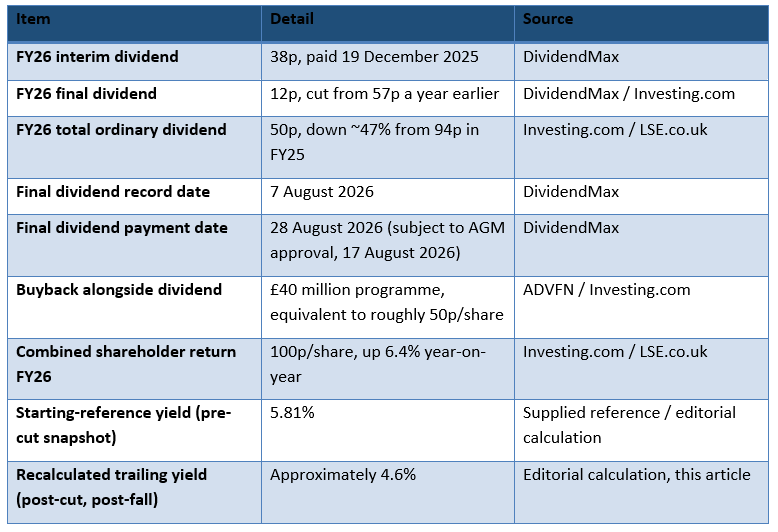
Working back through the arithmetic helps explain the gap between headline yield figures seen on some finance sites and the reality today. A 5.81% yield on the old 94p annual dividend implies a reference share price around 1,618p — broadly consistent with where Telecom Plus shares are understood to have traded before the 23 June announcement. That is an editorial calculation, not a directly sourced data point, but it is consistent with the scale of the subsequent share price fall.
Against a share price recently around 1,078p-1,080p, as quoted by Hargreaves Lansdown during this research session, the new 50p total FY26 dividend produces a trailing yield closer to 4.6%. Whether this counts as a "top" yield depends heavily on which dividend figure and which price a given source is using — a point worth stressing to readers who see different yields quoted across different platforms.
The ex-dividend date for the 12p final payment could not be independently verified from a primary source in this research session. Based on the confirmed 7 August 2026 record date, it is likely to fall in early August, but that specific date should be checked against the company's own investor relations announcements before being relied upon.
Dividend history
Telecom Plus built a reputation over several years as a steadily growing dividend payer. DividendMax's dividend history shows the following pattern of interim and final payments:
- FY23: interim 36p (paid December 2023), final 46p (paid August 2023 cycle)
- FY24: interim 37p (paid December 2024), final 47p (paid August 2024)
- FY25: interim 38p (paid December 2025), final 57p (paid August 2025), taking the FY25 total to 94p, itself up 13.3% on the prior year according to DividendMax
- FY26: interim 38p (paid December 2025, unchanged from the prior interim), final cut sharply to 12p (announced June 2026), taking the FY26 total to 50p
That FY26 final cut breaks a multi-year run of dividend growth. DividendMax's own dividend cover metric, cited on its site, put cover at around 1.1x based on the prior 94p dividend — a thin margin that likely contributed to the board's decision to rebase the payout to a lower, ostensibly more sustainable level, while introducing buybacks as a second, more flexible channel for returning cash.
Earnings and cash-flow analysis
FY26 headline numbers were, on their own, strong. Revenue rose 5.6% to £1.94 billion from £1.84 billion, adjusted pre-tax profit rose 4.7% to £132.2 million from £126.3 million, and statutory pre-tax profit increased 6.7% to £113.0 million from £105.9 million, according to figures reported by Investing.com and LSE.co.uk. Total customer numbers rose 23.3% to 1.43 million, aided by the TalkTalk broadband acquisition, with organic customer growth of 10.3% and services supplied up 12.1% to 3.80 million.
Management's own April 2026 trading update flagged that adjusted profit landed at the lower end of a previously guided £132 million-£138 million range, attributing the shortfall to reduced energy consumption during a mild winter — a reminder that even a reseller model carries some exposure to weather-driven demand swings, not just customer growth.
Cost pressures were also evident. Energy customer churn rose to 14.2% from 13.7%, which management linked to competitor pricing, while the bad debt charge increased to £41.2 million, equivalent to 2.1% of sales, which multiple reports attributed to cost-of-living pressures on household customers. Precise adjusted earnings per share and free cash flow figures were not confirmed by a primary source within this research session; readers wanting exact per-share figures should consult Telecom Plus's full annual report.
The company has not disclosed detailed FY27 guidance beyond profit: adjusted pre-tax profit for the year to March 2027 is expected to fall to roughly £80 million-£90 million, down sharply from £132.2 million in FY26, which management has attributed to the first year of investment under a new five-year growth plan, according to Investing.com's reporting of the results.
Balance-sheet analysis
Telecom Plus entered FY27 with net debt to adjusted EBITDA of approximately 0.9x-1.0x at the FY26 year-end, based on the company's own April 2026 trading update. Management has guided that this leverage ratio is expected to rise toward roughly 1.5x during FY27 as the group steps up investment in customer acquisition, technology and brand-building under its new growth strategy, as reported by Meyka and other outlets covering the June results.
A near-doubling of leverage from a low base is not unusual for a company entering an investment phase, and 1.5x net debt to EBITDA would still be a moderate level by general corporate standards. Nonetheless, it represents a genuine shift from the more conservative balance sheet Telecom Plus has run in recent years, and is one reason the board says future shareholder returns will blend dividends with more flexible buybacks rather than a single, ever-growing dividend.
Company-specific growth drivers
Telecom Plus's growth case for the next five years rests on a plan to more than double its higher-quality "multiservice" customer base from around 500,000 to more than 1 million by FY31, according to ADVFN's coverage of the strategy update. Management has set out four priorities: enhancing customer value, expanding the Partner distribution network, increasing brand awareness, and strengthening digital capabilities.
If delivered, management's long-term targets point to adjusted pre-tax profit of around £175 million and a return on capital employed above 30% by FY31. These are company guidance and targets, not guaranteed outcomes, and depend on sustained execution through a period of deliberately reduced near-term profitability.
Industry and economic backdrop
As a multi-utility reseller rather than a regulated network owner, Telecom Plus sits somewhat apart from traditional utility stocks, but it remains exposed to broader UK household energy and telecoms dynamics: wholesale energy costs, weather-driven consumption, competitive pricing in energy and broadband, and the state of household finances, which drives both customer switching and bad debt. The £41.2 million bad debt charge and rising energy churn reported for FY26 both point to a cost-of-living-squeezed consumer environment shaping recent results.
Valuation and share-price context (no recommendation)
Telecom Plus shares were quoted by Hargreaves Lansdown, during this research session, at around 1,078p-1,080p, with a price/earnings ratio near 9.2 and a market capitalisation of roughly £862 million. That P/E is markedly lower than the multiple the shares carried before the June results, consistent with reports that the stock fell more than 30% on the day the dividend cut and FY27 profit warning were announced.
This article does not make a buy, sell or hold recommendation. A lower valuation and a higher headline yield can reflect either an attractive entry point or a market correctly pricing in reduced near-term profitability and dividend growth — the data alone cannot distinguish between the two, and different data providers may show different current yields depending on whether they use the old 94p dividend, the new 50p dividend, or a forward estimate.
Main risks
Several risks are worth weighing. First, dividend cover has historically been thin (around 1.1x on the prior dividend, per DividendMax), and while the rebased 50p payout should improve that cushion, FY27's guided profit fall to £80 million-£90 million adjusted pre-tax profit will need to be tracked against the new dividend commitment. Second, leverage is set to roughly double toward 1.5x net debt/EBITDA, adding financial risk during the investment phase. Third, rising bad debt and energy churn point to consumer-facing cost pressures that could persist or worsen. Fourth, the five-year growth plan to FY31 is management guidance, not a guarantee, and near-term profit is being deliberately sacrificed for it. No dividend, including Telecom Plus's rebased payout, should be regarded as guaranteed or risk-free.
What investors may watch next
Income-focused investors may want to watch: confirmation of the exact ex-dividend date for the 12p final payment; shareholder approval of the dividend at the 17 August 2026 AGM; the pace and pricing thresholds at which the £40 million buyback is deployed; progress against the FY27 adjusted profit guidance of £80 million-£90 million; and any further detail management provides on dividend policy as the five-year plan unfolds toward FY31 targets.
Balanced conclusion
Telecom Plus's FY26 results told two stories at once: record revenue and profit growth on one hand, and a sharply reduced dividend with weaker FY27 profit guidance on the other. The market's reaction — a reported 30%-plus share price fall — suggests investors weighted the second story more heavily. For income-focused readers, the practical takeaway is that the widely cited 5.81% yield reflects an earlier snapshot rather than the post-cut, post-fall reality; a trailing yield closer to 4.6% looks more representative today. Whether Telecom Plus's five-year growth plan delivers the promised recovery in profit and shareholder returns by FY31 remains to be seen, and neither the current yield nor the rebased dividend should be treated as assured.


 Nov 13, 2026





 Please wait processing your request...