
 CA
 NZ
 US
 AU
 IND

 UK

 Share
 X (Formerly Twitter)
 Whatsapp
 Facebook
 LinkedIn
 Telegram
 Email This Article
 Copy Link
 Summarize with AI
 Chat GPT
 Perplexity

Key facts
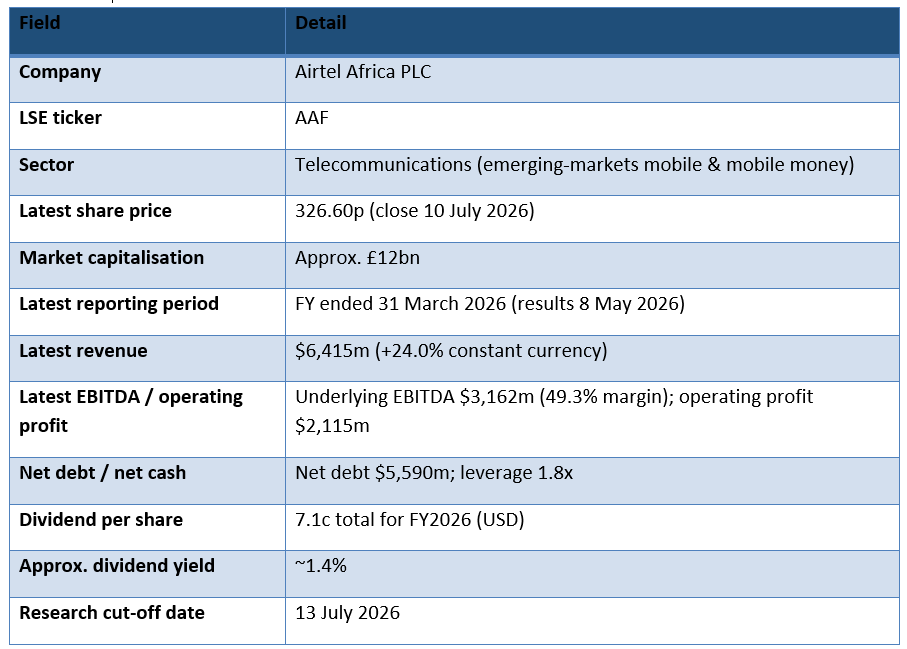
Summary
Airtel Africa is a London-listed telecommunications and mobile-money operator serving 14 sub-Saharan markets, with 183.5m customers and a fast-growing Airtel Money financial-services arm. It is attracting attention in July 2026 after FY2026 results showed profit after tax up around 147% and constant-currency revenue up 24.0%. The principal near-term catalyst is a planned Airtel Money IPO in the second half of 2026. The most important risk remains volatility in the Nigerian naira, which can materially reduce reported dollar earnings.
Five key takeaways
- Airtel Money customers rose 21.3% to 54.1m, with annualised transaction value exceeding $215bn in the fourth quarter, positioning financial services as a distinct growth engine alongside mobile connectivity.
- FY2026 revenue reached $6,415m, up 24.0% in constant currency but only 29.5% reported after favourable currency effects, underscoring how heavily results depend on exchange rates.
- Underlying EBITDA margin widened 280 basis points to 49.3%, while profit after tax jumped roughly 147% to $813m as prior-year currency headwinds eased.
- Net debt of $5,590m brought leverage down to 1.8x from 2.3x, and the group completed a second $100m buyback in March 2026.
- Management intends to float Airtel Money via an IPO in the second half of 2026, subject to market conditions, alongside a progressive, US dollar-denominated dividend.
Introduction
Airtel Africa shares have returned to prominence in July 2026 as investors reassess emerging-market telecoms operators that combine connectivity with digital financial services. The central story is not simply voice and data subscriptions; it is the convergence of mobile networks and mobile money across some of the world's fastest-growing populations. Airtel Africa PLC (LSE: AAF) sits at that intersection, operating in 14 sub-Saharan markets. This review reflects verified information available as of 13 July 2026, drawing on FY2026 results published on 8 May 2026, and examines both the growth case and the currency risks that accompany it.
Company overview
Airtel Africa provides mobile voice, mobile data and mobile-money services across 14 sub-Saharan countries, including Nigeria, Kenya, Uganda, Tanzania, Zambia, Malawi, Rwanda, the Democratic Republic of Congo, Chad, Niger, Gabon, Congo Brazzaville, Madagascar and Seychelles. It reported 183.5m customers at 31 March 2026, up 10.5% year on year, making it one of the largest operators on the continent by subscriber base.
The business model rests on three pillars: voice, data and Airtel Money, with growth increasingly driven by the latter two. Data customers reached 84.2m, up 14.8%, with average usage of 8.9GB per month and smartphone penetration of 49.5%, leaving a long runway for migration to data-enabled devices as roughly half the base still uses basic handsets.
Airtel Money, the group's mobile-money platform, allows customers to store value, transfer funds, pay merchants and access credit through a mobile handset rather than a bank account. In markets where formal banking infrastructure is thin, this positions Airtel Africa as a provider of financial inclusion as much as connectivity. The group reports in US dollars, which shapes how local-currency performance is translated for shareholders.
Its scale across both Anglophone and Francophone Africa gives it geographic diversification that few peers can match.
Latest financial performance
For the financial year ended 31 March 2026 (FY2026), Airtel Africa reported revenue of $6,415m, an increase of 29.5% as reported and 24.0% in constant currency; the gap illustrates how currency movements can flatter or depress the headline number. Fourth-quarter constant-currency growth was 22.3%, indicating momentum was broadly maintained through the year.
Growth was led by Nigeria, where revenue rose 47.5% in constant currency, followed by East Africa at 17.8% and Francophone Africa at 17.1%. Underlying EBITDA reached $3,162m, up 30.4% in constant currency, with the margin widening 280 basis points to 49.3% and the fourth-quarter margin at 50.3%. Operating profit rose 45.1% to $2,115m.
Profit after tax climbed to $813m from $328m, an increase of approximately 147%, as the prior year's currency-related pressures eased. Basic earnings per share were 18.6 cents, up from 6.0 cents. Operating free cash flow rose 39.4% to $2,278m, and net cash from operations increased around 41% to $3,195m. Capital expenditure was $884m, up 31.9%, with FY2027 capex guided at approximately $1.1bn. Management has flagged energy-cost inflation as a near-term margin headwind.
Balance sheet and financial position
Airtel Africa closed FY2026 with net debt of $5,590m. Reported leverage fell to 1.8x from 2.3x a year earlier, and on a lease-adjusted basis stood at 0.5x, indicating the group has been deleveraging as earnings expand. This gives management greater flexibility to fund investment and sustain shareholder returns.
The full debt-maturity schedule is not disclosed in the data reviewed here; readers seeking a detailed profile should consult the Annual Report and Accounts 2026. Strong operating cash flow appears sufficient to fund the guided FY2027 capex of roughly $1.1bn while continuing to service debt.
On capital returns, the group completed a second $100m share buyback programme in March 2026, reducing the share count to 3,654.9m from 3,750.8m. The planned Airtel Money IPO, intended for the second half of 2026, could provide an additional source of capital and crystallise value in the financial-services business, although it remains subject to market and geopolitical conditions.
Growth drivers
Mobile subscribers and data monetisation (AAF)
Subscriber growth of 10.5% to 183.5m provides the foundation, but the more valuable trend is the migration of existing customers up the value chain. With smartphone penetration at 49.5%, roughly half the base has yet to adopt data-enabled handsets, and each upgrade tends to lift average revenue per user. Group ARPU rose 12.8% in constant currency to $3.1, a figure that nonetheless shows the monetisation opportunity as data usage deepens.
Airtel Money and financial inclusion
Mobile money is the standout growth engine. Airtel Money customers grew 21.3% to 54.1m, with mobile-money revenue up 28.4% in constant currency and annualised fourth-quarter transaction value exceeding $215bn. In markets with limited bank coverage, it functions as everyday financial infrastructure, and the intended IPO could sharpen focus on the segment and potentially unlock a separate valuation for a business with a different profile from the core telco.
Network investment and currency exposure
Continued investment underpins the growth story: around 3,250 new sites were added, fibre reached 81,900km, and the group runs more than 3,100 5G sites across six markets. Yet this growth is exposed to currency risk. The Nigerian naira is the largest single foreign-exchange exposure: a 1% move in the US dollar equates to roughly $60m to $62m of revenue and $29m to $31m of EBITDA, a sensitivity that can swing reported results materially.
Telecommunications-sector outlook
Several structural themes support emerging-market operators such as Airtel Africa. Sub-Saharan Africa has a young, expanding population with rising demand for mobile data, and smartphone penetration remains well below developed-market levels, leaving scope for sustained data growth. Mobile-money adoption continues to broaden as digital payments displace cash in economies where formal banking is limited.
Balanced against these tailwinds are cost and currency pressures. Energy costs are a meaningful operating expense for tower networks, and inflation here can compress margins, a point management has flagged for the year ahead. Foreign-exchange volatility, particularly in Nigeria, can erode reported dollar earnings even when local-currency performance is strong. For Airtel Africa, the interplay between rapid constant-currency growth and translation risk defines the investment narrative more than any single sector trend.
Valuation and share-price context
Airtel Africa shares closed at 326.60p on 10 July 2026, giving a market capitalisation of roughly £12bn. The stock had risen around 76% over the trailing twelve months but was down about 8% year to date in 2026, suggesting some of the strong recovery had already been priced in.
On fundamentals, leverage stood at 1.8x net debt to EBITDA, and the indicated dividend yield was approximately 1.4%. Detailed EV/EBITDA and price-to-earnings multiples depend on the exchange rate used to translate dollar earnings into sterling and on the share count following buybacks, so they should be calculated with care. The combination of high constant-currency growth and elevated currency risk makes valuation judgements unusually sensitive to assumptions; the shares cannot be called objectively cheap or expensive without accounting for that FX uncertainty and the pending IPO.
Dividend analysis
Airtel Africa operates a progressive dividend policy, with distributions declared in US dollars and paid semi-annually. For FY2026 the total dividend was 7.1 cents per share, up 9.2% on the prior year. This comprised an interim dividend of 2.84 cents, paid on 12 December 2025, and a final dividend of 4.26 cents declared on 8 May 2026.
The final dividend went ex-dividend on 18 June 2026, with a record date of 19 June 2026 and payment scheduled for 24 July 2026; the currency-election deadline was 6 July 2026. Implied dividend cover is around 2.6 times, though not formally stated by the company. With operating free cash flow of $2,278m comfortably exceeding the dividend outlay, the distribution appears well supported by cash generation, subject to currency translation and investment commitments. The completed $100m buyback in March 2026 supplements the cash return.
Main risks
The most significant risk is currency volatility, above all in the Nigerian naira. Because the group reports in dollars, sharp local-currency depreciation can substantially reduce reported revenue and earnings, as the reported-versus-constant-currency gap illustrates. Competition across the 14 markets is intense and could pressure pricing and margins. Execution risk attaches to the network build-out and the planned Airtel Money IPO, which may be delayed or repriced if conditions deteriorate.
Regulatory change across multiple jurisdictions, including spectrum, taxation and mobile-money oversight, adds complexity, while energy-cost inflation is a live margin headwind. Macroeconomic and geopolitical instability in parts of sub-Saharan Africa could disrupt operations, and the group also cites cyber threats, supply-chain pressures, talent retention and platform resilience among its risk factors. These are interconnected: currency and macro stress often move together.
What investors may watch next
Several milestones are worth monitoring. The final FY2026 dividend of 4.26 cents is scheduled for payment on 24 July 2026. Management has guided FY2027 capital expenditure to approximately $1.1bn, and the pace of that spending relative to cash generation will influence free cash flow. Energy-cost inflation and its effect on the EBITDA margin will be a key watch point.
The most closely followed potential catalyst is the intended Airtel Money IPO in the second half of 2026, which remains subject to market and geopolitical conditions. Investors will also look to the next results for evidence that constant-currency momentum is being sustained and that naira volatility is not offsetting operational gains. No firm date for the next results has been verified here.
Conclusion
Airtel Africa presents a data-led growth story anchored in mobile connectivity and, increasingly, mobile money across 14 sub-Saharan markets. FY2026 delivered constant-currency revenue growth of 24.0%, a widening EBITDA margin of 49.3%, and profit after tax up around 147%, alongside deleveraging to 1.8x. Airtel Money, with 54.1m customers and a planned second-half 2026 IPO, stands out as the principal catalyst. Set against this is the persistent risk of Nigerian naira volatility, which can compress reported dollar earnings. With the final dividend due on 24 July 2026 and FY2027 capex guided near $1.1bn, the market may focus on whether operational momentum can withstand currency and energy-cost pressures. This is analysis, not a recommendation.


 Nov 13, 2026





 Please wait processing your request...