
 CA
 NZ
 US
 AU
 IND

 UK

 Share
 X (Formerly Twitter)
 Whatsapp
 Facebook
 LinkedIn
 Telegram
 Email This Article
 Copy Link
 Summarize with AI
 Chat GPT
 Perplexity

Key facts
Summary
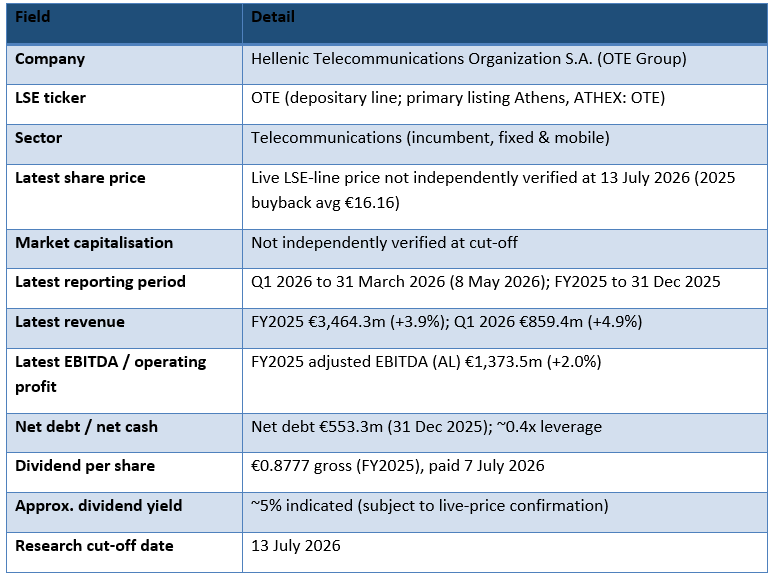
Hellenic Telecommunications Organization (OTE Group) is Greece's incumbent fixed and mobile operator, majority-owned by Deutsche Telekom. As an OTE telecom income stock it is highly cash-generative, lightly geared at roughly 0.4x, and returns close to 100% of free cash flow to shareholders. FY2025 brought record total shareholder remuneration of €532m, combining a €0.8777 gross dividend paid on 7 July 2026 with a €177m buyback. The live LSE-line share price could not be independently verified at the 13 July 2026 cut-off.
Five key takeaways
Record shareholder returns
FY2025 total remuneration reached €532m, around 100% of free cash flow, up 18% year on year.
Rising ordinary dividend
The €0.8777 gross dividend rose 22% and was paid on 7 July 2026.
Very low leverage
Net debt of €553.3m equated to roughly 0.4x adjusted EBITDA at 31 December 2025.
Fibre and 5G momentum
FTTH homes passed reached about 2.1m, targeting 2.4m in 2026, with 5G covering 99%+ of the population.
Price not verified
The live LSE-line quote was not independently confirmed; investors should verify the current price themselves.
Introduction
For income-focused investors in July 2026, the OTE telecom income stock case is simple: a dominant national operator generating dependable cash and handing almost all of it back to shareholders. Hellenic Telecommunications Organization S.A., trading on the London Stock Exchange as a depositary line under ticker OTE and primarily listed in Athens, is a steady payer within the Deutsche Telekom stable.
This article carries no recommendation. The live LSE-line share price, current market capitalisation and precise yield could not be verified at the 13 July 2026 cut-off. The most recent verified anchors are the 2025 buyback average of €16.16 per share and FY2025 earnings per share of €1.808. Investors should confirm the live price independently before acting.
Company overview
OTE Group is Greece's incumbent telecommunications operator, providing fixed-line voice, fibre broadband, mobile services under the COSMOTE brand and pay-television. Following the disposal of Telekom Romania Mobile on 1 October 2025 (enterprise value around €70m), Greece is now effectively the whole group.
Ownership is central to its character. Deutsche Telekom held 54.62% as of 24 July 2025, a stake that edges higher because OTE cancels the shares it buys back. The latest exact percentage was not independently verified at the cut-off but is at least 54.62%. This gives OTE the backing of a large European parent, while raising related-party considerations for minority investors.
The listing structure can confuse. OTE's primary, most liquid market is the Athens Exchange, where the ordinary shares trade under ticker OTE (Bloomberg HTO GA). The London OTE line is a depositary or GDR-style secondary line referencing those same shares, so UK holders share the same fundamentals, euro currency and dividend timetable as domestic shareholders.
Latest financial performance
FY2025 was a record year. Group revenue rose 3.9% to €3,464.3m, with a strong fourth quarter up 8.7% at €916.3m. Fixed-line revenue grew 5.2% to €2,052.2m, mobile revenue edged up 0.4% to €1,285.9m and mobile service revenue advanced 3.1% to €1,069.1m. Adjusted EBITDA after leases increased 2.0% to €1,373.5m, at a 39.6% margin.
Profitability strengthened further down the statement. Operating profit (EBIT) rose 4.6% to €821.0m, profit attributable to owners of the parent jumped 17.8% to €726.0m, and earnings per share rose 20.7% to €1.808. Adjusted profit to the parent was €627.9m, up 2.3%. Adjusted free cash flow after leases was €581.0m, with reported free cash flow of €542.8m, up 3.9%. Capital expenditure rose 8.7% to €611.6m as the fibre and 5G build accelerated.
Q1 2026 revenue, reported on 8 May 2026, rose 4.9% to €859.4m, with mobile service revenue up 5.5% to €258m, fixed retail up 1.1% to €233m and System Solutions surging 76.3%. Adjusted EBITDA after leases increased 2.8% to €338.4m, though the margin softened 80 basis points to 39.4%. Adjusted net profit fell 5.4% to €153.6m and free cash flow dropped 43.1% to €60.4m on timing of tax and working capital.
FY2026 guidance points to adjusted EBITDA after leases up around 3% and capital expenditure of roughly €600m. Headline free cash flow of about €750m assumes spectrum-auction timing and tax effects; underlying free cash flow is guided at roughly €570m to €580m. The group reiterated its intention to return close to 100% of free cash flow and reach 2.4m FTTH homes passed.
Balance sheet and financial position
OTE's balance sheet is a defining strength for income seekers. Net debt fell 14.0% to €553.3m at 31 December 2025, equating to net debt to EBITDA of around 0.4x, very low by telecom standards, where multiples of 2x to 3x are common. That leaves ample headroom to sustain distributions and fund the fibre roll-out.
Liquidity is comfortable. Cash stood at €520.9m, against long-term borrowings of €350.0m and short-term borrowings of €499.4m. Total equity was €2,110.9m, and the group repaid €60m of Deutsche Telekom notes on 7 October 2025. A detailed maturity ladder was not independently verified, but the low gearing and cash balance suggest limited near-term refinancing pressure. Crucially, the dividend and buyback are not funded by rising leverage.
Growth drivers
Fibre-to-the-home expansion
Fibre is the clearest structural growth lever. FTTH homes passed reached about 2.1m, at 2.138m in Q1 2026, targeting 2.4m for 2026 and roughly 3.5m, around 70% of the market, by 2030. FTTH customers grew 43.7% to 567k, reaching 625k (up 45.3%) by Q1 2026, while utilisation climbed from 34% to 39%. As passed homes convert, revenue and margins benefit.
TERNA FIBER acquisition
In January 2026 OTE completed the TERNA FIBER acquisition, adding around 480k homes and accelerating coverage towards the 2.4m target, though integration carries execution risk.
Mobile and 5G
Mobile is shifting to higher-value contracts: postpaid subscribers rose 7.2% to 3,062,907, offsetting a 5.7% decline in prepaid to 4,041,594. Data usage jumped 30% to 18.3GB per user and 5G device penetration reached 44.2%. The 5G network covers over 99% of the population, with standalone 5G at roughly 78% to 79%.
Tower carve-out
In November 2025 OTE spun around 3,800 towers into COSMOTE TELEKOM TOWERS. Such separations can crystallise value and add operational flexibility.
Telecommunications-sector outlook
The European telecom backdrop is defined by heavy but productive fibre and 5G investment. Greece, having lagged some Western European peers on fixed fibre penetration, offers a long runway for FTTH conversion, supported by EU funding and national digitalisation goals.
Competition is intensifying: Digi, expanding in Greece, is pressuring pricing at the lower end. OTE operates under the Greek regulator EETT and the EU's European Electronic Communications Code, which shape wholesale pricing and spectrum policy. A spectrum auction referenced for 2027 will influence capex and free cash flow, which is why OTE's headline and underlying guidance diverge. The sector's high entry barriers and infrastructure intensity tend to favour scale players such as OTE, provided capital discipline holds.
Valuation and share-price context for OTE
Any precise valuation of OTE is constrained: the live LSE-line share price and market capitalisation could not be independently verified at the 13 July 2026 cut-off. Quoting exact price-to-earnings, EV/EBITDA, dividend-yield or free-cash-flow-yield multiples that depend on an unverified price would be inappropriate, so this section stays conceptual.
The most recent verified anchors are the 2025 buyback average price of €16.16 per share and FY2025 earnings per share of €1.808. On those anchors, the trailing earnings multiple would sit in the high single digits, a level associated with mature European incumbents, though readers must confirm the current price. The FY2025 gross dividend of €0.8777 implies a trailing yield of roughly 5% to 5.5% if the shares trade in the mid-teens, but the exact figure hinges on the live quote.
Investors typically weigh telecoms on EV/EBITDA, dividend yield and free-cash-flow yield. With adjusted EBITDA after leases of €1,373.5m and adjusted free cash flow of €581.0m, the cash characteristics are clear even if the market's pricing is not; no view is offered on whether the shares are cheap or expensive.
Dividend analysis
The dividend is the centrepiece of the OTE story. For FY2025 the group delivered total shareholder remuneration of €532m, up 18% and equivalent to around 100% of free cash flow. This comprised a €355m ordinary dividend and a €177m buyback, up 16%.
The ordinary dividend of €0.8777 gross per share rose 22% year on year, an adjusted €0.90214 for treasury shares, with a 5% withholding tax leaving a net €0.857033. The timetable, set at the 9 June 2026 AGM, was an ex-date of 1 July, record date of 2 July and payment on 7 July 2026 via Piraeus Bank. OTE pays annually, rather than in quarterly instalments.
Sustainability looks reasonable. The ordinary dividend was covered roughly twice by adjusted profit to the parent of €627.9m, while total remuneration matched adjusted free cash flow, provided that cash flow holds near the guided €570m to €580m underlying level. Shareholders also received an extraordinary dividend of €0.1019 per share, around €40m, paid on 30 December 2025 from proceeds of the Telekom Romania Mobile sale; such special distributions are one-offs.
Main risks
Several risks temper the income case. The most immediate is capital intensity: the fibre and 5G build requires sustained spending, guided at around €600m in FY2026, which competes with cash for distribution. Any acceleration in capex, or a shortfall in FTTH conversion, could pressure the payout.
Competitive and market risks are real. Digi's expansion threatens pricing in value segments, while prepaid mobile erosion continues, down 5.7%. The Greek macroeconomic backdrop, though improved, remains more volatile than larger Western European markets, and regulatory pricing decisions could compress margins. The 2027 spectrum auction adds timing uncertainty to capex and free cash flow.
Structural factors also warrant attention. Deutsche Telekom's majority holding, above 54.62% and rising, concentrates control and creates related-party dynamics that may not always align with minority interests. The TERNA FIBER integration carries execution risk. Finally, the unverified live share price means investors cannot currently gauge the market's valuation independently.
What investors may watch next
The most immediate catalyst is the Q2 and H1 2026 results, scheduled for 29 July 2026, which will show whether the strong start has been sustained and how free cash flow tracks guidance. Beyond that, the buyback pace, any change in Deutsche Telekom's stake, progress on the 2.4m FTTH target and clarity on the 2027 spectrum auction all bear watching.
Conclusion
Hellenic Telecommunications Organization enters the second half of 2026 as a defensive telecom income proposition: a dominant Greek incumbent, simplified after the Romanian exit, generating strong cash flow and returning almost all of it. The FY2025 record €532m remuneration, the 22% dividend increase paid on 7 July 2026 and the very low 0.4x leverage define its appeal to income investors, while fibre and 5G provide a credible growth underpin.
The clear caveat is pricing. The live LSE-line share price, market capitalisation and exact yield could not be independently verified at the 13 July 2026 cut-off; the most recent verified anchors are the 2025 buyback average of €16.16 per share and FY2025 EPS of €1.808. This article offers no recommendation, and investors should confirm the live price and their own circumstances before acting.


 Nov 16, 2026





 Please wait processing your request...