
 CA
 NZ
 US
 AU
 IND

 UK

 Share
 X (Formerly Twitter)
 Whatsapp
 Facebook
 LinkedIn
 Telegram
 Email This Article
 Copy Link
 Summarize with AI
 Chat GPT
 Perplexity

Key facts
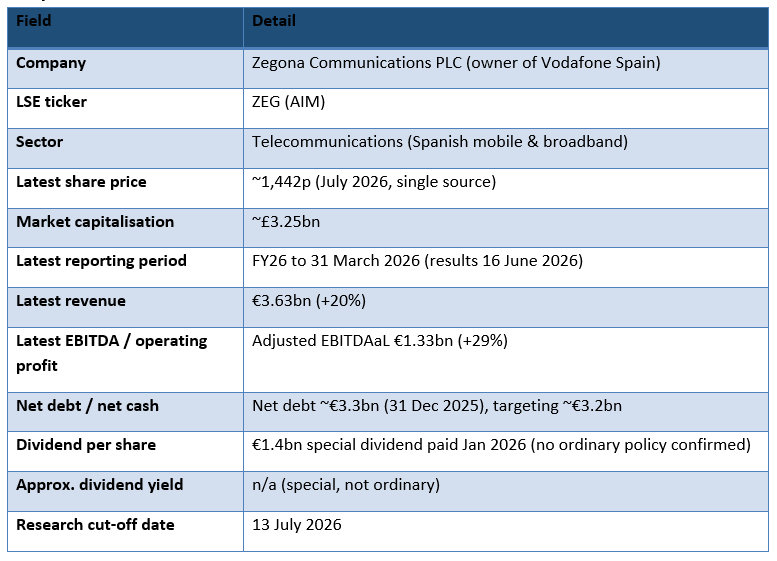
Summary
Zegona Communications PLC (LSE:ZEG), listed on London's AIM market, is the holding company that acquired Vodafone Spain in May 2024 and is executing a private-equity-style turnaround. Its FY26 results to 31 March 2026 showed revenue of €3.63bn and adjusted EBITDAaL of €1.33bn (+29%), with service revenue returning to growth in the second half. Zegona has monetised fibre through joint ventures, funded a €1.4bn special dividend from disposals, and completed a €3.7bn refinancing that cut interest costs. Net debt stood at roughly €3.3bn amid fierce Spanish price competition, notably from low-cost entrant Digi.
Five key takeaways
- Zegona is running an aggressive, deal-driven turnaround of Vodafone Spain, prioritising cost reduction, asset monetisation and deleveraging.
- FY26 revenue reached €3.63bn (+20%) and adjusted EBITDAaL €1.33bn (+29%), with service revenue back to growth in the second half (Q3 +1.1%, Q4 +2.0%).
- Returns to date have been special and opportunistic, chiefly a €1.4bn special dividend funded by the PremiumFiber sale, not a confirmed ordinary dividend policy.
- A €3.7bn refinancing is expected to cut annual interest costs by roughly €60m and pushes the earliest maturity to 2031.
- Risks remain elevated: net debt near €3.3bn, intense Spanish price competition, Digi's expansion, and reliance on disposals to fund returns.
Introduction
Zegona Communications is one of the more distinctive stories on London's junior market. Rather than a conventional telecoms group, it functions like a specialist buyout vehicle that acquired a single large asset to transform. That asset is Vodafone Spain, whose acquisition completed at the end of May 2024.
Since then, Zegona has pursued a playbook familiar from private equity: cut costs sharply, monetise underused assets such as fibre, refinance expensive debt, and return cash when disposals allow. The FY26 results published on 16 June 2026 offer the clearest read yet on whether that is working. This article examines the numbers, the balance sheet and the risks, without any recommendation.
Company overview
Zegona Communications PLC is an AIM-listed holding company whose sole material operating business is Vodafone Spain, one of the country's largest integrated telecoms operators, providing mobile, fixed broadband, fibre and television services. Its management, with a track record of buying, restructuring and selling European telecoms assets, has positioned it explicitly as a turnaround vehicle.
The Spanish market is intensely competitive and has recently consolidated. Vodafone Spain's principal rivals include MasOrange, the MasMovil-Orange merger that has grown to challenge Vodafone in mobile; Telefónica, the incumbent under the Movistar brand; and Digi, a low-cost operator capturing a large share of net additions, particularly in broadband.
This four-way structure shapes Zegona's strategy: network sharing, fibre partnerships and disciplined pricing have become central levers. Vodafone Spain historically lost ground on price and momentum, and reversing that is the core of the thesis. As a thin corporate structure above a large operating asset, Zegona's equity value is heavily geared to both Vodafone Spain's performance and the acquisition debt.
Latest financial performance
Zegona's FY26 results, for the year to 31 March 2026, marked the first full 12-month period under its ownership. Total revenue rose 20% to €3.63bn from €3.01bn, though much of that increase reflects the full-year comparison against a part-year prior period rather than pure organic growth.
The more telling signal came from service revenue, which returned to growth in the second half, up 1.1% in Q3 and 2.0% in Q4. For a business whose central challenge has been arresting revenue erosion, that inflection is significant, if still early.
Profitability improved markedly. Adjusted EBITDAaL, the sector's preferred earnings measure after leasing costs, climbed 29% to €1.33bn from €1.03bn, and the cash-flow margin expanded to more than 21% from 17% the prior year, reflecting the aggressive cost reduction.
The company remained loss-making at the pre-tax level, but the loss narrowed sharply to €189.4m from €438.8m, helped by improved trading and lower financing drag. Vodafone Spain's operational cash flow rose 22% to €763m. Earnings per share, capital expenditure and a formally defined free-cash-flow figure were not separately disclosed in the available data, so the profitability picture should be treated as directional.
Balance sheet and financial position
The defining feature of Zegona's balance sheet is leverage. Net debt stood at roughly €3.3bn as at 31 December 2025, with management targeting a reduction to around €3.2bn and a longer-term leverage range of 1.5 to 2.0 times earnings. That debt, the consequence of a heavily borrowed acquisition, magnifies risk for equity holders.
Zegona has also cut the cost of that debt. In June 2026 it announced a €3.7bn refinancing, expected to close on 14 July 2026. The package comprised €1,100m of 4.25% senior secured notes due 2032, a €1,350m term loan A at Euribor plus 1.75% due 2031, a €1,283m term loan B at Euribor plus 2.00% due 2032, and a €500m undrawn revolving credit facility.
The refinancing replaced materially more expensive instruments, including €1,320m of 6.75% notes due 2029 and €748m of 8.625% US dollar notes due 2029, along with an existing term loan. The result is expected to be roughly €60m of annual interest savings, with the annual debt cost falling from €294m towards a run-rate near €170m and a blended cost of about 4.3%.
Just as important, it pushed the earliest maturity out to 2031, removing near-term pressure. Lower interest costs and a longer runway both support cash generation, though the debt load remains high relative to the group's size.
Growth drivers
Zegona's growth rests on several interlocking levers, each carrying execution risk.
Operational transformation and cost reduction
The most visible driver has been cost reduction. Lifting the cash-flow margin from 17% to more than 21% in a single year points to substantial savings from restructuring an inefficient cost base. Continued margin expansion is central to management's ambition, though the specific opex and headcount measures were not verified in the available data.
Fibre joint ventures and asset monetisation
Zegona has moved decisively to monetise Vodafone Spain's fibre. Through vehicles branded FiberPass and PremiumFiber, developed with MasOrange and sovereign investor GIC, it has raised roughly €1.8bn. The PremiumFiber completion alone generated €1.4bn, funding both the special dividend and debt reduction while retaining wholesale access.
Network sharing and the RANco discussions
Beyond fibre, Zegona has explored mobile network sharing. A potential radio-access-network venture, referred to as RANco, involving Vodafone Spain, MasOrange and Telefónica, was under discussion as of January 2026. Such sharing can materially lower mobile network costs, though terms and approvals were not confirmed.
Return to commercial momentum
Commercially, signs have improved. Vodafone Spain reported 10.2m contract mobile lines with 128,000 net additions in FY26, the strongest in around five years, and broadband reached 2.6m lines with 29,000 net additions. With service revenue back to growth, these figures suggest the operational bleeding has slowed.
Telecommunications-sector outlook
The Spanish telecoms sector is in a period of structural change. Consolidation, most notably the MasOrange merger, has reduced the number of network operators and could, in principle, support more rational pricing, but Digi's expansion has kept price competition intense at the value end of the broadband market.
Fibre monetisation has become a defining theme across European telecoms, with operators separating capital-heavy infrastructure into dedicated vehicles backed by long-term investors, and Zegona's fibre joint ventures fit squarely within this trend. Network sharing is another lever: shared radio-access networks cut duplicated capital spending, and the proposed RANco venture would extend this to mobile. European regulation, including spectrum policy and scrutiny of joint ventures, remains a swing factor.
Valuation and share-price context for ZEG
Zegona's market capitalisation stood at approximately £3.25bn in July 2026, with the shares quoted around 1,442p. A single source indicated the stock had risen about 93% over the preceding year, a figure to treat with caution given its single provenance and the volatility typical of a leveraged, single-asset equity.
Any assessment of value must account for the balance sheet. Enterprise value, which adds net debt to equity value, is heavily influenced by the roughly €3.3bn of net debt, so it materially exceeds the equity market capitalisation and multiples such as EV to EBITDAaL look quite different from equity-only measures. Conceptually, investors weigh EV against the €1.33bn of adjusted EBITDAaL, recognising that leverage amplifies equity's sensitivity to earnings changes. This article makes no claim that the shares are cheap or expensive; the point is that debt is central to interpreting any valuation.
Capital allocation and shareholder returns
Zegona returned roughly €1.6bn to shareholders in FY26: a €1.4bn special dividend paid in January 2026, funded directly by the PremiumFiber sale, alongside a €200m share buyback, substantial relative to the group's market value.
The crucial qualification is that these returns were special and opportunistic, arising from asset disposals rather than recurring operating cash flow. There is no confirmed ongoing ordinary dividend policy, so investors should not annualise the FY26 payout; the distribution reflected a one-off monetisation event.
Management has also been clear that deleveraging is a priority alongside returns. With net debt near €3.3bn and a target of around €3.2bn, cash from operations and further disposals must be balanced between reducing debt and rewarding shareholders, a tension characteristic of a leveraged turnaround.
Main risks
The transformation carries significant execution risk. Turning around a large operator is difficult, and much of the FY26 improvement came from cost action and disposals rather than proven, durable revenue growth. Should service-revenue growth stall, the investment case would weaken materially.
High leverage is a persistent concern. Net debt of roughly €3.3bn leaves limited room for error, and although the refinancing lowered interest costs, floating-rate elements expose the group to movements in Euribor. A rise in rates or a cash shortfall would pressure the balance sheet.
Competition is unrelenting. Spanish pricing is aggressive, and Digi has been capturing the majority of broadband net additions while MasOrange has overtaken Vodafone in mobile ranking. Sustained price pressure could cap the revenue recovery on which the thesis depends.
Reliance on disposals to fund returns is itself a risk, because such sources are finite and lumpy. Regulatory approval of fibre and network-sharing joint ventures, along with spectrum policy, adds further uncertainty. Finally, the single-country, single-asset concentration offers no diversification to cushion a downturn in Spain.
What investors may watch next
Several near-term markers will help gauge progress. The most immediate is completion of the €3.7bn refinancing, expected on 14 July 2026. Beyond that, the outcome of the RANco discussions could influence the mobile cost base, and further fibre or asset monetisation would speak to both deleveraging and additional returns.
The service-revenue trajectory through coming quarters will show whether the second-half inflection is durable, alongside progress towards the roughly €3.2bn net-debt target and the next results.
Conclusion
Zegona Communications offers a rare example of a private-equity-style transformation playing out on a public market. The FY26 results suggest genuine early progress: sharply higher EBITDAaL, expanding margins, a return to service-revenue growth and a cheaper, longer-dated debt structure.
Yet the case remains finely balanced. Net debt near €3.3bn, a ferociously competitive Spanish market, and returns that so far depend on asset sales rather than recurring cash flow all temper the optimism. Whether the turnaround becomes self-sustaining will depend on durable revenue growth and continued deleveraging. As always, this is analysis rather than advice, and readers should form their own view.


 Nov 13, 2026





 Please wait processing your request...