
 CA
 NZ
 US
 AU
 IND

 UK

 Share
 X (Formerly Twitter)
 Whatsapp
 Facebook
 LinkedIn
 Telegram
 Email This Article
 Copy Link
 Summarize with AI
 Chat GPT
 Perplexity

Summary
Pennon Group (LSE:PNN) traded around 470p-476p in mid-July 2026, putting its indicated dividend yield near 6.15%-6.2%, based on a 29.29p total FY2025/26 payout (9.26p interim plus a 20.03p final approved on 8 July 2026). The final goes ex-dividend on 23 July 2026, paying 4 September 2026. Dividend cover is thin — roughly 0.97x on underlying earnings — after a 2025 rights issue rebased the payout onto a CPIH-linked growth policy.
Five key takeaways
- Pennon shares traded in a 470p-476p range in mid-July 2026, implying an indicated dividend yield of roughly 6.15%-6.2%, close to the ~6.15% reference figure used as this article's starting point.
- The FY2025/26 final dividend of 20.03p goes ex-dividend on 23 July 2026, with a record date of 24 July 2026 and payment on 4 September 2026, following AGM approval on 8 July 2026.
- Dividend cover is tight: the 29.29p total FY2025/26 dividend was covered only around 0.97 times by underlying EPS of 28.3p, and around 0.66 times by reported EPS of 19.4p.
- Pennon's 2025 £490 million rights issue rebased the per-share dividend lower and reset policy to CPIH-linked growth (inflation was 3.0% to May 2026), funding a record £3.2 billion AMP8 investment programme.
- South West Water was fined a record £1.85 million in June 2026 over Brixham drinking water failures, underlining the regulatory and reputational risks that sit alongside the income case.
Introduction
Pennon Group PLC (LSE:PNN), owner of South West Water and Sutton & East Surrey Water (SES Water), is one of a handful of UK-listed regulated water utilities that still attracts income-focused investors despite a turbulent few years for the sector. As of this research date, 13 July 2026, the stock's dividend yield sits well above the wider FTSE 250, prompting the question of whether Pennon deserves a place among the water names investors watch most closely as the 26 July window approaches.
This article examines Pennon's current dividend position, the financial results underpinning it, the balance-sheet pressures created by record infrastructure spending, and the regulatory backdrop set by Ofwat's PR24 price review. It is an analytical overview, not a recommendation to buy, sell or hold the shares.
Company overview
Pennon Group is a FTSE 250 listed water and wastewater utility headquartered in Exeter. Its principal subsidiary, South West Water, supplies water and wastewater services across Devon, Cornwall and parts of Dorset and Somerset, and — following earlier restructuring — also serves the Bristol and Bournemouth areas. Pennon additionally owns SES Water, a smaller water-only supplier covering Sutton and parts of east Surrey.
The group's operations are almost entirely regulated by Ofwat, the economic regulator for water in England and Wales, so revenues, allowed returns and permitted price increases are all shaped by the price review cycle — currently AMP8, running from 2025 to 2030.
Latest dividend position for LSE:PNN
Pennon's board declared a total FY2025/26 dividend of 29.29 pence per share, split between a 9.26p interim (paid on 2 April 2026) and a 20.03p final, approved by shareholders at the AGM on 8 July 2026, according to the company's dividends and financial calendar pages.
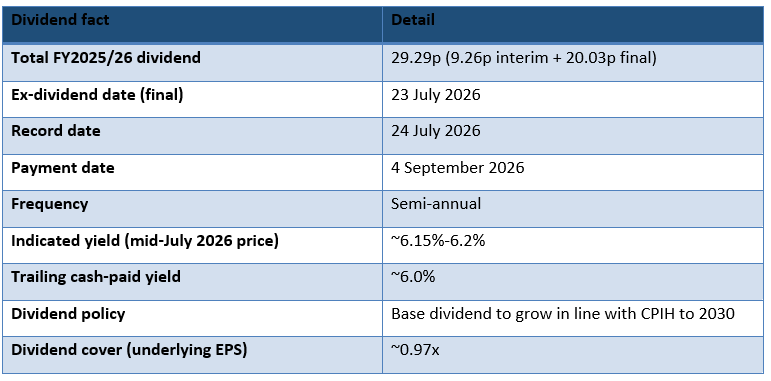
With the final already approved and the interim already paid, this 29.29p figure is best described as an "indicated" annualised rate rather than a purely trailing or forward number. Investors wanting the September payment must hold shares before the 23 July ex-dividend date — three days ahead of the "July 26" date in this article's headline, which should be read as a general watch-list marker rather than a Pennon-specific event.
Why dividend yield figures vary across websites
Different providers can show very different yields for the same stock. Hargreaves Lansdown's dividend page showed a "trailing 12-month" yield of under 2% at the point of research — likely measuring only the most recent single payment against the price, rather than summing the last two distributions of a semi-annual payer. Other sites quote a full trailing-twelve-month cash-paid figure (around 6.0% on Pennon's numbers), while those using the latest interim-plus-final combination arrive closer to 6.15%-6.2%. None is "wrong"; they simply use different windows and treat declared-but-unpaid dividends differently, which is why cross-checking multiple sources matters before relying on a single quoted yield.
Dividend history
Pennon's per-share dividend has been volatile over five years, shaped less by operating performance than by two corporate events: the 2021 disposal of waste-management arm Viridor (which funded a large special dividend and a rebasing of the ordinary payout) and the January 2025 rights issue.
DividendMax's compiled history shows total dividends falling from 44.37p in FY2023/24 to 31.57p in FY2024/25 — down 28.8% — before slipping to 29.29p in FY2025/26. On a per-share basis, this looks like consecutive cuts.
The picture changes in total cash terms. Pennon's results state aggregate payout rose from £133.7m to £138.2m year-on-year — up roughly 3.4%, broadly in line with CPIH inflation of 3.0% for the twelve months to May 2026. The apparent per-share decline mainly reflects dilution from the January 2025 rights issue, which raised approximately £490 million through a 13-for-20 offer priced at 264p — a discount of roughly 35% to the pre-announcement close, according to Hargreaves Lansdown. The issue expanded the share count materially, so the same or growing dividend pool is now spread across more shares.
Earnings and cash-flow analysis
Pennon's FY2025/26 results (year ended 31 March 2026), announced on 10 June 2026, showed a marked improvement on a prior year depressed by regulatory penalties and one-off items:
- Revenue: £1,291.4m, up 23.2% from £1,047.8m
- Underlying operating profit: £325.5m, more than double the prior £148.5m
- Underlying EBITDA: £519.2m, up 55% from £335.6m
- Underlying EPS: 28.3p, recovering from a 10.3p underlying loss per share
- Reported EPS: 19.4p, versus a reported loss of 16.1p
- Free cash flow from operations: £529.7m, up from £233.6m
- Capital expenditure: £643.6m
The swing from loss to profit is genuine, but it highlights how thin the safety margin around the dividend remains. Underlying EPS of 28.3p only just exceeds the 29.29p total dividend, implying cover of roughly 0.97 times. On statutory reported EPS of 19.4p, cover falls to around 0.66 times — meaning the dividend was not fully covered by reported earnings this year, though it was covered by underlying cash generation. This gap between underlying and statutory profit, partly a function of regulatory penalty accounting and financing costs, is worth monitoring.
Return on Regulated Equity (RoRE) came in at 6.7%, ahead of the 5.4% allowed return — a supportive regulatory signal — even as net Outcome Delivery Incentive (ODI) penalties of £42.0m, driven by extreme weather and tougher targets, weighed on reported numbers.
Balance-sheet analysis
Net debt rose to £4,508.9m at 31 March 2026, from £4,078.2m a year earlier, as Pennon funded its record AMP8 programme. Water Group gearing stood at 61.8%, which management describes as within its 55-65% target range. Liquidity, comprising cash and committed facilities, totalled £998.3m at year-end.
Credit ratings for Pennon and South West Water's debt could not be independently confirmed with a specific current grade during this research session; investors wanting a current agency view should check Moody's, S&P or Fitch directly, since rating actions can move independently of results.
Using disclosed net debt and Regulatory Capital Value (RCV) of £6,505.2m alongside an estimated market capitalisation (implying roughly 470-475 million shares at a price near 475p, giving around £2.2-2.25bn) gives an enterprise value of roughly £6.7-6.8bn — close to, and only modestly above, disclosed RCV. This is an editorial calculation from verified inputs, not a reported figure, and is indicative only.
Management guided that FY2026/27 net interest costs should rise a further 10-15%, reflecting the enlarged debt pile and refinancing at prevailing rates — a factor that will keep squeezing statutory earnings even as underlying performance improves.
Company-specific growth drivers
Pennon's growth case rests principally on the AMP8 investment cycle. The company confirmed total AMP8 investment of £3.2bn through to 2030, targeting RCV growth of 34%, alongside operational gains such as a 34% reduction in pollution incidents and a 17% cut in storm overflow use cited in the results.
For FY2026/27, management guided to Water Group revenue growth of £50-70m, underlying EBITDA growth of 5-10%, and capital expenditure of £620-700m. A newly created Chief Asset Officer role is intended to strengthen long-term asset resilience, part of what chief executive Keith Haslett described as a focus on "operational discipline and capital delivery."
Industry and economic backdrop
The wider UK water sector remains under intense regulatory and political scrutiny after years of criticism over sewage discharges, leakage and underinvestment. Ofwat published its PR24 Final Determinations for South West Water and SES Water on 19 December 2024, which Pennon accepted; the associated plan envisaged substantial capital investment to 2030, funded partly through permitted bill increases and partly through new equity — hence the 2025 rights issue.
This settlement sits within a broader narrative of rising customer bills, tighter environmental targets and continued public and media attention on water company performance — all factors that can influence operational costs and sentiment toward the sector's equities.
Valuation and share-price context for LSE:PNN
Pennon shares traded in a range of roughly 470p to 476p around this research date, per Investing.com and Hargreaves Lansdown, against a 52-week range of 439.40p to 605.50p reported by Investing.com — indicating meaningful volatility over the past year.
BofA Securities analyst Julius Nickelsen maintained a "Buy" rating on 7 July 2026 while trimming the price target to 600p from 610p, according to StreetInsider — implying upside from prevailing levels, though such targets reflect a single house view. This article offers no buy, sell or hold recommendation; a high dividend yield can just as easily reflect a depressed share price or elevated perceived risk as an attractive income opportunity.
Main risks
Several risks bear on Pennon's dividend outlook. Cover is thin, and any further regulatory penalties, weather-related ODI charges, or AMP8 cost overruns could pressure even CPIH-linked growth. South West Water's £1.85 million fine over the 2024 Brixham cryptosporidium outbreak, handed down in June 2026, together with ongoing legal claims and a separate guilty plea to sewage pollution charges awaiting sentencing at Plymouth Magistrates' Court, illustrate continuing exposure.
Rising net debt and gearing near the top of the target range leave limited headroom before further equity or restructuring might be needed, particularly if interest costs keep climbing as guided. Executive remuneration controversy, highlighted by reporting on former CEO Susan Davy's departure package, adds reputational risk. No dividend is guaranteed, and Pennon's own recent history of rebasing shows payouts can be cut when circumstances demand.
What investors may watch next
Attention in coming weeks is likely to focus on the 23 July ex-dividend date and 4 September payment, any further Ofwat or Drinking Water Inspectorate updates on the Brixham case, sentencing outcomes at Plymouth Magistrates' Court, and progress against FY2026/27 guidance on EBITDA growth, capex and interest costs when Pennon next updates the market.
Balanced conclusion
Pennon Group presents a recognisable UK water-sector income profile: a high headline yield near 6.15%-6.2%, underpinned by a CPIH-linked policy, set against thin earnings cover, rising net debt, and ongoing regulatory and reputational challenges such as the Brixham water-quality failures. The FY2025/26 results show genuine operational recovery, with revenue, EBITDA and free cash flow all improving markedly. Whether the stock belongs among the "top" UK water names to watch around 26 July will likely depend less on the yield alone and more on how successfully Pennon executes its £3.2bn AMP8 programme while keeping gearing, cover and regulatory relations under control. This article is not investment advice; readers should conduct their own research or consult a regulated adviser before investing.


 Nov 16, 2026





 Please wait processing your request...