
 CA
 NZ
 US
 AU
 IND

 UK

 Share
 X (Formerly Twitter)
 Whatsapp
 Facebook
 LinkedIn
 Telegram
 Email This Article
 Copy Link
 Summarize with AI
 Chat GPT
 Perplexity

Summary
Yü Group PLC (LSE:YU.), the AIM-listed B2B energy supplier, paid a 67p total dividend for FY2025 (22p interim, 45p final), up from 60p a year earlier. Against a share price of roughly 1,620p-1,660p in mid-July 2026, that produces a trailing yield of about 4.0%-4.1%, close to the 4.10% reference figure often quoted. Dividend cover from adjusted EPS of 216p is around 3.2 times, but the payout history only restarted in 2022 after a full suspension in 2019-2021.
Key takeaways
- Yü Group's FY2025 total dividend rose to 67p per share, up roughly 12% on FY2024's 60p, continuing a four-year run of increases since payouts resumed in 2022.
- The trailing dividend yield sits close to 4.0%-4.1% at a share price near 1,620p-1,660p, broadly in line with the 4.10% starting reference, though quoted figures vary by source and pricing snapshot.
- FY2025 revenue reached £700m (+8%), adjusted EBITDA £51m (+4%) and adjusted diluted EPS 216p, giving dividend cover of roughly 3.2 times earnings.
- Net cash stood at £106m at year-end 2025, supporting a self-funded £9m investment programme under a new three-year plan to double market share.
- Management guides FY2026 revenue of £850m-£875m but expects adjusted EBITDA and profit before tax to be broadly flat as growth spending offsets normalising wholesale energy margins.
Introduction
Yü Group PLC (LSE:YU.), the Nottingham-based B2B energy and utilities supplier trading as Yü Energy, has built one of AIM's more eye-catching growth and dividend stories of the past three years. Having suspended its dividend entirely between 2019 and 2021, the company has since rebuilt payouts rapidly, culminating in a 67p total dividend for the year ended 31 December 2025. As of this research date, 13 July 2026, shares trade broadly between 1,620p and 1,660p, putting the Yü Group dividend yield at roughly 4.0%-4.1% on a trailing basis — close to the 4.10% snapshot that first drew attention to the name. This article examines the numbers behind that yield, the growth strategy driving them, and the risks investors should weigh.
Company overview
Yü Group operates through Yü Energy, supplying gas, electricity and (increasingly) water to small and medium-sized enterprises, industrial users and commercial clients across the UK, and Yü Smart, a metering arm that installs smart meters and earns what the company describes as long-dated, index-linked rental income. Unlike household-facing suppliers, Yü Energy focuses squarely on the B2B market, differentiating on fixed-price contracts, digital service and multi-utility bundling. Management frames its addressable market as worth more than £50bn, positioning Yü Group as a "challenger" taking share from larger incumbents, according to the company's published investment case.
Latest dividend position for LSE:YU.
The most recently confirmed distribution is the FY2025 final dividend of 45.0p per share, which followed shareholder approval at the AGM on 21 May 2026 and was paid on 18 June 2026, per the "Result of AGM and Dividend Timetable" RNS on Investegate. Combined with the 22.0p interim dividend paid on 19 December 2025, the total dividend for the year to 31 December 2025 reached 67.0p, up from 60.0p for FY2024. No dividend has yet been declared for FY2026, so any forward yield quoted elsewhere should be treated as an estimate rather than a confirmed figure.
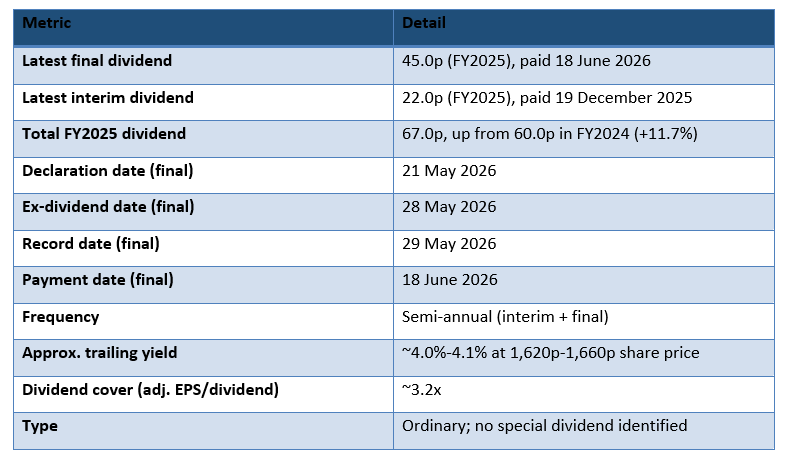
Different data providers show noticeably different yields on the same day — this article found figures ranging from roughly 3.8% up to 5.3%. That spread stems from a mix of factors: some sites use delayed or previous-day closing prices, others annualise only the most recent single payment rather than the trailing 12-month total, and subscription-based forecast tools sometimes blend in analyst-estimated future dividends that have not been declared. Investors are best served by checking the primary RNS dividend amounts against a real-time share price rather than relying on a single aggregator's headline yield.
Dividend history
Yü Group's dividend record is unusually volatile for a "dividend growth" narrative. Payouts were modest through 2016-2018 (2.25p to 3.0p), before an accounting issue disclosed in October 2018 triggered a sharp share-price collapse, as reported at the time by Shares Magazine. The dividend was cut and then suspended entirely for 2019, 2020 and 2021. A modest 3.0p payment resumed in 2022, followed by a jump to 40.0p in 2023, 60.0p in 2024, and 67.0p in 2025 — an average growth rate that data provider Simply Wall St calculates at around 51% a year over nine years, while cautioning that "payments have been volatile during that time." In practice, the meaningful growth track record spans only four years.
Earnings and cash-flow analysis
FY2025 revenue rose 8% to £700m from £646m, according to Sharecast's coverage of the results, with adjusted EBITDA up 4% to £51m and profit before tax up 9% to £49m. Adjusted diluted EPS increased to 216p from 210p. On that basis, the 67p total dividend implies dividend cover of roughly 3.2 times earnings, and Simply Wall St separately calculates an earnings payout ratio of about 31% and a cash-flow payout ratio of about 39% — both comfortably below levels that would typically raise sustainability concerns. Interim H1 2025 figures showed similar momentum: revenue of £341.0m (+9%), adjusted EBITDA of £22.9m (+4%, a 6.7% margin), and operating cash flow of £39.6m, per the company's interim results PDF. Capital expenditure remains modest relative to revenue — £1.9m was invested in smart meter assets in H1 2025 alone, partly financed through a £15.2m facility with Siemens Finance, of which £8.4m was drawn at that point.
Balance-sheet analysis
Net cash strengthened materially through 2025, reaching £106m at year-end (up from £85m in FY2024) and £109.9m at the H1 2025 mark, a 27% year-on-year increase according to the interim report. Management has stated the new £9m growth investment programme is intended to be self-funded from cash generation rather than requiring fresh debt or equity. For a business that must post collateral against wholesale energy hedging and extend credit terms to SME customers, a healthy net cash buffer is an important cushion — working capital and collateral needs can move quickly if wholesale prices spike, even where the underlying business is growing profitably.
Company-specific growth drivers
Operationally, 2025 was a standout year. Meter points supplied grew 49% to 131,000, energy volumes rose 14% to 2.5TWh, and the company added 43,000 net customers, according to Sharecast's report of the results. Market share increased from 2.7% to 3.5%, and Yü Group said it captured 11% of B2B energy switchers during the year, up from 7% previously. Chief executive Bobby Kalar described the group as "commencing an ambitious three-year plan to double our current market share" — a stated management ambition rather than a guaranteed outcome. The Yü Smart metering arm, offering what the company calls 15-year-plus, index-linked rental income, is positioned as a source of more predictable, lower-risk earnings alongside the retail supply business.
Industry and economic backdrop
The UK business energy supply market has consolidated since the 2021-2022 wholesale price crisis forced weaker suppliers out, leaving surviving challengers like Yü Group with room to take share from larger, less nimble incumbents. However, wholesale prices have since normalised from crisis peaks, compressing the unusually wide margins some suppliers earned during the volatile period. Proactive Investors has previously flagged bad-debt risk across the sector as government energy support schemes for businesses have been scaled back, a dynamic that can pressure smaller commercial customers' ability to pay. Yü Group has said it uses hedging arrangements, including with Shell Energy Europe, to manage commodity exposure, though hedging reduces rather than eliminates price risk.
Valuation and share-price context (no recommendation)
Shares have traded in a wide 52-week range of roughly 1,430p to 1,950p-1,960p, based on data from LSE.co.uk and Investing.com, and stood around 1,620p-1,660p across sources checked in mid-July 2026 — well below the February 2026 high. On the day the FY2025 results were announced (17 March 2026), shares fell around 4.2% to 1,705.5p despite the headline growth, according to Sharecast, suggesting the market focused on management's caution that 2026 EBITDA and pre-tax profit are expected to be broadly flat as growth investment offsets normalising commodity margins. The trailing price/earnings ratio sits around 7.7-8.3 times on different providers' data, using adjusted EPS of roughly 216p. This is not a recommendation to buy, hold or sell; a lower valuation multiple and an elevated yield can reflect either an overlooked opportunity or a market pricing in genuine risk, and it is not always possible to know which in advance.
Main risks
The clearest risk is history itself: the 2018 accounting issue and subsequent dividend suspension show that Yü Group's earnings and payouts have not always been stable. Bad-debt exposure to SME customers is a live sector-wide concern as support schemes are withdrawn. Wholesale energy price swings can strain working capital and collateral requirements even with hedging in place. As an AIM-listed small-cap with a market value of roughly £280m-£290m, the shares are more volatile and less liquid than large-cap utilities, and the ~15%-17% pullback from the 52-week high illustrates that volatility directly. Management's own guidance that FY2026 profit growth will be "tempered" by investment spending is a reminder that near-term earnings momentum may slow even as revenue and market share continue expanding. No dividend, including Yü Group's, should be regarded as guaranteed.
What investors may watch next
A trading update was scheduled in the company's financial calendar for 21 July 2026, shortly after this research date, which should offer an early read on how FY2026 is progressing against the £850m-£875m revenue guidance. Interim results for H1 2026 are typically published around September, with any new interim dividend declaration to follow — based on the historical pattern, an ex-dividend date around November and payment around December would be consistent with prior years, though this is not yet confirmed. Investors will also watch whether net cash generation keeps pace with the self-funded £9m investment plan, and whether bad-debt trends across the B2B energy sector stay benign.
Balanced conclusion
Yü Group PLC has rebuilt a fast-growing dividend on the back of genuine operational momentum — rising meter points, expanding market share and a strengthening net cash position through FY2025. Cover and payout ratios currently look comfortable, and management has articulated a clear three-year growth ambition. Set against that is a company whose earnings and dividend history includes a multi-year suspension, a small-cap AIM listing with real share-price volatility, and management's own signal that 2026 profit growth will be tempered by investment. The roughly 4.1% yield reflects both the opportunity and the uncertainty embedded in a smaller, faster-growing utility supplier, and investors weighing it should look past the headline figure to the underlying cover, cash position and sector risks discussed above.
Top of Form
Bottom of Form


 Nov 13, 2026





 Please wait processing your request...