Company Overview: Raspberry Pi Holdings PLC (LON: RPI) is a designer and developer of single board computers (SBCs) and compute modules for industrial Internet of Things (IoT) customers and embedded uses. The company’s product portfolio comprises of SBCs, compute modules, accessories, and semiconductors. This report covers the Price Action and Technical Indicators Analysis along with the Target Levels, Stop Loss, Support Levels, Resistance Levels, and Recommendations on the stock.
FTSE All-Share Index (.FTAS) Market Round-Up
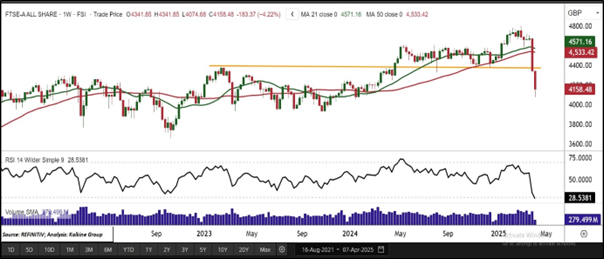
Last week, the FTSE All-Share Index (.FTAS) settled on a negative note, following the bearish movement of the US equity markets. Notably, the index settled at 4341.85 with a loss of 7.05% for the week ending April 04, 2025. The recent move in the domestic indices is majorly led by the bearish indications from the global equity markets.
From a technical perspective, FTAS is currently exhibiting bearish momentum, reinforced by a recent bearish candlestick pattern that signals the potential for continued downside. The stock trades below a key ascending trendline and crucial horizontal support, reflecting prevailing negative sentiment. The 14-period RSI stands at 28.53, indicating persistent bearish pressure, though it hovers just below the oversold zone, warranting caution. Additionally, the price remains below the 21-period and 50-period SMAs, which now act as resistance levels. This setup suggests weak investor interest and limits upward traction. Overall, technical indicators point to a bearish outlook with potential for further downside in the near term.

Global Markets Wrap-Up
Wall Street indices ended last week in negative territory, extending their losses amid broad-based market weakness. The S&P 500 closed at 5,074.08, registering a steep weekly decline of approximately 9.58%, while the NASDAQ Composite fell 10.02% to finish at 15,587.79 for the week ending April 4, 2025.
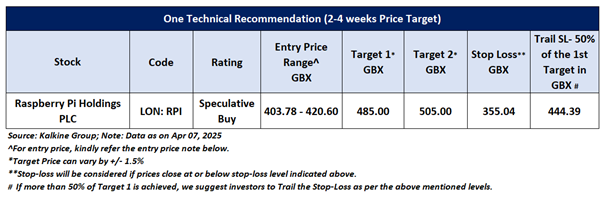
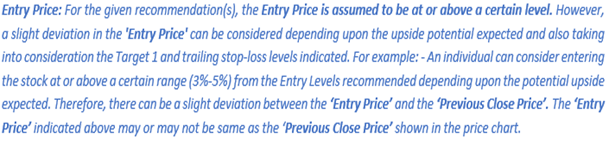
Having understood the US market performance over the past week, taking cues from major global news, and based on technical analysis of the FTSE All-Share Index (.FTAS) for the upcoming week, now have a look at the one LSE-listed stock pick from the technical analysis standpoint. Noted below are the recommendations based on entry price, target prices, and stop-loss Raspberry Pi Holdings PLC (LON: RPI) for the next 2–4-week duration:
Raspberry Pi Holdings PLC (LON: RPI)
Noted below are the key price indicators for the recommended stock:

Price Action Analysis (on the Daily Chart)
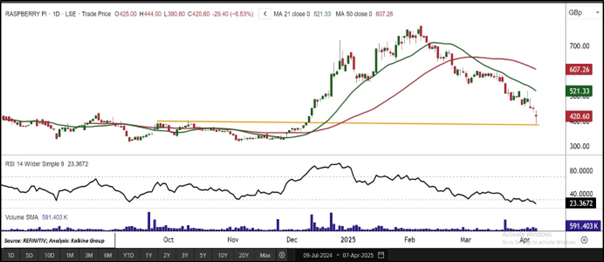
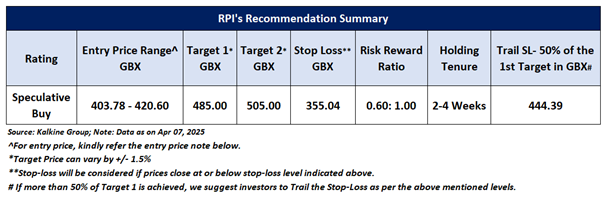
On the daily chart, RPI is showing signs of a potential reversal after a sharp decline from recent highs, now trading above a key horizontal support level. The appearance of a Doji candlestick pattern near this support suggests the downward momentum may be slowing, signalling the possibility of a reversal or short covering. Rising trading volume around the support area highlights growing buyer interest, adding strength to the bullish outlook. These technical signals indicate that RPI may be gearing up for a rebound, with the potential for upward movement in the near term if support levels continue to hold. As approaches the next resistance at GBX 485.00, this could present a short-term obstacle over the next 2-4 weeks. A breakout above GBX 485.00, with rising volume, could trigger a rally towards the next target at GBX 505.00, suggesting significant upside potential in the coming weeks.

Technical Indicators Analysis (On the Daily Chart)
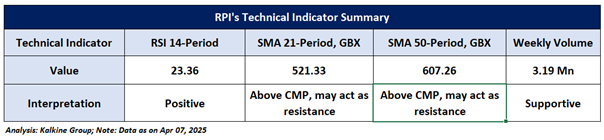
On the daily chart, the RSI 14-Period (Relative Strength Indicator) at 23.36 signals oversold conditions with possible bullish divergence, supported by rising volumes indicating potential upward reversal. The current market price (CMP) is trading below the trend-following indicators, the 21-period SMA and the 50-period SMA which may act as small resistance levels.
General Recommendation:
As per the above-mentioned price action and technical indicators analysis, Raspberry Pi Holdings PLC (LON: RPI) is looking technically well-placed on the chart, and a ‘Speculative Buy’ recommendation has been given on the stock. Investment decisions should be made depending on an individual’s appetite for upside potential, risks, and any previous holdings. This recommendation is purely based on technical analysis, and fundamental analysis has not been considered in this report. The summary of recommendations is as follows:
Markets are trading in a highly volatile zone currently due to certain macro-economic and geopolitical tensions prevailing. Therefore, it is prudent to follow a cautious approach while investing.
Upcoming Major Global Economic Events
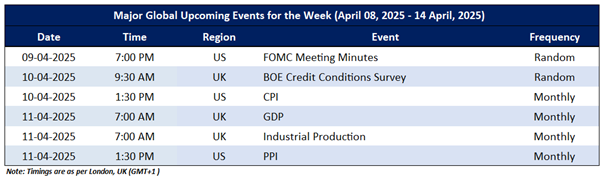
Market events occur on a day-to-day basis depending on the frequency of the data and include an update on employment, inflation, GDP, consumer sentiments, etc. Noted below are the upcoming week's major global economic events that could impact the FTSE All-Share Index and listed stocks’ prices.
Related Risks: This report may be looked at from a high-risk perspective and recommendations are provided for a short duration. Recommendations provided in this report are solely based on technical parameters, and the fundamental performance of the stocks has not been considered in the decision-making process. Other factors which could impact stock prices include market risks, regulatory risks, interest rate risks, currency risks, social and political instability risks, etc.
Note 1: Past performance is not a reliable indicator of future performance.
Note 2: Individuals can consider exiting from the stock if the Target Price mentioned as per the technical analysis has been achieved and subject to the factors discussed above.
Note 3: ‘Kalkine reports are prepared based on the stock prices captured either from the London Stock Exchange (LSE) and or REFINITIV. Typically, both sources (LSE and or REFINITIV) may reflect stock prices with a delay which could be a lag of 15-20 minutes. There can be no assurance that future results or events will be consistent with the information provided in the report. The information is subject to change without any prior notice.
Note 4: How to Read the Charts?
The Green color line reflects the 21-period moving average while the red line indicates the 50-period moving average. SMA helps to identify existing price trends. If the prices are trading above the 21-period and 50-period moving average, then it shows prices are currently trading in a bullish trend.
The Black color line in the chart’s lower segment reflects the Relative Strength Index (14-Period) which indicates price momentum and signals momentum in trend. A reading of 70 or above suggests overbought status while a reading of 30 or below suggests an oversold status.
The Blue color bars in the chart’s lower segment show the volume of the stock. The volume is the number of shares that changed hands during a given day. Stocks with high volumes are more liquid than stocks with lesser volume and liquidity in stocks helps in easier and faster execution of the order.
The Orange color lines are the trend lines drawn by connecting two or more price points and used for trend identification purposes. The trend line also acts as a line of support and resistance.
Technical Indicators Defined: -
Support: A level at which the stock prices tend to find support if they are falling, and a downtrend may take a pause backed by demand or buying interest. Support 1 refers to the nearby support level for the stock and if the price breaches the level, then Support 2 may act as the crucial support level for the stock.
Resistance: A level at which the stock prices tend to find resistance when they are rising, and an uptrend may take a pause due to profit booking or selling interest. Resistance 1 refers to the nearby resistance level for the stock and if the price surpasses the level, then Resistance 2 may act as the crucial resistance level for the stock.
Stop-loss: In general, it is a level to protect further losses in case of unfavorable movement in the stock prices.
Risk Reward Ratio: Risk reward ratio is the difference between an entry point to a stop loss and profit level. This report is based on ~60% Stop Loss of the Target 1 from the entry point.
A trailing stop-loss is a modification of stop-loss in case of favourable movement in the price to protect the gains. Individuals can Trail the Stop-Loss as per the aforementioned levels if the stock price achieves more than 50% of the Target 1. Individuals should consider exiting from the position as per the Trailing Stop-Loss level if the price starts moving downwards after achieving more than 50% of the Target 1.
The reference date for all price data, currency, technical indicators, support, and resistance levels is April 07, 2025. The reference data in this report has been partly sourced from REFINITIV.
Abbreviations
CMP: Current Market Price
SMA: Simple Moving Average
GBP: British pound sterling
GBX: British pence sterling
RSI: Relative Strength Index
Note: Trading decisions require a thorough analysis by individuals. Technical reports in general chart out metrics that may be assessed by individuals before any stock evaluation. The above are illustrative analytical factors used for evaluating stocks; other parameters can be looked at along with additional risks per se. Past performance is neither an indicator nor a guarantee of future performance.
Past performance is not a reliable indicator of future performance.

 AU
AU
 CA
CA
 US
US
 NZ
NZ
 IND
IND

 UK
UK

 Please wait processing your request...