Explore 3 Stock Ideas & Industry Insights Download Free Report

CB CB · USD/Mt

Cobalt

45386.47
USD/Mt

About Cobalt

Cobalt has emerged as one of the key industrial commodities with the growing popularity of electric vehicles (EVs) powered by lithium-ion batteries. It is estimated that up to 20kg of cobalt is required for EV batteries per car. In addition to the lithium-ion battery segment, cobalt is used in the manufacturing of strong magnets, super alloys, dyes, and pigments.

Cobalt, when mixed with certain metals, forms superalloys, which are used in the manufacturing of jet engines as superalloys retain strength under high pressure and temperature. Cobalt isotopes are used in the medical industry for cancer treatment.

During the mid-twentieth century, cobalt was used in beers as it helped in maintaining a foamy head. The practice stopped due to potential health hazards posed by the combination of alcohol and cobalt.

World Resources of cobalt

The majority of cobalt deposits is found in sediment-hosted stratiform copper deposits of Congo (Kinshasa) and Zambia, nickel-bearing laterite deposits in Australia, and magmatic nickel-copper sulphide deposits hosted in mafic and ultramafic rocks in Canada, Russia, the United States and Australia.

Also, significant resources have been identified in polymetallic nodules and crusts in the Atlantic Ocean, Indian Ocean, and the Pacific Ocean.

Global Production

The Democratic Republic of Congo (DRC) is the world leader in cobalt production. Russia, Australia, and Canada are also significant players, but DRC contributes nearly 31% of the global production (2025).
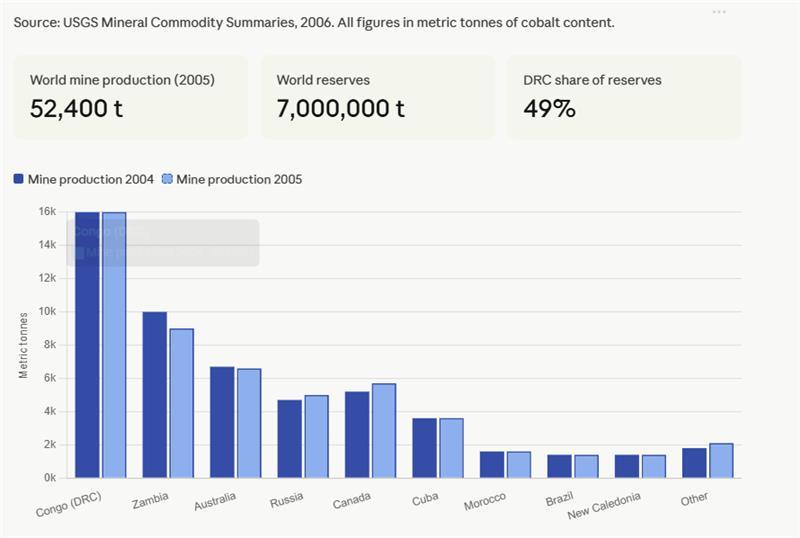
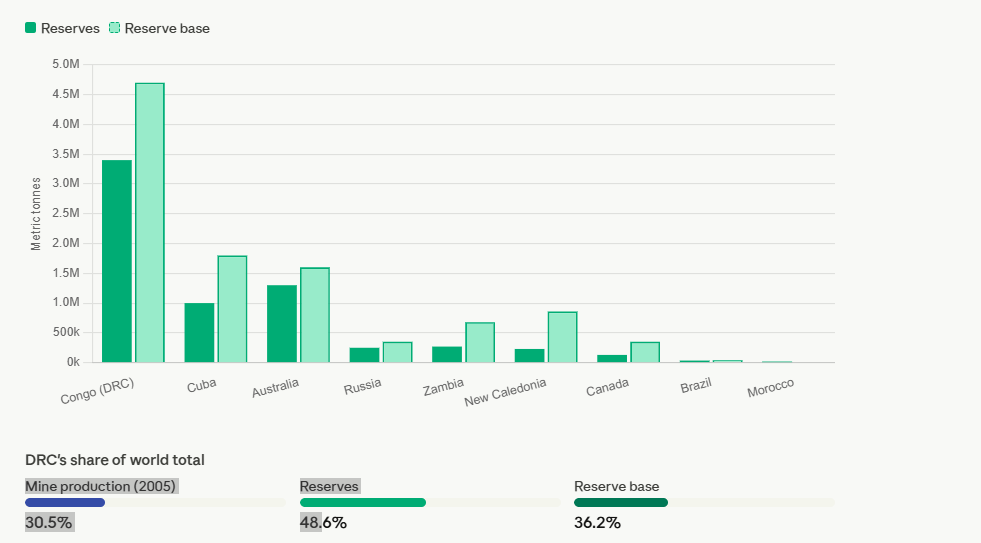


2024-2025 production and reserve data (Data Source: USGS)

The mining industry of DRC has been under scrutiny for several years as reports of unethical and human rights violations keep making the headlines in the African country. A lot of artisanal mining also occurs in the country.

China, which is the global leader in cobalt consumption, uses nearly 80% of the global cobalt supply in the manufacturing process of the rechargeable battery industry.

Related Companies

Company Price (gbp) Chg (gbp) % Chg High (gbp) Low (gbp) Marketcap (Mn)
Loading related companies…

Frequently Asked Questions

What are the major applications of cobalt?

Cobalt has numerous applications, including alloys as an ingredient in lithium-ion batteries, and for the manufacturing of strong magnets.

Cobalt when alloyed with aluminium and nickel forms a strong magnet for industrial purposes. Properties of cobalt alloys make them suitable to be used for manufacturing jet turbines and gas turbine generators as they can withstand high temperatures.

Cobalt 60, a radioactive isotope of natural cobalt, is used in cancer treatment. For ages, cobalt has been used in the glass and ceramic industries to provide rich blue colour.

Why is cobalt gaining so much importance lately?

The electric vehicle industry is on fire. Cars which are yet to be rolled out in 2022 from major EV manufacturers have already been pre-booked. The EV manufacturers are experiencing challenges to cope with the rise in demand for electric vehicles.

Lithium-ion batteries use cobalt extensively. The metal is also the costliest component in an EV. Besides EV batteries, cellphones, laptops and other electronic devices having batteries use lithium-ion batteries with cobalt in them.

With the booming electric vehicle market, the cobalt industry is expected to emerge as a robust, thriving market in the near future.

How much cobalt does Tesla use in its cars?

According to industry reports, the EV industry consumed nearly 19,000 tonnes of cobalt in 2020. In the same year, Tesla sold nearly 500,000 electric cars but used only 2,000 tonnes of cobalt in its batteries. Although Tesla sold the highest number of cars that year, it used less cobalt than its competitors due to its usage of lithium iron phosphate (LFP) batteries.  

On average, lithium batteries used in EVs require up to 20kg of cobalt. Battery manufacturers are trying to cut down on the cobalt content to 10kg per car as the metal is the costliest component of lithium-ion batteries used to power electric cars.

Cobalt News

We use cookies to help us improve, promote, and protect our services. By continuing to use this site, we assume you consent to our Cookies Policy. For more information, read our Privacy Policy and Terms and Conditions
