
 AU
AU
 CA
CA
 US
US
 NZ
NZ
 IND
IND

 UK
UK

 Share
Share
 X (Formerly Twitter)
 Whatsapp
 Facebook
 LinkedIn
 Telegram
 Email This Article
 Copy Link
 Summarize with AI
 Chat GPT
 Perplexity
Image Source : Krish Capital Pty Ltd
Index Update: The FTSE 100 index, a key benchmark index for the London stock exchange, trading lower around 0.18% on 03 January 2025. Sectors such as Basic Materials, Industrials, Consumer Cyclicals has witnessed a substantial decrease.
Macro Update: British retail footfall declined by 2.2% in 2024, the largest drop since 2021, with a 2.5% year-on-year decrease in Q4 as festive shopper traffic remained lacklustre despite a few key trading days around Christmas. This reflects broader economic challenges, as highlighted by industry data. U.S. President-elect Donald Trump added to energy policy debates, criticizing the U.K.'s renewable energy efforts by calling for the reopening of the North Sea for oil exploration and the removal of windmills, opposing the government’s windfall tax increase on oil and gas producers to fund renewable projects. On the financial front, London’s FTSE 100 traded flat on Friday after reaching a two-week high the previous session, while the mid-cap FTSE 250 slipped by 0.2%. Industrial metal miners faced a 1.1% decline, driven by a stronger U.S. dollar that weighed on base metal prices, dampening market momentum.
Top Market Movers: Among top gainers on FTSE 100 index, BP PLC (LSE: BP.) witnessed a rise of 1.18% followed by SHELL PLC (LSE: SHEL) which gained around 1.05%.
Commodity Update: The U.S. dollar edged lower on Monday as bond yields declined, though it stayed close to recent highs. The 10-year Treasury yield, which hit a seven-month peak last week, eased to 4.599%. Rising yields have supported the dollar’s recent strength. In commodities, gold edged up 0.01% to $2,618.40, while silver slipped 0.29% to $29.317, and copper declined 0.13% to $8,929.50. Brent crude rose 0.50% to $74.36 per barrel. Oil prices rose Tuesday, boosted by growth in China’s December manufacturing, but remain set for a second yearly decline amid demand concerns in key consuming nations.
Our Stance: The dollar remained strong, nearing a two-year high against major currencies as investors anticipated a widening gap in U.S. economic growth compared to other regions. The dollar index peaked at levels unseen since November 2022, while the euro, pound, and yen hit multi-month lows. Oil prices were stable on Friday and on track for weekly gains, buoyed by optimism surrounding potential economic stimulus in China and the prospect of lower U.S. interest rates. These factors supported energy markets despite broader global economic concerns. The robust dollar highlights investor confidence in the U.S. economy relative to its global peers, but the currency’s strength could pressure export-driven economies and markets. While oil markets show resilience, continued stimulus in China and clarity on U.S. monetary policy will be crucial in sustaining this momentum amidst mixed global economic signals.
FTSE 100
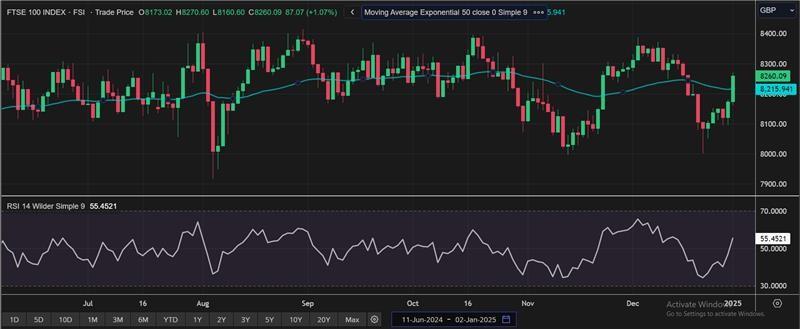
The FTSE 100 closed at 8,260.09 on Thursday, marking a 1.07% gain, supported by a bullish candlestick pattern and strong support at 8,002.00. The positive movement is accompanied by the index slightly sloping upwards relative to its 50-period Exponential Moving Average (EMA), suggesting that the price is currently trading above it, signaling a bullish trend. The Relative Strength Index (RSI) stands at 55.45, indicating neutral market conditions. This reflects a moderate bullish sentiment with a slight positive bias.
On the weekly chart, the FTSE 100 gained 0.80%, closing at 8,149.78, just above the 50-period SMA at 8,117.48, offering some support. The critical support level to watch is 7,932, while immediate resistance is 8,400. A breakout above this resistance could signal a shift toward a more bullish trend. However, a drop below 8,020 may indicate further downside risks. Investors should monitor these key levels for clearer direction in the coming sessions.
Data Source - EODHD/Others


 Jun 05, 2026




 Please wait processing your request...