
 AU
AU
 CA
CA
 US
US
 NZ
NZ
 IND
IND

 UK
UK

 Share
Share
 X (Formerly Twitter)
 Whatsapp
 Facebook
 LinkedIn
 Telegram
 Email This Article
 Copy Link
 Summarize with AI
 Chat GPT
 Perplexity
Image Souce: Krish Capital Pty Ltd
Index Update: The FTSE 100 index, a key benchmark index for the London stock exchange, went up around 0.88% on 03 December 2024. Energy, HealthCare & Basic Materials sector demonstrated a substantial growth. Moreover, Utilities sector faced a significant decline.
Macro Update: The UK's Office for National Statistics warned that its transition to a new labour market survey may be delayed until 2027, complicating the Bank of England's efforts to gauge inflation pressures amid ongoing economic challenges. British retailers reported a 3.3% drop in November sales volumes, the weakest since April, attributed to the timing of Black Friday sales shifting to December and weakening consumer confidence. Meanwhile, the UK’s cybersecurity incidents rose by 16% in 2024, highlighting increased hostile activity in the digital space. On the financial front, the FTSE 100 reached a six-week high, gaining 2.2% in November, as a weaker pound boosted internationally focused companies like Unilever and HSBC, which benefit from dollar-denominated revenues.
Top Market Movers: Among top gainers on FTSE 100 index, Centrica PLC (LSE: CNA) witnessed a rise of 4.16% followed by EasyJet PLC (LSE: EZJ) which gained around 3.51%.
Commodity Update: The dollar strengthened on Tuesday amid political unrest in France, which pressured the euro. At the same time, concerns over China's economic slowdown and tariff risks pushed the yuan to a one-year low. Investors are eyeing U.S. employment data on Friday, which could influence expectations on a potential Federal Reserve rate cut later this month, currently priced at a 50% chance. In commodities, gold rose 0.10% to $2,661.10, silver climbed 0.47% to $31.00, and copper dropped 0.32% to $8,975.50. Brent crude slipped 0.13% to $71.74 per barrel, with OPEC+ expected to extend output cuts through Q1 2025.
Our Stance: Asian stocks saw a strong performance on Tuesday, led by a rally in the tech sector, driven by record highs on Wall Street. The dollar regained strength against major currencies as traders assessed the outlook for U.S. interest rates. However, the political instability in France caused the euro to weaken, approaching a one-week low. Meanwhile, the U.S. took action against China's semiconductor industry, further escalating trade tensions by limiting exports to 140 companies. This crackdown led to volatility in Chinese stocks, with chipmakers and financial firms facing pressure from both external sanctions and expectations of lower interest rates squeezing margins. Despite these challenges, the Nasdaq and S&P 500 posted record highs, supported by tech stocks and positive market sentiment ahead of the U.S. jobs report later in the week. The continued crackdown on China's semiconductor industry by the U.S. introduces a layer of geopolitical risk, impacting Chinese and regional markets, while investors cautiously await upcoming economic data.
FTSE 100
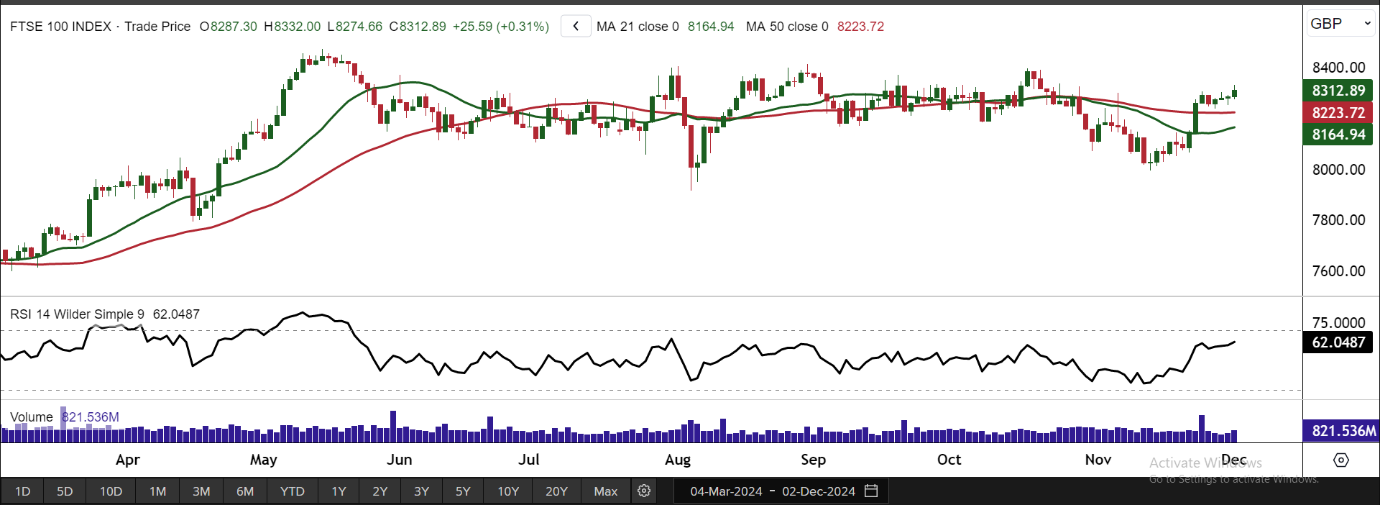
The FTSE 100 closed at 8,312.89, up 0.31%, forming a bullish candlestick pattern that reflects strong investor sentiment and confidence in the market. The index is currently trading above both its 21-period and 50-period Simple Moving Averages (SMAs), which now act as key support levels, suggesting the potential for further upward movement. The Relative Strength Index (RSI) is at 62.04, indicating that while bullish momentum remains intact, the market is not overbought, leaving room for additional gains. On the weekly chart, the FTSE 100 closed at 8,287.30, up 0.31%, following a bounce from the 21-period SMA at 8,241.06. This rebound supports the positive outlook and reinforces the strength of the ongoing trend. Immediate resistance is found at 8,400, and a breakout above this level could signal further bullish movement. However, a drop below 8,020 may suggest downside risks and potential consolidation. Investors should monitor these levels closely for trend direction.


 Jun 05, 2026




 Please wait processing your request...