
 AU
AU
 CA
CA
 US
US
 NZ
NZ
 IND
IND

 UK
UK

 Share
Share
 X (Formerly Twitter)
 Whatsapp
 Facebook
 LinkedIn
 Telegram
 Email This Article
 Copy Link
 Summarize with AI
 Chat GPT
 Perplexity
Image Source : Krish Capital Pty Ltd
Index Update: The FTSE 100 index, a key benchmark index for the London stock exchange, went down around 0.67% on 17 December 2024. Energy, Real Estate, & Consumer Non - Cyclicals sector faced a significant decline.
Macro Update: British pay rose by 5.2% in the three months to October, exceeding expectations and raising concerns about potential delays in Bank of England interest rate cuts, despite signs of economic slowdown. The Office for National Statistics highlighted the rise in average weekly earnings, excluding bonuses, adding complexity to monetary policy outlooks. The UK competition regulator approved Carlsberg’s $4.23 billion acquisition of Britvic, clearing the way to create a UK beverage "powerhouse." In Australia, BHP and Rio Tinto announced plans to jointly develop a pilot plant in Western Australia to produce 30,000-40,000 tonnes of low-carbon iron annually, accelerating decarbonization in the steel industry with renewable energy and advanced technologies. Meanwhile, UK outsourcing firm Capita warned of a £120-140 million cash outflow in 2024 due to its exit from low-margin contracts, causing its shares to drop 11% to a four-month low of 15.50 pence.
Top Market Movers: Among top gainers on FTSE 100 index, Standard Chartered PLC (LSE: STAN) witnessed a rise of 1.12% followed by Sage Group PLC (LSE: SGE) which gained around 0.79%.
Commodity Update: The U.S. dollar remained stable on Tuesday as traders anticipated key central bank meetings this week, including a likely rate cut by the U.S. Federal Reserve and a hold decision by the Bank of Japan. In the commodities market, gold edged up by 0.05% to $2,671.70 per ounce, while silver dropped 0.28% to $30.97 per ounce, and copper fell slightly by 0.02% to $9,069.00 per ton. Oil prices were muted, with Brent crude slipping 0.20% to $73.81 per barrel, as weak economic data from China weighed on market sentiment ahead of the Fed's upcoming policy meeting.
Our Stance: The global financial landscape is marked by anticipation of the U.S. Federal Reserve's upcoming rate cut, widely expected to lower rates by 25 basis points during its Dec. 17-18 meeting. However, investor focus lies on the Fed's updated economic projections, which will reflect challenges such as persistent inflation, a strong labor market, geopolitical uncertainties, and the potential impact of U.S. election outcomes on global trade and immigration. Asian markets showed mixed responses, with stocks wavering and the dollar maintaining strength ahead of this week's central bank meetings. Oil prices dipped slightly, with West Texas Intermediate at $70.60 per barrel and Brent crude at $73.89, driven by profit-taking after a recent rally and weaker Chinese economic data. Meanwhile, U.S. equity markets reflected optimism, as the Nasdaq closed at a record high and the S&P 500 advanced, underpinned by market confidence in the Fed’s impending rate cut. Investors are now keenly awaiting the Fed's guidance on future rate moves, which could shape financial trends in 2025 and beyond.
FTSE 100
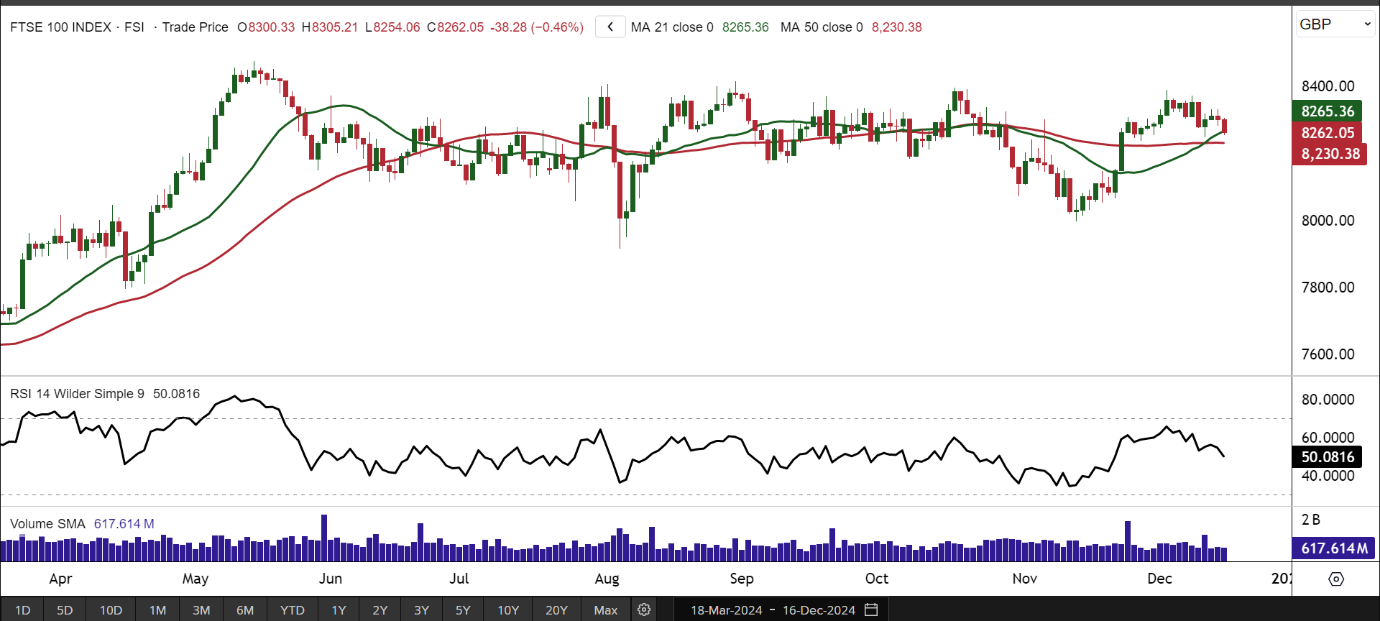
The FTSE 100 closed at 8,262.05, down 0.62%, despite forming a bearish candlestick pattern, which indicates that investor sentiment remains relatively positive. The index continues to trade above the 50-period Simple Moving Average (SMA), which serves as a key support level, suggesting that there is still potential for further upward movement. The Relative Strength Index (RSI) stands at 50.08, showing neutral momentum with a slight bias toward bullish continuation. On the weekly chart, the index fell by 0.10%, closing at 8,300.33, but remains well above the 50-period SMA at 8,047.08, with additional support at 7,932. Immediate resistance is at 8,400, and a breakout above this level could signal a shift towards a more bullish trend. Conversely, a drop below 8,020 could signal downside risk. Investors should watch these critical levels for potential consolidation or a breakout, as the index remains in a range-bound phase.

 Jun 05, 2026
 Please wait processing your request...